Categories
Blogs Content Marketing

How can your written content boost your SEM Strategy 

Search engines may run on algorithms, but SEM wins or loses depending on how clearly you talk to people, not robots. In fact, the average landing page converts at about 6.6% across industries, while the top 10% push above 11%, which shows how much your on‑page message and structure can separate you from the pack. When your ads and landing pages use the same everyday language your audience types into Google, you earn better Quality Scores, cheaper clicks, and more chances to turn those searches into sales. 

Strong headlines, simple ad copy, and focused landing pages help people see, in a split second, that they are in the right place, which is why “good words” often beat “big budgets.” With the right message, Search Engine Marketing becomes less about bidding wars and more about attracting people who are ready to act.

What is Search Engine marketing?

Search engine marketing (SEM) means paying to show ads on search engines like Google when people type certain keywords. Ads appear above the organic results so you can catch users who are ready to buy or learn more. SEM covers search ads, shopping ads, and branded campaigns that drive traffic to pages designed to convert visitors into leads or customers. Clear writing helps your ads promise real value, and your landing pages deliver on that promise, boosting Quality Score and potentially lowering your cost per click.

Users leave quickly if the page doesn’t match what they searched for, so relevance earns top spots at better prices. Simple headlines with clear benefits and copy that answers basic questions turn more clicks into customers without always raising your bids.

​How Can Keyword Research Align SEM and Content?

Keyword research syncs SEM and content by matching user queries to tailored pages, skyrocketing Quality Scores and slashing costs.

Alignment Roadmap

  • Discover Intent: Analyze tools like Ahrefs for volume, difficulty, and searcher goals to pinpoint high-value terms.
  • Map Strategically: Assign keywords to funnel stages top for awareness posts, bottom for sales pages, which ensures ad-to-content flow.
  • Optimize Deeply: Weave terms naturally into titles, intros, and CTAs, lifting relevance and dwell time by 30%.
  • Measure & Iterate: Track conversions in Google Analytics, refining clusters to achieve 20%+ ROI gains.

​If you want to learn all about keywords, then read our blog on the best keyword optimization techniques

How Do Search Engine Marketing & Ad Auctions Work?

Search engines use ad auctions to decide which ads show and where they appear on the page every time someone searches. In Google Ads, your Ad Rank depends on your bid, Quality Score, and expected impact of ad extensions and formats, not just how much you are willing to pay. 

Quality Score itself looks at expected click‑through rate, ad relevance, and landing page experience, so your words and on‑page content directly affect how much you pay per click.

  1. Search intent

Search intent indicates what the user wants to do, such as learn something, find a site, or buy a product. When your ad and landing page match that intent, Google marks your ad as more relevant and rewards you with higher Quality Scores and lower CPCs. You can spot intent in words like “how” or “best” for research, and “buy,” “price,” or “near me” for shoppers, then tailor your headline and copy to match.

  1. Keyword competition

Keyword competition measures rival bids and ad strength, rated by Quality Score (1-10). Fierce fights hike costs, but relevance-focused ads outrank higher bidders. Target mid-tier or long-tail keywords to claim spots at an affordable rate.

  1. Keyword volume and cost

Keyword volume tracks monthly searches, balancing high-traffic terms with rising costs against niche ones with lower CPC. High volume draws more auctions but demands premium bids; tools forecast costs to target value. Aim for 1,000+ volume keywords with CPC under $2 for scalable ROI.

Why Are High-Quality Landing Pages Vital for SEM?

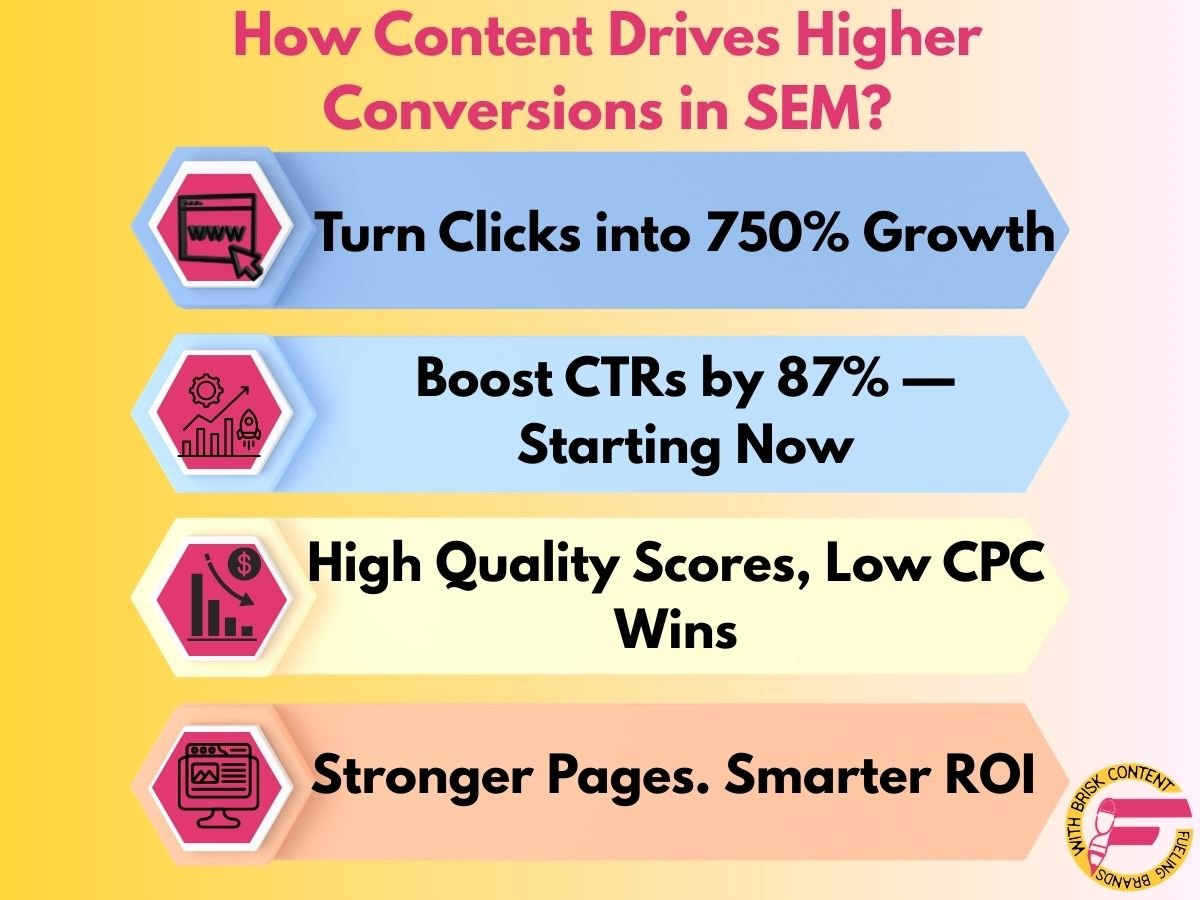
High‑quality landing pages are vital because they decide what happens after the click, and they feed back into your Quality Score. Google checks whether your landing page is appropriate, easy to use, and transparent, and this “landing page experience” score affects your ad position and CPC. When landing page experience and ad relevance are rated above average, click‑through rates can rise by 87% and conversion rates by 750%, underscoring the importance of clear content and structure.

A good SEM landing page repeats the core promise from the ad, answers key questions quickly, and points to one main call to action. Pages that focus on a single offer, avoid clutter, and load quickly tend to convert far better than generic homepages and send a strong signal of relevance back to the ad platforms. Recent data shows that landing pages from PPC search traffic convert at about 10–11%, but high performers that test headlines, copy, and forms can reach much higher rates. This means every improvement you make to the written content on your landing page can both increase conversions and lower CPC at the same time.

How Can Content Drive Higher Conversions in SEM?

Content drives higher conversions in SEM when it speaks directly to the user’s problem and makes the next step feel safe and easy. Strong headlines echo the user’s search terms and highlight a clear benefit, such as saving time, reducing risk, or getting a better price. Supporting copy then addresses the main objections, explains what happens after the click, and uses social proof such as reviews or case results to build trust quickly.

In the checkout area, simple wording and short, clear labels can reduce friction and drop-offs. Many landing pages convert best when they ask for only the most important fields, because every extra field can lower completion rates. Testing content through A/B experiments, such as trying different headlines or calls to action, often shows that small language changes can lift conversions by meaningful margins. When your copy aligns with user intent and keeps the promise made in the ad, you turn more clicks into customers without always increasing ad spend. 
How Content Drives Higher Conversions in SEM?

What Role Does Retargeting Content Play in Search Engine Marketing?

Retargeting content pulls back visitors who left your site or saw your ads. These warm leads convert 43-70% better than new leads, with some campaigns achieving 150% lift. Tailor messages to past actions, like cart abandoners, who see free shipping ads. Use friendly reminders with urgency, not pushy sales. Retargeting cuts acquisition costs by half and increases click rates compared to display ads. Pair it with a search for full coverage. Clear, helpful copy nudges users to finish without annoyance, turning browsers into buyers across the funnel.

How Should You Use Analytics to Optimize Search Engine Marketing(SEM) Content?

Analytics reveal how users respond to SEM content to inform smart fixes. Track CTR, bounce rate, time on page, and conversions per keyword in Google Analytics. High click-through rate but low sales signal an intent mismatch. Rewrite the copy to fit better. Compare devices and audiences to spot wins, like shorter mobile intros. A/B test headlines and CTAs for proven lifts. 

Regular checks turn data into better writing that exceeds average rates of 10-11%. This loop refines ads and pages so each change brings more revenue from the same spend.

Conclusion 

Written content is the thread that connects every part of your SEM strategy, from keyword research and ad auctions to landing pages and retargeting. When your words match real search intent and lead to helpful, focused pages, you earn higher Quality Scores, lower CPCs, and stronger conversion rates. Instead of treating SEM as a pure bidding game, treat every keyword as a conversation and every click as a chance to prove value. 

Review your current ads and landing pages, update the language to match user intent, and test one improvement this week. With each round of better writing and smarter targeting, you build a system that attracts the right visitors, earns their trust, and converts more of them into loyal customers.

How does better written content improve SEM results?

Better-written content improves SEM results by aligning with user intent, boosting Quality Scores, and helping landing pages convert more clicks into leads or sales.

 How often should I update my SEM ad copy and landing page content?

You should review and update your SEM ad copy and landing page content at least every few weeks, using performance data to test new headlines, offers, and calls to action.

What is the first content change I should make to boost SEM performance?

A good first change is to rewrite your main headline so it repeats the key search keyword and clearly states one strong benefit for the user.
Categories
Blogs Content Marketing

Top 5 Tips To Create Effective SEO Content Strategy

“SEO is not about optimizing for search engines; it’s about optimizing for people.”-Rand Fishkin, founder of Moz

When it comes to increasing your website’s visibility in search engine results, it’s best to aim high. An effective SEO content strategy helps your site rank higher on search engine result pages (SERP), the higher your click-through rate and the more organic traffic you’ll receive.

Yet reaching those treasured top slots requires some effort. You’ll need a complete SEO content strategy based on audience, keywords, and user intent, as well as a finger on the pulse of the ever-changing search landscape.

We’ll look at how SEO-driven content fits into your overall search visibility efforts in this post and the important aspects you’ll need to construct an effective campaign.

Components of a Successful SEO Strategy

Before we get started, let’s take a step back and look at the larger picture. According to reports, more than 200 Google ranking factors influence where sites appear in SERPs. SEO content authoring is vital, but it is only one of several.

A thorough SEO strategy consists of four components:

  • On-page SEO helps search engines understand a page’s content, enabling it to be matched to relevant search queries. Writing meta titles and descriptions, using headers, optimizing images, creating informative URLs, and adding internal links are all examples of these tasks.
  • Off-page SEO involves earning backlinks from other websites to demonstrate your content’s credibility and value. A link-building approach may include guest articles, influencer collaborations, or outreach to reference pages.
  • Technical SEO makes it easier for search bots to crawl your site by addressing issues such as site speed, loading times, mobile compatibility, security, and other technical factors.
  • Content SEO is the creation of information that users want to consume. The information should be simple to read, informative, and provide a considered response to the search query.

Implementing a successful Content Strategy

Implementingan effective SEO content strategy makes your website more attractive to search engines, enabling their crawlers to quickly explore, categorize, and rank your content. If you are looking for tips to make your content stand out and rank on SERP, then read our blog on 12 tips to take your content to the next level.

This involves search bots collecting and organizing data based on essential SEO features like metadata and keywords. Ultimately, search engines evaluate a page’s relevance, quality, and user-friendliness to determine its usefulness and placement in search results.

Crafting a Winning SEO Content Strategy

To succeed in the competitive world of SEO, your content must be top-notch and match the needs of your target audience. Google’s aim is to deliver the most appropriate and useful results for users’ searches. As a result, your content must be high-quality and relevant to rank well. To achieve this, you should create a comprehensive SEO content strategy centered on the following key components: understanding your audience, identifying their needs, setting clear business goals, and crafting content that aligns with both your audience’s needs and your business objectives. Building your strategy around these components allows you to create content that engages your audience and improves your search engine rankings.

Target Audience

To start with SEO content writing, it is crucial to identify your target audience. You should understand their needs, concerns, preferred information sources, and content format preferences, such as videos or comprehensive articles. Adjust your content to cater to your audience and use a tone that connects with them effectively.

Industry Niche

SEO content strategies are not one-size-fits-all and depend on the industry niche. Researching customer search terms and competitor keyword targeting is essential. For industries such as landscaping, event planning, plumbing, real estate, and automobile repair, local SEO is crucial. Health and finance businesses that publish on “your money, your life” topics must prioritize quality and subject-matter expertise. In summary, effective SEO content strategies vary by industry, and businesses must tailor their approach accordingly.

Search Intent 

A successful SEO content strategy goes beyond simply targeting keywords and considers the search intent behind them. By understanding the user’s intent, you can create content that directly addresses their questions and needs. For instance, a cosmetics company targeting the keyword “moisturizer with retinol” should determine whether the user is seeking general information about the product or is already aware of the benefits and is comparing different brands. By tailoring content to match user intent, you increase the likelihood of ranking higher in search results and delivering value to your target audience.

Top 5 Tips for SEO Content Strategy 

  1. Conduct thorough keyword research

Use keyword research tools to identify relevant and high-traffic keywords that your target audience is searching for. This will help you create optimized content for these keywords, making it easier for your target audience to find your website.

  1. Optimize your website structure

Ensure your website structure is optimized for search engines, with a clear page hierarchy, easy navigation, and well-structured URLs. This will help search engines better understand the content of your website and make it easier for users to find what they’re looking for.

  1. Create high-quality, engaging content

Publish high-quality content that is engaging and informative for your target audience. This will not only help you rank higher in search engine results but will also help you establish yourself as an authority in your industry.

  1. Promote your content: 

Share your content on social media platforms, email newsletters, and other channels to increase visibility and reach a wider audience. This will help you attract more traffic to your website and improve your search engine rankings.

  1. Analyze and optimize: 

Monitor your website’s performance using analytics tools and adjust as needed to improve your SEO strategy. This includes optimizing your content for new keywords, improving your website structure, and changing your content promotion strategy. By constantly analyzing and optimizing your SEO strategy, you can stay ahead of the competition and continue to improve your search engine rankings.

Final Thoughts 

If you want your content to reach your target audience successfully, start by understanding their needs and preferences. Create content that resonates with them and delivers your message in a way that connects. By doing so, you can improve your SEO rankings and build a loyal following of readers. For the best SEO content, contact Content Fayah.

Categories
Blogs Content Marketing

9 Powerful Content Marketing Strategies to Hold Your Audience’s Attention

Content is everywhere today, but only the smartest brands know how to hold attention in a world full of noise. Your audience scrolls fast, skips faster, and forgets even faster. That’s why you need more than random posts. You need a content plan that grabs attention in seconds, delivers value without delay, and keeps people coming back because they genuinely enjoy what you create. An effective content marketing strategy helps you cut through the clutter, speak directly to your ideal audience, and build trust that lasts. 

When your content is clear, helpful, and memorable, you don’t have to chase customers; they follow you because they feel connected to your brand. This blog walks you through nine powerful strategies that help you do exactly that: capture attention, keep it, and turn it into long-term growth.

What is a Content Marketing Strategy?

A content marketing strategy is a basic plan for making and sharing useful information that your audience cares about. The goal is to attract people, keep them interested, build trust over time, and encourage them to take actions that help your business, such as signing up, booking a call, or making a purchase.

Instead of pushing sales through traditional ads, this approach focuses on delivering real value through blogs, videos, podcasts, emails, and social media posts. It feels helpful, not salesy.

A good strategy connects your content with your business goals, your audience’s needs, and the right platforms, such as your website, email, and social channels. When done well, it helps improve brand awareness, search rankings, and customer loyalty.

Why You Need a Content Marketing Strategy

For a firm to succeed, a clear content marketing plan is essential. It extends audience engagement, increases social media traction, builds trust, and delivers higher-quality, more valuable leads.

Engage audiences longer:

When your content is interesting and valuable, people enjoy it so much they stick around and come back for more, spending more time with your brand.

Produce more traction on social media: 

Sharing content that’s easy to like, comment on, and share helps more people see your brand and talk about it, boosting your presence on social channels.

Build trust with your audience: 

Regularly providing helpful, relevant content demonstrates that you understand your audience’s needs and care about them, which builds trust and fosters loyalty to your brand.

Generate more and higher-quality leads: 

Good content attracts the right people by addressing their needs, guiding them through their buying decision, and encouraging them to take action, such as signing up or making a purchase.

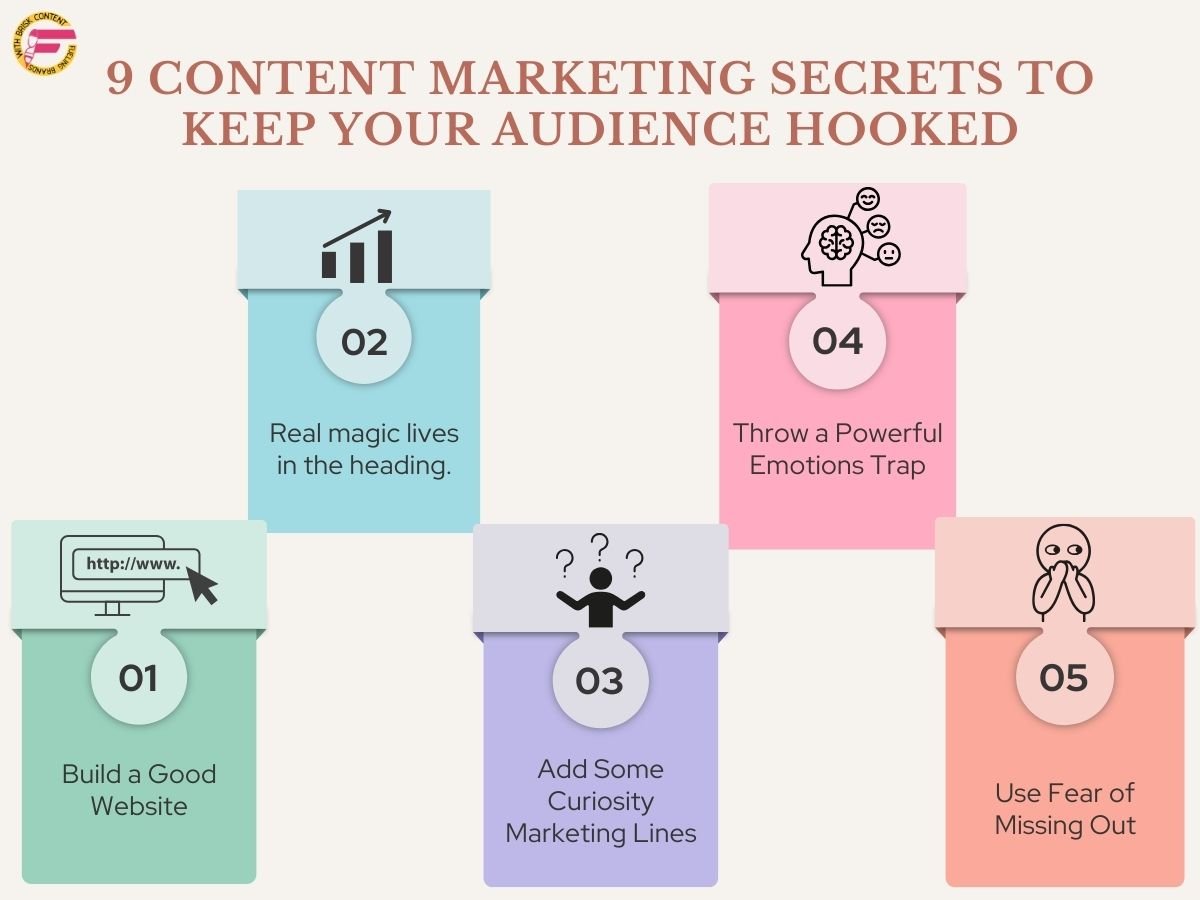
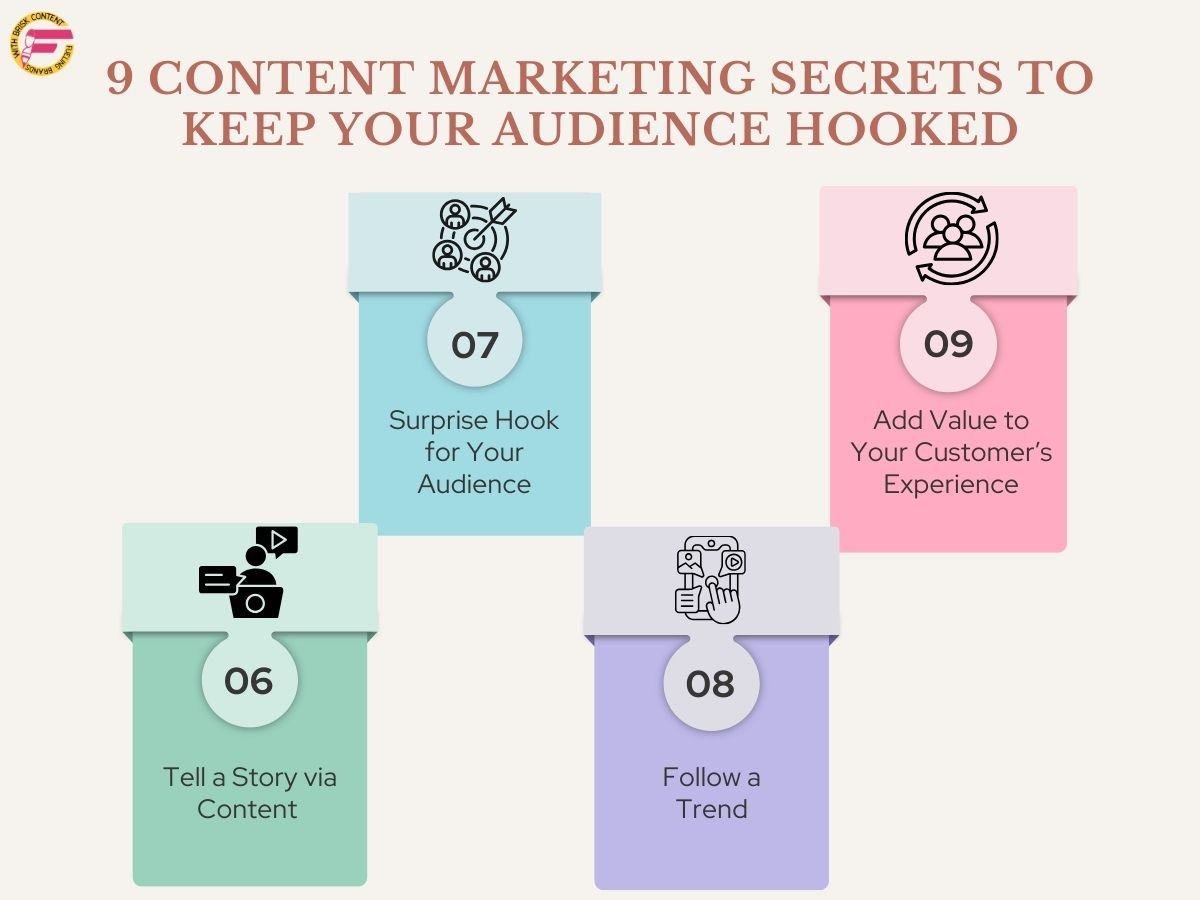
9 Content Marketing Secrets 

  1. Build a Good Website

Imagine a website that’s easy to navigate and looks great. It makes a strong first impression and encourages visitors to stay by enabling them to find what they want quickly and enjoy browsing.

  1. Actual Magic is in the Heading

Your title is the gateway to your content; if it is clear and compelling, it will immediately draw readers in and pique their interest.

  1. Add Some Curiosity Marketing Lines

Tease your audience with questions or hints that don’t give everything away, so they feel motivated to keep reading to learn the details.

  1. Throw a Powerful Emotions Trap

When your content makes people feel something, whether it’s happiness, surprise, or empathy, they’re much more likely to connect with it and share it with others.

  1. Use Fear of Missing Out

If you create a sense of urgency or exclusivity, such as “limited time offer” or “only a few spots left,” it encourages people to act now rather than wait.

  1. Tell a Story via Content 

People love hearing good stories, so share relatable experiences or journeys to make your content resonate and evoke emotion in your audience.

  1. Surprise Hook for Your Audience

Unexpected twists or facts throughout your content keep readers interested and make your message stand out from the usual.

  1. Follow a Trend

When you jump on current trends or popular topics, your content feels fresh and relevant, which naturally draws more attention and engagement.

  1. Add Value to Your Customer’s Experience

Focus on giving your audience something useful, whether it’s tips, insights, or helpful information that makes their life easier or better.

Conclusion & CTA

In the end, holding your audience’s attention isn’t about posting more; it’s about creating content that feels real, valuable, and worth their time. When you focus on clarity, emotion, curiosity, and genuine usefulness, people stay with your brand because they want to, not because you force them to. These tips will help you stand out in a crowded market and turn those who just stop by into loyal followers who trust what you say.

If you’re ready to build deeper connections and grow your brand the right way, start applying these ideas to your next piece of content. Small improvements add up fast, so take the first step today and create something your audience will remember.

1. How can I tell if my content marketing strategy is actually working?

Essential indicators, including website traffic, lead generation, social media engagement, and conversion rate, can be monitored. You can identify which information resonates with your audience and adjust your approach by regularly analyzing these metrics.

2. What type of content should I focus on to connect better with my audience?

Focus on content that provides real value, whether it’s solving a problem, answering questions, or entertaining your audience. Mixing formats like blogs, videos, and social posts tailored to your audience’s preferences works best.

3. How often should I update my content to keep my audience interested without overwhelming them?

Make an effort to stick to a regular publishing schedule that satisfies the demands of your team and your audience, such as once a week or every two weeks. Update outdated content regularly to keep your readers engaged and avoid overwhelming them.

FAQs

1. How can I tell if my content marketing strategy is actually working?

Essential indicators, including website traffic, lead generation, social media engagement, and conversion rate, can be monitored. You can identify which information resonates with your audience and adjust your approach by regularly analyzing these metrics.

2. What type of content should I focus on to connect better with my audience?

Focus on content that provides real value, whether it’s solving a problem, answering questions, or entertaining your audience. Mixing formats like blogs, videos, and social posts tailored to your audience’s preferences works best.

3. How often should I update my content to keep my audience interested without overwhelming them?

Make an effort to stick to a regular publishing schedule that satisfies the demands of your team and your audience, such as once a week or every two weeks. Update outdated content regularly to keep your readers engaged and avoid overwhelming them.