Categories
Blogs Content Marketing Content Writing

Does Fluff always Hurt your Content? A Word About Extra Words

“Cut the fluff” is advice handed out like freebies in content writing circles. Indeed, search engines don’t reward padding, and readers don’t have the patience for it either.

But somewhere along the way, the rule became a religion. As a result, articles are sometimes scrubbed so clean of fluff that they read like instruction manuals. Technically correct but sans nuance, and about as enjoyable to read as the back of a shampoo bottle.

Avoiding fluff is a good idea. Avoiding it blindly, without understanding, is the problem. 

What Is Fluff?

Fluff is any word, sentence, or phrase that doesn’t add new information to what you’re saying. It’s the “In today’s fast-paced world…” at the start of an article or three sentences that say the same thing in slightly different ways.

What Does Fluff Actually Look Like?

Consider this sentence: “Water is, without a doubt, absolutely essential and critically important for human survival and life.”

Now compare it to: “Water is essential for survival.”

Same information. The first version just has a lot of company. That extra words or phrases such as “without a doubt”,  “absolutely,  “critically important,” and ”life” are fluff.

Another common example is the throat-clearing opener: “In this blog post, I will be discussing the topic of fluff in content writing and why it may or may not always be considered a bad thing.” You could delete that entire sentence, and the reader would lose nothing. The article itself does the explaining.

Have you ever searched for a recipe online and landed on a personal blog where the author goes on and on about the dish’s background and the importance of each ingredient? All content except the real recipe is fluff. 
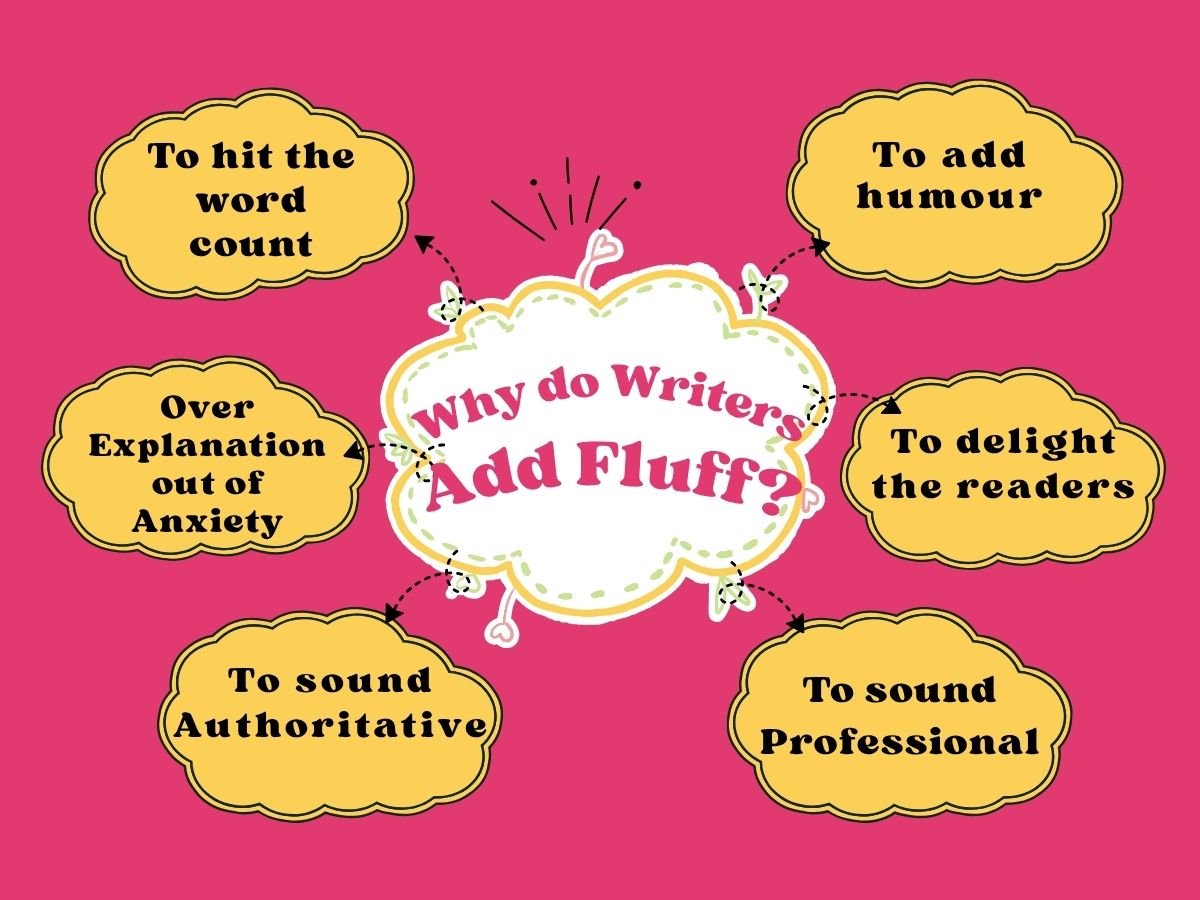
Why Do Writers Add Fluff?

Writers don’t add fluff randomly. There is almost always a reason behind it. The purpose could be practical,  psychological and sometimes creative. Let’s try to understand what could be the reason for adding the fluff:

To hit the word count: Along with deadlines, professional content writers also have to ensure a minimum word count. When a client asks for 1,500 words and the writer has only 900 good ones, fluff is used to fill the gap. 

Out of anxiety: When the author is trying to explain a relatively new or tough concept, they fear that the reader won’t understand unless the point is made twice, then once more to be sure.

To sound authoritative: More words signal more expertise(according to some). Long-form content is the most trusted form of content. There is an unspoken assumption that if someone wrote this much, they must really know what they are talking about.

To sound professional: When the quarterly report starts with something like “It is with great pleasure that we present the findings of this quarter, which reflect the continued dedication and tireless efforts of our exceptional team across all departments.” All they want to say is “Here are this quarter’s results.” The compliments are just fluff, but they do make the reader feel good.

To delight the readers: Some writers take pride in how good they are at word play and vocabulary, and like to flaunt it. And in doing so, they obviously add words that might not add new information, but they do add value to their content by making it more interesting to read.

To add humor: “I personally believe, and this is just my own humble opinion which you are absolutely free to disagree with, that pineapple on pizza is a war crime.” Many great writer have used humor as a very effective tool in their writing. So the fluff (humor) is what attracts readers to their article. It may not add new information, but it evokes emotions in readers, hooking them into the article. (The article itself could be on a very serious subject, but the writer writes in such a way that it isn’t too heavy or preachy)

Content That Should Absolutely Cut the Fluff

With all that said, there are categories where fluff has no place whatsoever.

Technical documentation needs to be precise and scannable. A developer reading API docs at midnight is not looking for a warm opening paragraph. Medical or legal content must be exact, as even a single extra word can cause confusion or misinterpretation. Instructions and how-to guides should respect the reader’s time above all.

In these formats, fluff can actually cause harm by obscuring critical information.

Why Does AI Write Such Fluffy Content?

AI models are trained on enormous amounts of human-written text. A lot of that text, especially online, is fluffy. For instance: blog posts optimized for search engines, corporate reports padded for length, academic papers written to impress rather than inform. The model learns patterns from all of it.

If you’ve ever used an AI writing tool, you’ve probably noticed it has a fondness for a certain kind of opening: “In the ever-evolving landscape of…” or “It goes without saying that…” (and then it says it anyway).

The result is prose that technically says something but often takes the long way around to say it. It mirrors the internet’s own writing habits.

Why Fluff Is Not Always Bad

This is the part most content guides skip, and I think that’s a mistake.

Fluff, in the right place, serves a purpose.

Think about a personal essay or a lifestyle blog. The writer is talking about their morning routine, their favorite coffee and the way the light hits the window at 7 AM. Is every sentence strictly informative? No. Is it fluff? Technically, yes. Does it ruin the piece? Absolutely not — it is the piece. That warmth, that texture, that unhurried pace is exactly what the reader came for.

Or consider a brand that writes conversationally — one that opens emails with “Hope your week is going well!” before getting to the point. Is that informative? No. Is it building a relationship with the reader? Yes. In that context, a little fluff is doing emotional labor so that the customer feels the sender is a person and not a machine.

Even in longer educational content, a well-placed example or a gentle recap can help the reader stay oriented. 

Not every word needs to be load-bearing. Sometimes a sentence exists simply to let the reader breathe. Here’s summing up what fluff in the right place does for your content:

  • It builds an emotional connection with the reader
  • It establishes personal and brand voice. 
  • It makes difficult content more digestible.
  • It creates breathing room.
  • It evokes emotions and hooks the readers.
  • It signals care and respect
  • It softens the message.

Conclusion

Fluff is like sugar.

Some content can’t do without it: a personal essay without warmth is just a list of facts, and a travel blog without a little lightness can feel cold and robotic. 

Some content needs just enough to make the reading experience pleasant without distracting from the substance, such as educational blogs and editorials. 

And some content will taste genuinely weird with it, such as technical guides, medical information, and legal writing. It’s like sprinkling sugar on your fried chicken. Nobody wants that.

So next time someone tells you to cut all the fluff,  pause and ask yourself what kind of content you’re writing? Who are you writing it for, and what do you want them to feel? Then choose your fluff wisely.

Because sometimes, a few extra words are exactly what make something worth reading.
Categories
Blogs Content Marketing Content Writing NEW Post

Content Marketing Strategies for Electric Vehicle Startups

The electric vehicle industry is one of the fastest-growing commercial sectors globally. With rising fuel prices and more people becoming environmentally aware, the demand for EVs is increasing. In 2025 alone, over 20 million EVs are expected to be sold worldwide, with more than one in four new cars sold globally being electric. 

This growth has led to a surge in startups in the EV sector. There are now over 4,350 EV startups operating globally

But building a great electric vehicle is only half the battle. The other half is penetrating markets. To enter and rule the new markets, the buyers need to be educated, reassured, and inspired. 

Since in this digital age the easiest way to learn more about a brand is to search online, buyers (especially Gen X and Z) look for brand reviews on YouTube and social media before they ever walk into a showroom. This is where having an effective content marketing strategy becomes a necessity for EV startups looking to penetrate new markets.

Why Content Marketing Works for EV Startups

For an EV startup’s growth and brand awareness, content marketing is a strategic and budget-friendly weapon that delivers several compounding advantages over traditional paid advertising, such as:

Cost-Effective Market Penetration

Unlike automakers with century-old brand recognition and billion-dollar advertising budgets, EV startups are largely unknown to consumers and have limited budgets. They cannot afford expensive television spots or rely on word-of-mouth to build momentum. 

Digital content marketing generates 3x more leads at 62% lower cost. A well-written SEO blog post or a viral YouTube video can outperform a $100,000 TV spot. For a capital-constrained startup, this could make all the difference.

Builds Trust Before the Sale

EVs represent a transformative shift in the vehicle market. Consumers have concerns about charging infrastructure and long-term reliability. educational content such as blogs, battery explainer videos and webinars directly addresses these concerns and builds trust.

Creates Community and Brand Loyalty

EV buyers are often passionate, value-driven individuals who care about sustainability. Therefore, as a start-up EV brand, you should focus on circulating content that tells authentic stories and builds communities through forums, owner groups and social campaigns. His marketing strategy helps convert customers into brand ambassadors who promote your products for free.

Supports Investor and Media Relations

If you have an authentic content presence, you will be more likely to attract not only customers but also investors. Informative and engaging content lets the investors find and trust your brand organically. 

For example, (1)  If your company’s founder has a well-followed LinkedIn page, it signals credibility and reach, others regularly cite (2) or reports and research published by your company, it positions you as an authority in your space, (3) or if your attractively made product launch video goes viral it depicts the excitement in the market towards your product. These successful content moments carry more weight than any traditional marketing and pitch decks. 

EV Content Marketing for Startup Brands

For an EV startup entering a new market, the content mix needs to educate, inspire, and convert across multiple touchpoints. Here are the key content types you must be creating for effective digital marketing:

Website copy and UX Optimization

An SEO-optimized website ensures you rank highly on search engines for relevant searches such as ‘Most reliable EV vehicle in town’ or ‘EV with best battery life’. Take advantage of keyword analysis, content optimization, and technical SEO to improve organic visibility and drive relevant traffic to your site.

Your website is your digital showroom. Ensure it’s fast, mobile-optimized, and compelling. tuff it with engaging visuals and informative content. A clear call-to-action, such as a demo request or newsletter subscription, is critical to convert curious visitors into customers.

Educational Content

Regularly publish in-depth articles, blogs and ebooks targeting high-intent keywords in your new market. Topics like “Top 5 Electric Cars Under ₹15 Lakh in India 2026” or “Benefits of purchasing an EV” capture buyers in the research phase. The articles and blogs that address the customer’s pain points build trust and drive more leads.

For example, a startup launching in India could publish “EV vs Petrol: 5-Year Cost Comparison” or “Why are EV’s more cost-effective compared to the other vehicles” to capture organic search traffic from budget-conscious buyers.

Video Content

Leverage the popularity of videos, as they are more powerful than images for showcasing a physical product. Invest in making content, like reels, “Day in the Life” owner vlogs, and comparison videos. A well-made, informative and entertaining video, ending with a clear call-to-action such as ‘ Order through this link now to avail 10% discount’ or ‘Type EV to receive a detailed catalog’, can help boost engagement and generate leads. 

For example, A two-wheeler EV startup could film a 90-second “Mumbai Rush Hour in an Electric Scooter” reel to speak directly to urban commuters.        

Social Media Storytelling

Choose from a number of different social media platforms for content marketing. You don’t have to be present and posting on all platforms, but make sure whatever content you make fits each platform naturally. Avoid copying and pasting the same content across all platforms. 

You can use LinkedIn to drive B2B fleet deals by leveraging case studies and webinars to connect directly with decision-makers. Platforms like Instagram and TikTok are best for posting short demo videos and fun road-trip stories by customers.  

Podcasts and Webinars

Podcasts are a powerful platform that is gaining popularity, especially among Gen Z. Appearing as a guest on EV-focused podcasts positions founders as industry experts and leaders. 

Whereas hosting webinars on hot topics in the sector, which everyone wants to know more about, such as “The Future of EV Infrastructure in [Country]”, attracts fleet buyers, government stakeholders, and media attention simultaneously

User-Generated Content & Consumer Stories

The best form of content for marketing is user-generated content (UGC). By providing incentives, get satisfied consumers to share their experiences through a hashtag campaign and referral programs.

Authentic UGC content converts far better than polished ads because buyers trust users more than companies and can relate to it more easily.

For example, A campaign like #MyFirstEVExperience, where owners document their transition from petrol to electric, creates authentic marketing material.

Influencer & Micro-Influencer Partnerships

In new markets, a regional influencer with 80,000 followers who is trusted by local commuters can outperform a national TV campaign.

So, rather than celebrity endorsements, partnering with Micro-Influencers, such as YouTubers and Instagrammers, gives startups access to deeply loyal niche audiences at a fraction of the cost.

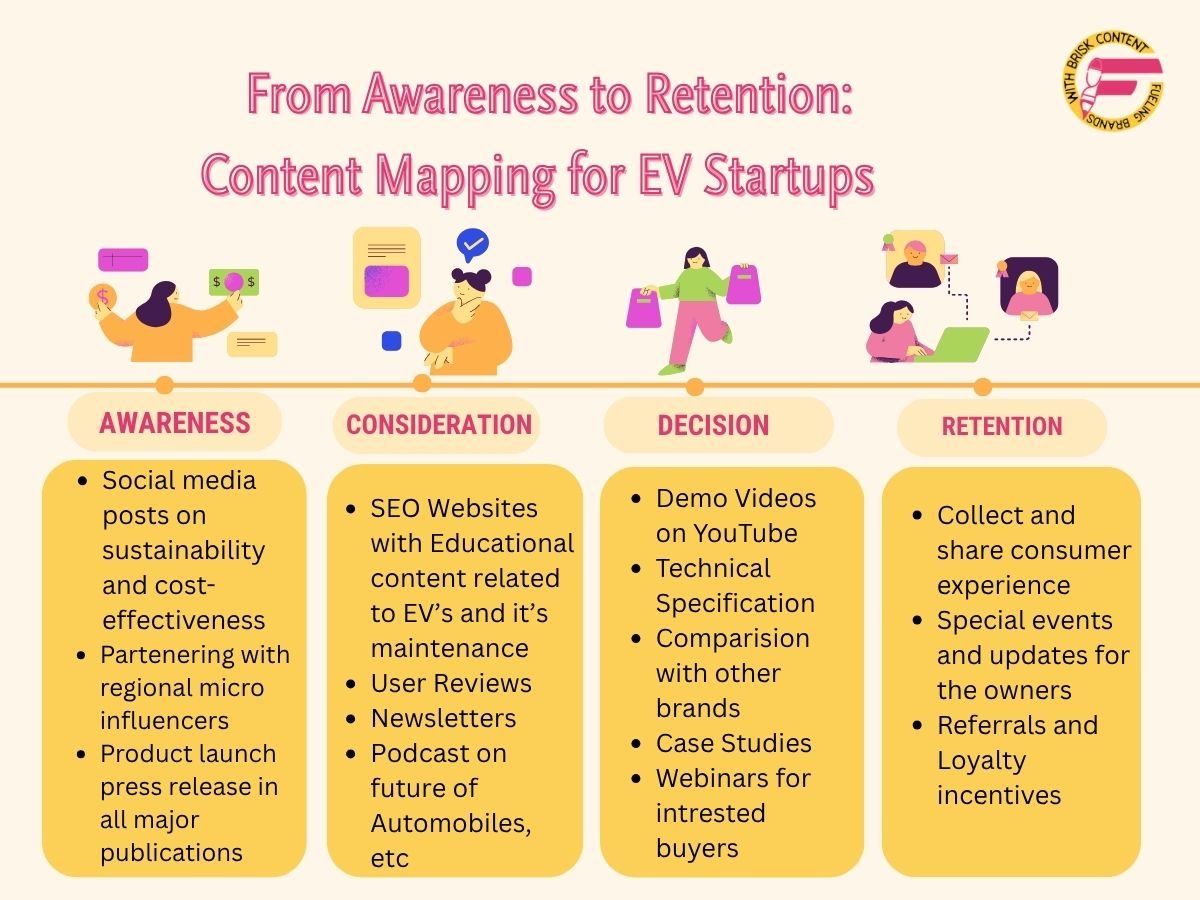
Buyer’s journey content mapping for EV startups

Conclusion

With the Air Quality Index (AQI) dipping in many Indian states and other metropolises, the majority of the urban population is consciously making environmentally viable decisions. V startups seeking to penetrate the market should pitch their products as sustainable, safe and cost-effective to attract Gen Z.

With the help of content marketing, it is not very difficult for startups to penetrate new markets, but the electric vehicle (EV) sector is highly competitive. To succeed, start-ups must differentiate their products. Moreover, to penetrate a new market, they need to clearly understand their audience’s values and needs and devise a content strategy accordingly. It is also critical to understand the market’s economic conditions and social norms.

The type of content you create for marketing should first prioritize understanding local culture, building awareness (for both the environment and the brand), and addressing customer concerns about your product. The content should not only be useful and informative but also entertaining and attention-grabbing to spread awareness quickly.

Use Google PPC (pay-per-click) to reach potential customers instantly. Through an SEO-optimized website and targeted Google Ads, your EV brand will appear when users search online for electric vehicles or sustainable transport solutions.

Digital content marketing is way cheaper, has a wider reach and is more effective than pushy traditional marketing. Thus, it is the best choice for startups looking to make an impact in a new market with limited resources.

FAQ’s

Q1. How much should an EV startup budget for content marketing when entering a new market?

Most growth-stage startups allocate between 8% and 15% of their marketing budget to creating content and distribution. he good news is that content marketing’s ROI compounds over time — a blog post written today continues to drive organic traffic for years, unlike a paid ad that stops working the moment you stop paying for it.

Q2. What types of content are needed to reach buyers in emerging markets such as India, Southeast Asia, and Africa?

Content that directly addresses buyer anxiety around price, charging infrastructure, and product reliability performs best in the emerging market. Also, make sure the content in regional languages adheres to all cultural norms. Short-form video (Instagram Reels, YouTube Shorts) and WhatsApp-friendly infographics also tend to have significant reach, given mobile-first internet usage.

Q3. How long does it take for content marketing to show results for an EV startup?

Content marketing is a medium-to-long-term investment. EO-focused blog content usually takes 4–9 months to rank on search engines and generate consistent organic traffic. While social media community building and YouTube channels usually show meaningful growth in engagement within 3–6 months of consistent posting. However, a viral video, a well-timed press release, or an influencer partnership can dramatically compress this timeline.

Ready to make your EV brand stand out in a crowded market? Partner with our expert content marketing team to craft strategies that drive leads, build trust, and accelerate growth.
Contact US

Categories
Blogs Content Marketing Post

White Paper vs. eBook: Which is the better format?

Thousands of research studies and statistics indicate that short‑form content, such as Instagram Reels, TikTok videos and quick-hit podcasts, achieves the highest viewership and engagement. And more often, you as content marketers fall into the trap of believing that content with the most views is the “winner.” But is it really?

Let’s think about it this way: Why did you create the content in the first place? What was your primary goal? If the answer is, “To get the highest views and comments,” then an engrossing short-form content will achieve that objective. But if your answer is “To generate leads and drive conversions,” then according to the research, short‑form alone will definitely fall short.

Short-form content may go viral quickly, but it loses the race when it comes to generating meaningful leads. An expert analysis by MarketingLTB shows that long‑form guides lift email opt‑in rates by 54%, and long‑form landing pages can boost conversions by 20–60%. In fact, 72% of marketers report that long‑form content generates more qualified leads than short‑form content.

So, when it comes to lead generation, long‑form content is the clear winner. 

This blog explores two important long‑form formats, whitepapers and e-books, to determine which is best for your content marketing strategy. We’ll compare them across key metrics and help you decide which one should become an indispensable part of your content marketing strategy.

What is a Whitepaper?

White papers are in-depth, authoritative pieces of content in which the author identifies a problem and presents a detailed, research-backed solution. It is text-dense and loaded with accurate data to prove the author’s point of view. 

An example of a high-quality white paper is ‘Global Cybersecurity Forum 2025’, a strategic white paper published by the World Economic Forum (WEF) in affiliation with Accenture, a cybersecurity solutions provider. It reflects Accenture’s expertise in cybersecurity and shows how the company is ready with solutions to address the cyber threats the world will face in the future due to AI.

What is an ebook?

An ebook, or Electronic book, is not as deep or scholarly as a whitepaper. It is easier to read and understand than a white paper. Along with text, it also includes images and videos to provide a more engaging experience for readers. Instead of providing a single solution, it offers an overall view of an issue, comparing and contrasting the features of many available solutions.

ProductSchool is an online education platform for product managers and designers. Their dedication to publishing helpful ebooks has made them leaders in online education.

Now that we understand what both whitepapers and ebooks are, let’s look at how they differ in purpose, audience, and format. Then we decide which format deserves a place in your content strategy. 

What Purpose Does Each Serve?

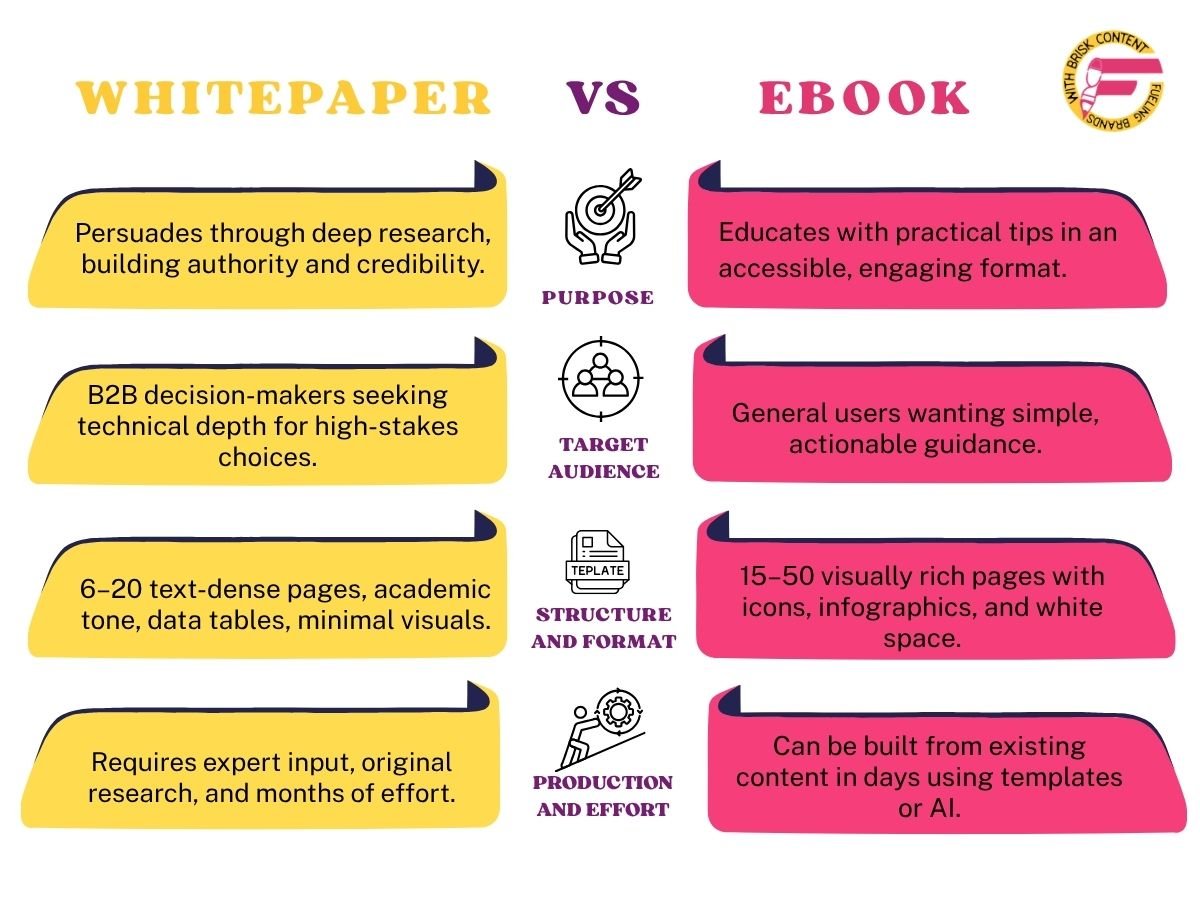
Whitepapers: The primary intent is to present detailed information on a selected topic and to persuade the audience by building credibility and authority. The selected topic usually addresses a unique solution to a specific problem your industry is facing or will face. It is also used to build Thought Leadership.

A high-quality whitepaper delivers in-depth information backed by well-researched data and thorough analysis. It is authored by a team with high-level expertise in their field, for an audience actively seeking solutions. The ultimate goal is to build enough credibility that your potential customer trusts you as the best solution provider.

For instance, if you make medical devices, you might publish a white paper on clinical research to build credibility. Or if you are in the renewable energy field, a white paper on the long-term cost benefits of switching to solar could help you target large corporations and government tenders.

ebooks: On the other hand, the purpose of an ebook is to educate and provide practical tips that are easy to comprehend and apply. 

You can publish ebooks to introduce or explain complex concepts and connect with them in the process. It uses images and videos to make the information more digestible and engaging. The ultimate purpose is still to generate leads by providing value, while keeping it simple and visually engaging.

For instance, if you run a health food brand, you could publish an ebook on ‘Easy meal prepping for busy professionals’.

Who is the Target Audience?

Whitepapers: Written for high-level professionals and decision-makers, these detailed documents address the technical details they seek. Since they are responsible for making high-stakes decisions, the whitepapers provide them with in-depth information. The whitepaper format is therefore primarily used as a B2B marketing tool. 

Ebooks: Written mainly for the end user who is not really concerned with the complex technical details. The target customers just want to learn enough about the topic to help them with a task or day-to-day decisions. The easy-to-understand format, along with engaging visual content, makes the ebook the format of choice for companies looking to connect with a new audience. 

For instance, a Chief Technology Officer at a million-dollar company would refer to a vendor’s white paper to assess the vendor’s authority and expertise. But a small-business owner, a first-time user seeking digital security for his business, will prefer an easy-to-understand cybersecurity ebook.

Format and Structure

Whitepaper: a lengthy piece of content, ranging from around 6 to 20 pages. It is filled with text, research citations and data tables. It uses minimal colors. In its structure, it is similar to an academic writing or a case study.

Ebook – Ebooks typically have 15 to 50 pages, but the textual information on each page is comparatively very little. They are formatted to look visually appealing. They are dotted with icons, pull quotes, infographics, and videos. Intentional white spaces are inserted to make it easier to skim and read.

Production and Effort Cost

Whitepaper: Because your white papers must be in-depth and accurate, they require extensive original research and analysis, fact-checking, and, in some cases, legal review. The whole process may take months and is costly to produce, as it requires input from experts in the field. Therefore, most whitepapers can only be viewed for a fee.

eBooks: Your ebook content can often be built from already existing blog posts or articles. Even if the selected topic is new, with the help of AI and hundreds of readily available templates, you can have an ebook ready in a matter of days at minimal cost. There are thousands of free ebooks available online.

Distribution Channel

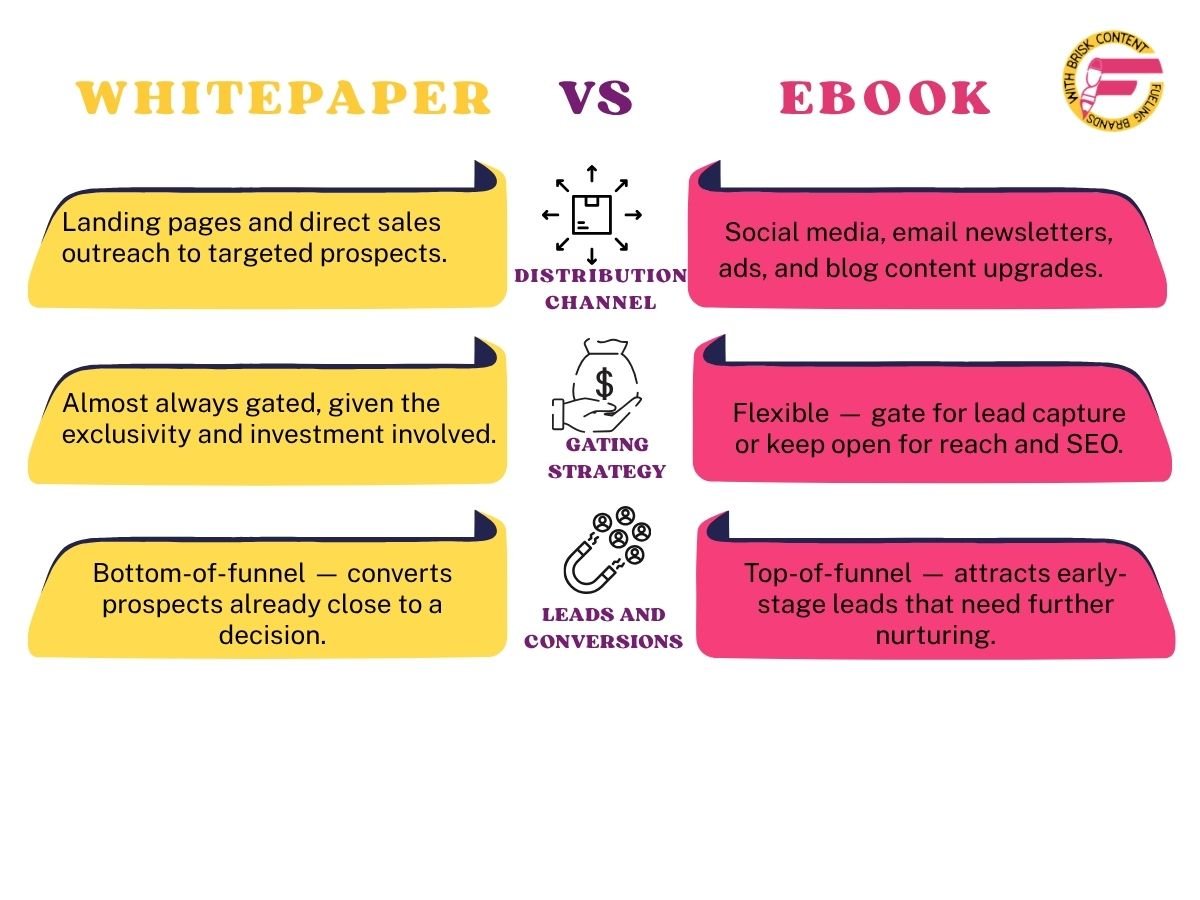
Whitepapers: You typically distribute them via dedicated landing pages. At the B2B level, they are shared by sales representatives via personal email to specific clients. 

In marketing terms, a prospect who has shortlisted a few vendors downloads it to validate their decision. It can therefore be considered as a bottom-of-the-funnel content, where the buyer is very close to making a purchase decision.

eBooks: You can promote via social posts, email newsletters, paid ads, and content upgrades on blog posts. It is built for a broad reach. 

For example, when someone searches “how do I build a content strategy” and lands on your free ebook, that is top-of-funnel marketing, reaching buyers who are just beginning their journey.

Gating Strategy

A decision every marketer must make before publishing either of these pieces of content is their ‘Gating Strategy.’ This means whether they require the reader to take any action to read the content. This action could be to fill out a form with their personal information or pay an access fee. Gated content may have a limited audience but higher-quality leads.

Whitepapers: As mentioned, they contain in-depth content authored by a group of experts after extensive research and analysis. Due to its exclusivity and cost, these reports are mostly gated.

eBooks: Can be gated or ungated, depending on their exclusivity and content quality. Gating it may reduce its reach, but it will be successful in generating quality leads. If the purpose is broader reach and SEO, keep it ungated. 

It all boils down to Lead and Conversion.

After all, this is what the blog is about, ‘which format generates more leads?’. The answer, unfortunately, is not simple. Although both are long-form content, their intended uses differ.

eBooks cast a wide net. They attract readers just beginning to explore a topic, offering accessible, visually engaging information that draws people into your ecosystem. They are very effective lead-generating content. But the leads they bring in are early-stage buyers’ journeys and need time and nurturing before they are ready to buy.

Whitepapers, on the other hand, work at the other end of the funnel. When a person downloads your whitepaper, they already know what they need and are evaluating whether you are the best solution provider. A well-crafted white paper doesn’t just inform; it also persuades the audience through its presentation. It is the final push that moves your prospect from consideration to conversion.

To learn more about how to write effective Bottom-of-the-Funnel content, read our blog on ‘What is bottom of the funnel content and how to create it?

Conclution

Whitepapers and eBooks should not be seen as competitors but as partners in a well-rounded content strategy. So the real answer is, if your goal is to grow your audience and fill your pipeline, investing in ebooks is a good move. If you are looking to close that pipeline and convert prospects into customers, whitepapers can help you get there.

The final word is that instead of choosing between the two, the smart content strategists use both for the right audience at the right moment.

FAQ’s

Can a small business benefit from whitepapers, or are they only for large corporations?

Whitepapers are not exclusive to large corporations. Any business with genuine expertise and a B2B audience can leverage them. However, given the time and cost involved, small businesses should weigh whether their audience is actively seeking that depth of information before investing in one.

Do I need to hire an expert to write a whitepaper?

Not necessarily. If you have in-house subject-matter experts, they can contribute core insights. However, a professional writer or editor is strongly recommended to ensure the content meets the high standards your audience expects from this format.

How do I decide which format to start with if I am new to long-form content?

Start with an ebook. It is faster to produce, less costly, and helps you build an audience before investing in the more formal whitepaper format.

Can an ebook ever replace a whitepaper in a B2B strategy?

No, they both serve different stages of the buyer journey, so one cannot fully replace the other. An ebook attracts and nurtures early-stage leads, while a whitepaper helps close decisions at the bottom of the funnel.

How often should a company publish whitepapers and ebooks?

There is no fixed rule, but a practical approach is to publish ebooks more frequently, perhaps quarterly, since they are quicker to produce, and reserve whitepapers for major topics where you have strong original research and expertise to offer.

Not sure whether your business needs a whitepaper, an eBook, or both?
Let’s figure it out together. Book a free consultation with our team and walk away with a clear plan tailored to your audience, goals, and budget.
Contact us