Categories
Content Marketing

Top 5 Content Marketing Mistakes that Push Gen Z Away

Each generation has its own values, experiences, and environment that shape its preferences. Gen Z is no different. As they are soon set to become the largest consumer group, it is essential to understand what affects Gen Z’s choices and how they decide where to spend their money. For instance, they deeply value social-emotional well-being, inclusivity, and transparency over cash, and therefore brands must realign their business and marketing practices accordingly.

In this blog, we’ll look at common content marketing mistakes that push Gen Z away from your content. We will also explore what changes are needed to be made to your content strategy to build authentic connections with them and boost conversions through your content. 
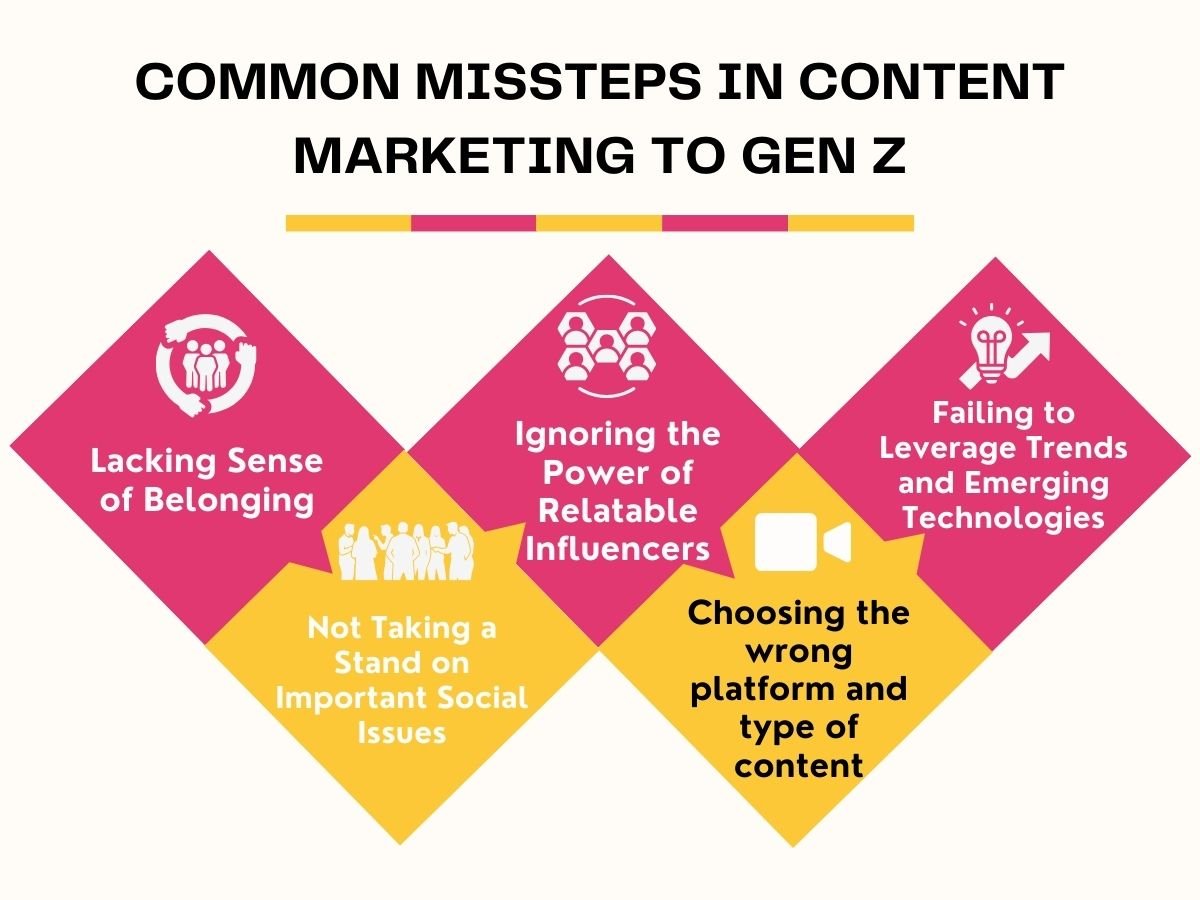
Common Missteps in Content Marketing to Gen Z

  1. Lacking Sense of Belonging

Brands should avoid salesy content and self-promotion. Instead, give their opinions importance by promoting user-generated content. Stop simply broadcasting promotional messages and invest in creating forums and events where they can share their experiences. Nykaa started the #NykaaArmy. Hashtag encourages beauty tutorials and honest product reviews from real users, boosting trust and conversion.

According to the stats, user-generated content influences 90% of Gen Z’s purchase decisions. The aim should be to create content that enhances a sense of belonging. 

Another good example of a successful UGC (User Generated Content) strategy is Nike’s app-based Run Club. This app connects runners through shared challenges, progress updates, and live athlete Q&A Sessions. It also created forums where users support each other and access exclusive events, thereby strengthening a collective sense of achievement and brand loyalty. 

  1. Not Taking a Stand on Important Social Issues 

For Gen Z, brand, quality, and price are not the only variables to consider when choosing a product. 68% of Gen Z base their buying decisions on how well they connect with the company’s values. They appreciate brands that give back to the community and have an active stance on critical social issues. 

This generation is acutely aware of global challenges and refuses to remain silent in the face of injustice. If your content strategy neglects social issues such as inclusivity, diversity, sustainability, and mental health, it risks losing meaningful connections with them. They seek brands that don’t just talk about change but actively support causes through concrete actions. Companies that fail to align with these values will be unable to cultivate loyalty.

Brands that align with social causes see stronger engagement from these consumers. For instance, Nike’s campaigns supporting racial equality resonated powerfully with this demographic. In India, brands like Tata and FabIndia have built trust through initiatives in education, healthcare, and sustainable livelihoods for rural artisans, creating a value-driven brand identity. 

The key is ensuring these commitments are genuine, as Gen Z quickly identifies and rejects brands that make hollow claims without meaningful action. Always remember that loyalty among Gen Z is established not by rewards and gifts, but by building a strong, value-based image.
  1. Ignoring the Power of Relatable Influencers

Gone are the days when mega film stars and sports stars were worshiped like gods and had immense influence on buyers’ product choices. Gen Z trusts micro-influencers for authenticity because they can relate to them. 51% of Gen Z see influencers as trend pioneers. When they endorse a brand, they inspire many of their followers.

Instead of wasting millions of dollars on superstars, it is more effective to team up with trending social media influencers who have millions of followers to boost credibility and trust, which, in turn, will get you more new customers.

Mamaearth created a success story with the #MamaearthMagic contest on Instagram, where micro-influencers shared authentic personal stories. This campaign boosted trust and sales of natural products among young parents.

  1. Choosing the wrong platform and type of content

More than 90% of Gen Z own a smartphone, and more than 50% spend more than 4 hours on social media per day. These statistics clearly show where to find them. If your target customers are Gen Z and your content is not mobile-optimized and social media-friendly, your marketing campaign is doomed. 

As for content, combine education with entertainment in bite-sized formats such as videos, reels, and memes. Get to the point quickly while keeping things visually dynamic and genuinely engaging.

Invest in high-quality video content, as a significant number of Gen Z spend significant time on platforms like YouTube, Instagram, and TikTok. Video content, therefore, becomes a crucial tool for engaging potential Gen Z customers.

Even though Gen Z is known for a short attention span, it does not mean they do not read. Gen Z reads but hates rambling, so you need to get to the point fast. The content should be short, crisp and optimised for mobile. Avoid long paragraphs and unnecessary filler; break up the written content with relevant images and videos. 

Always provide TLDR(Too Long: Didn’t Read) summaries and deliver the gist in 2 to 3 sentences for fast scrollers.

Another thing to keep in mind is using AI when creating the content. Gen Z views AI-generated content as untrustworthy, whether written or multimedia, and thus fails to connect with it. So, keep your content human and authentic.

  1. Failing to Leverage Trends and Emerging Technologies

The Gen Z are more tech-savvy than any other generation. If you want to stay ahead, you have to know how to leverage the latest technologies to get them interested in your content. For instance, Gen Z is attracted to immersive technologies such as AR and VR, with over 47% of respondents engaging in these experiences.

Gen Z shoppers view these technologies as necessary for digital interaction. They are comfortable chatting with chatbots for instant replies and solutions, and experiencing new products digitally with the help og technology. Lenskart is a successful example of leveraging immersive technology, where customers can try new eyeglasses digitally.

This feature attracted new customers and simplified the buying process, increasing the customer base and sales. For brands and creators, this trend presents an opportunity to develop AR and VR experiences that enhance engagement with Gen Z. 

Conclusion

Gen Z isn’t against marketing, but they just can’t bear inauthenticity. For brands to thrive with this generation, they must understand that success isn’t about shouting louder; it’s about speaking their language. 

The shift from promotional to conversational and from one-way broadcasting to genuine interaction is the new standard. Gen Z rewards brands that respect their intelligence, value their time, and treat them as collaborators rather than targets.

Ready to transform your content strategy for Gen Z? ContentFayah specializes in creating growth marketing strategies and engaging content that resonates with today’s audience. We’ll help you ditch the corporate jargon and build interactive campaigns that spark honest conversations. Let’s optimize your content to connect, not just convert.

Let’s optimize your content to connect, not just convert. and start building genuine relationships with Gen Z’s
Contact Content Fayah today

FAQ

1. How long should my Gen Z content be?

Keep it under 60 seconds for video and under 150 words for text posts. Gen Z will engage with longer content if it’s genuinely valuable, but you need to hook them immediately. Front-load your most interesting point.

2. Can I still promote my products to Gen Z?

Absolutely, just don’t make it your leading message. Follow the 80/20 rule: 80% value-driven content (entertainment, education, community) and 20% promotional. When you do promote, make it feel like a natural recommendation, not a sales pitch.

3. What platforms should I focus on for Gen Z marketing?

TikTok and Instagram are dominant, with YouTube for longer-form content.

4. How do I use humor without seeming like I’m trying too hard?

Stay self-aware and culturally current without forcing memes or slang. When in doubt, be clever and relevant rather than just being trendy.

5. What if my brand operates in a “boring” industry?

No industry is inherently boring if the content is creative and engaging. Focus on the human stories, unexpected insights, and real problems you solve.

Categories
Content Marketing

Crafting Content Briefs: How to Customize for Every Format

Did you know that content marketing generates over 3 times as many leads as outbound marketing tactics, and guess what: it’s 62% less expensive. Only 89% of marketers with strategic planning (like detailed content briefs) actively use it to drive demand. Imagine you are spinning your wheels on blogs, videos, and emails that collapse because they are not dialed in to each format, wasting time and resulting in zero conversions. Sound familiar? That’s where the content brief, your behind-the-scenes hero, turns chaos into content gold. 

In this blog, we will unpack what a content brief is, reveal a content brief template, and walk through how to write a content brief, from content brief primary keyword research and competing URLs content analysis to crafting a flawless content brief structure. Learn to customize content brief formats, grab content brief examples, and amp up your content brief SEO. Time to craft content that converts.

What Is a Content Brief?

A content brief is your roadmap for creating content that beats the mark every time. You can think of it as a fraud sheet that aligns your team’s vision with audience needs and SEO goals. Unlike an uncertain outline, it details everything from content briefs and primary keywords to tone, structure, and calls to action, ensuring consistency across formats such as blogs, videos, and infographics.

 It saves hours of revision time by front-loading research, making it easy to customize content brief formats for any channel. Whether you’re a solo creator or leading a team, a strong foundation in content briefs turns chaotic ideas into polished, high-performing pieces that rank and convert.

What to Include in a Content Brief?

A solid content brief template includes essential pieces that steer writers while leaving room for their creative spark. Start with your content brief primary keyword and secondary keywords for SEO focus as detailed in The Ultimate Guide to Content Marketing in 2025. Add a reader profile (pain points, demographics), content brief structure outline (H2s, bullet points), estimated word count, and tone guidelines. 

Include competing URLs’ content analysis perceptions, unique angles from original research or expert interviews, and CTAs. Visuals, such as suggested images or data charts, round it out. This checklist makes sure your brief is comprehensive, adaptable, and ready to create content brief magic across formats.

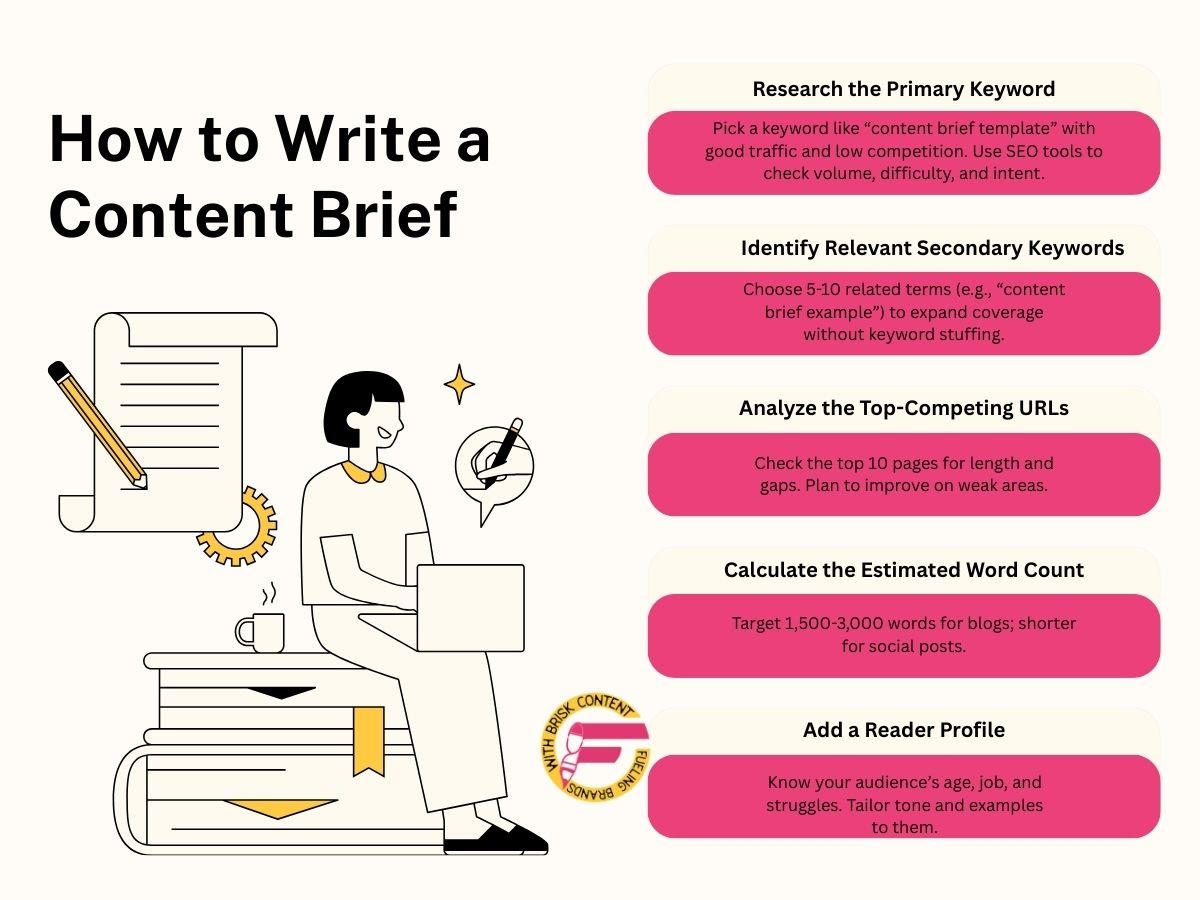
How to Write a Content Brief?

A content brief follows a simple step-by-step process. Start with primary keyword research (Ahrefs/SEMrush for volume/intent). Add secondary keywords. Analyze top-competing URLs for gaps. Set word count by format (2,000+ blogs). Build a reader profile, add original research or expert interviews, then craft a suggested structure with headings/FAQs. Follow this how-to write a content brief path for SEO wins and reader love.

  1. Research the Primary Keyword

Start with your main keyword, the star of your brief. Use tools to check search volume, difficulty, and intent (like informational or buying-focused). Select terms with strong traffic but low competition, such as “content brief template.” This sets up your content brief SEO from the start.

  1. Identify Relevant Secondary Keywords

Support your star with 5-10 secondary keywords, such as “content brief example” or “customize content brief formats.” These expand coverage, boost topical authority, and capture related searches without keyword stuffing.

  1. Analyze the Top-Competing URLs

Check the top 10 ranking pages: their length, layout, and links. Spot gaps like missing data or weak visuals, then plan to beat them. This gives you a clear advantage.

  1. Calculate the Estimated Word Count

Fit the length to your format and competitors: 1,500-3,000 words for blog posts, shorter for social posts. Add more depth for guides. It keeps content full while remaining easy to read.

  1. Add a Reader Profile

Paint a vivid picture: Age, job, challenges (e.g., “Busy marketer struggling with SEO”). Tailor tone and examples to them for deeper resonance and higher engagement.

  1. Perform Original Research

Just don’t go through Google survey readers, crunch fresh stats, or test tools. This adds credibility and shareability, setting your content apart in content brief SEO.

  1. Interview In-House Experts

Talk to your team for real insights. Quotes and stats from SMEs make your brief authoritative and authentic.

  1. Create a Suggested Structure

Outline H1-H3s, intros, lists, and CTAs. Suggest transitions and FAQs for the flow. A sound content brief structure makes writing effortless.

3 Effective Content Brief Examples (+ Why They Work)

Have you ever wondered how top brands create content that ranks well and keeps readers hooked? Real examples show the way. Backlinko adds solid data and smart keywords to drive significant traffic. Relato creates short-story-style email briefs that achieve very high open rates. Beam makes video briefs with clear timings and attractive visuals for short, fast clips. They do well because they combine SEO skills, audience understanding, and the right content format, much like the B2B hacks in 7 Content Hacks for a Successful B2B Marketing. Use their approach to strengthen your content.

Example 1: Backlinko

Backlinko’s briefs are SEO stars. They check top pages, add charts, and break things into steps. This lands them #1 by filling gaps others skip.

Example 2: Relato

Relato does great story briefs for emails and social posts. They hook readers with simple flows. Result? Lots of likes and shares, without pushy sales.

Example 3: Beam

Beam’s video briefs outline hooks within the first 5 seconds, additional clips, and next steps. Built for YouTube, they grow watch time and fans fast.

Conclusion

Content briefs are your shortcut to blogs, videos, and emails that hit home every time. They line up the best keywords, map out reader needs, and sketch a clear path so nothing falls through the cracks. Simple steps like identifying top pages and fresh ideas help everyone move faster with fewer changes. Top brands like Backlinko prove that strong briefs mean more visitors and real impact. Pick up a basic template today, adjust it for your style, and see your content climb charts while pulling in loyal fans. No more wasted effort; just smart, steady wins. Ready to try? Contact Content Fayah now to build your first brief and share your results in the comments. We love to hear how it goes.

FAQs

1. What is a content brief?

A content brief is a short guide with keywords, reader information, and structure to make content easier and more effective.

2. How to write a content brief?

To write a content brief, you need to research keywords, check rivals, add a reader profile, and outline the structure step by step.

3. Why use a content brief template?

It keeps teams aligned, boosts SEO, and cuts revisions to deliver better results faster.

Categories
Content Marketing

Guide to Effective Content Ideation Techniques

In simple terms, content ideation is the process of generating, selecting and developing engaging content ideas in line with your content strategy. As content creation gets competitive, maintaining a steady flow of original ideas is a challenge content creators frequently face. So, how do we stay ahead of the competition? How do we ensure we never run out of creative content ideas?

Following Effective Content Ideation Techniques can help you overcome creative blocks by stimulating your imagination. These research-backed techniques will cover every avenue for idea discovery, every method of idea generation, and every source of inspiration or collaboration that can spark fresh content ideas.

In this blog, we will first examine why content ideation is so essential for content creators. Then we will explore techniques for generating fresh content ideas and discuss tools to streamline and enhance the process. As a bonus, we will further examine why human factors should never be underestimated in the ideation process for creating content that is relevant and grounded in reality.

Why is content ideation essential?

Let’s have a look at some stats by the Content Marketing Institute to understand the importance of Content Marketing today:

  • 91% of  B2B marketer use content marketing to reach their customers 
  • 72% of content marketers say that regularly updated, relevant content helps improve their lead generation.
  • Email campaigns and academic content are the top content marketing methods.

These statistics make it clear that content marketing is the backbone of the marketing strategy and cannot be underestimated. 

Effective content marketing requires a steady stream of engaging content posted on time. The first step to creating content is to come up with an idea for the content. This is where the role of content ideation comes into play. The ideation process helps streamline the generation and development of ideas needed to create fresh content and, therefore, is an indispensable part of a content marketing strategy. 

The first step in the ideation process is generating ideas. Let’s explore some of the most effective content ideation techniques that will ensure you always have enough fresh ideas at your disposal.

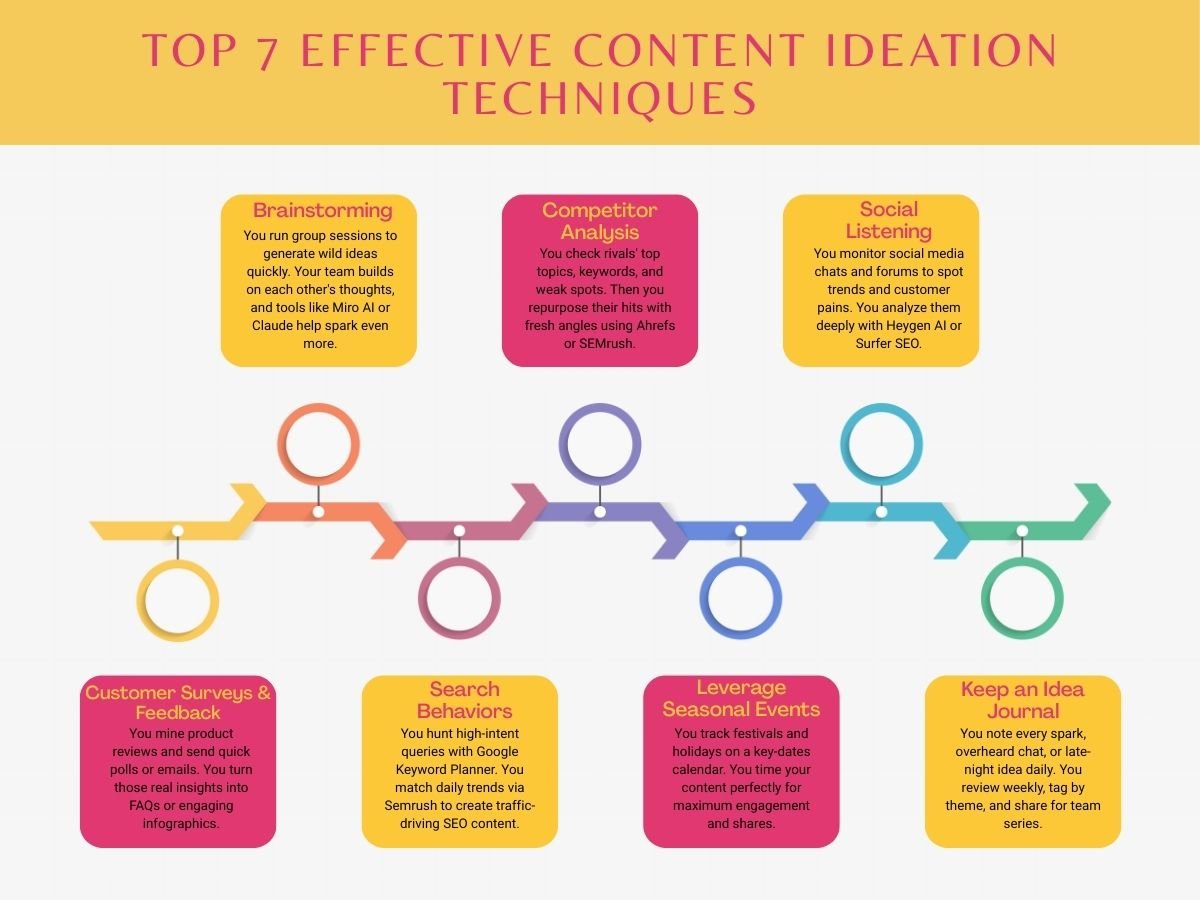
Top 7 Effective Content Ideation Techniques

1) Brainstorming

    A group exercise that can generate an extensive volume of ideas quickly. It encourages free thinking and allows team members to build upon each other’s ideas. The goal is to explore a wide range of options before narrowing down to the best options. Brainstorming sessions facilitate wild and quirky ideas, where no final decisions have to be made instantly. Fresh ideas should be jotted down, even if they feel ‘weird,’ as they could spark innovative solutions later. Including people from other departments ensures diverse perspectives and fosters collaboration that drives creative and practical outcomes.

    Miro AI, Claude, HyperWrite, and IdeaMap are some AI tools for brainstorming and idea generation.

    2) Competitor Analysis

      You can generate new ideas for your content by monitoring your rivals to detect gaps where your content can shine more brightly. Survey their topics, keywords, and rankings to uncover what pushes their traffic and where they fall short. Repurpose their high-performing content by adding missed angles and deeper insights to capture more search visibility. 

      AI tools for competitor analysis, such as those from Ahrefs or SEMrush, will help you easily uncover competitors’ top-ranking pages, organic keywords, and total traffic.

      3) Social Listening

        New ideas can also be generated by tracking what your users and potential customers discuss on social media platforms related to your products and services. Monitoring online forums and communities will make you aware of the conversation around your industry. This technique will help you better understand your customers’ preferences and their current concerns. When you create content around these trends and concerns, it will automatically resonate with your audience and help your content rank higher.

        AI tools like Heygen AI and Surfer SEO can help you analyse the data collected to generate optimized organic keywords for your content. 

             4) Customer Surveys and Feedback

        Another way to generate ideas from your customers is to examine product reviews and gather feedback. These often reveal unmet needs and areas that require guidance. These insights can be converted into targeted content, such as FAQs or how-to guides, that address specific concerns and build trust. 

        Alternatively, you can conduct a quick survey or poll via email and social media to gauge preferences and uncover fresh ideas directly. Use open-ended questions such as “What’s your biggest challenge with [product]?” to spark rich, detailed responses across multiple topics. Share survey results as standalone content pieces, such as infographics, to boost engagement and generate even more ideas. This will also help you keep your content calendar audience-focused.

        5) Search Behaviors

        New content ideas can also be generated using keyword tools like Google Keyword Planner or Semrush to uncover what people actually search for. Check auto-suggests and trends to align topics with high-intent queries your audience types daily. This valuable information will reveal relevant topics and popular keywords to inspire you to create SEO content that drives organic traffic. 

        6) Leverage Seasonal Events

        Festivals and holiday seasons can also provide ideas for new content. Keep track of national and international events and festivals. You can boost engagement by aligning content with these seasonal events and tapping into audience excitement.

        Plan ahead with a calendar of key dates, prioritizing high-impact ones for your niches, such as travel and finance. This keeps your content timely and shareable, and boosts conversions year-round.

        7) Keep an Idea Journal

        You can jot down every spark, random notes, overheard chats, or late-night thoughts into a simple app or notebook for later. Review weekly to connect dots across entries and spot patterns for content series. Tag by theme or urgency to build a personal idea bank that never runs dry. Share snippets in team huddles to develop solo ideas into something solid. 

        Adding the Human Touch

        There are a number of AI tools that will help you generate ideas without using any techniques, but these ideas overlook the Human factor. Adding the human touch to content ideation means valuing all the human stakeholders who make that content and for whom the content is made. 

        Genuine ideas emerge from collaboration, avoiding disconnected themes. For example, Airbnb’s cross-team sessions turned host stories into “Experiences” content, growing bookings 25%. We make content for our audience, so it is imperative that we never ignore audience feedback. HubSpot analyzes support tickets to create “How-to” guides that promote engagement by 30%. Trending topics are important, but never undervalue evergreen topics like “SEO Basics” that drive steady traffic. Focus on empathetic storytelling, addressing real challenges, and use customer testimonials to spark global conversations and sales uplift. 

        Conclusion

        Content ideation techniques form the foundation of successful marketing strategies that deliver consistent results. Teams that master brainstorming, social listening, competitor analysis, and customer feedback maintain a year-round pipeline of fresh, audience-focused ideas. These methods, backed by tools like Ahrefs, SEMrush, and Miro AI, eliminate creative blocks while ensuring content aligns with search trends and real user needs. Statistics from Content Marketing Institute confirm 91% of B2B marketers rely on content marketing, with 72% seeing improved lead generation from regular, relevant posts. The human touch remains irreplaceable, blending AI efficiency with empathetic storytelling for authentic connections.

        Ready to build an unstoppable content pipeline? ContentFayah specializes in turning ideation into high-ROI campaigns. Schedule your free strategy session today and get a custom content calendar plus 3 ready-to-publish ideas tailored to your brand. Transform scattered thoughts into steady growth. Start now.

        FAQs

        1. What are the most effective content ideation techniques for 2026?

        Brainstorming, competitor analysis, social listening, and customer surveys top the list. Tools like Ahrefs, SEMrush, and Miro AI streamline the process while human collaboration ensures ideas stay authentic and audience-focused.

        2. How can AI tools enhance content ideation without losing the human touch?

        AI excels at competitor analysis (Ahrefs), keyword research (SEMrush), and brainstorming (Miro AI), but human insight adds empathy. Combine AI-generated data with customer feedback and team brainstorming to create content that ranks high and resonates deeply.

        3. How often should content creators practice ideation techniques?

        Weekly brainstorming sessions plus daily social listening keep ideas flowing. Review your idea journal every Friday and align monthly with seasonal events. Consistency across techniques prevents creative blocks and maintains fresh, SEO-optimized content.

        Categories
        Content Marketing

        Web Content Writing for Businesses: Do’s and Don’ts

        Your website’s content can make or break your brand’s reputation. You may get a visitor to land on your page, but will they stay? Will they act? That depends on how well your content speaks to them. 

        While boring or jargon-filled lines drive you away, interesting, simple-to-understand content keeps you interested. Your website can stand out in the highly competitive Indian digital market, where users have short attention spans and sharp content is essential. Without sacrificing creativity or quality, let’s get into the fundamental dos and don’ts of content writing for websites.

        Why Quality Content Matters

        The content of your website serves as your digital greeting. Well-written content reflects your professionalism, increases search engine exposure, and helps you draw in, hold on to, and convert visitors. Conversely, poor content undermines confidence and causes users to quickly abandon a website.

        Dos of Content Writing

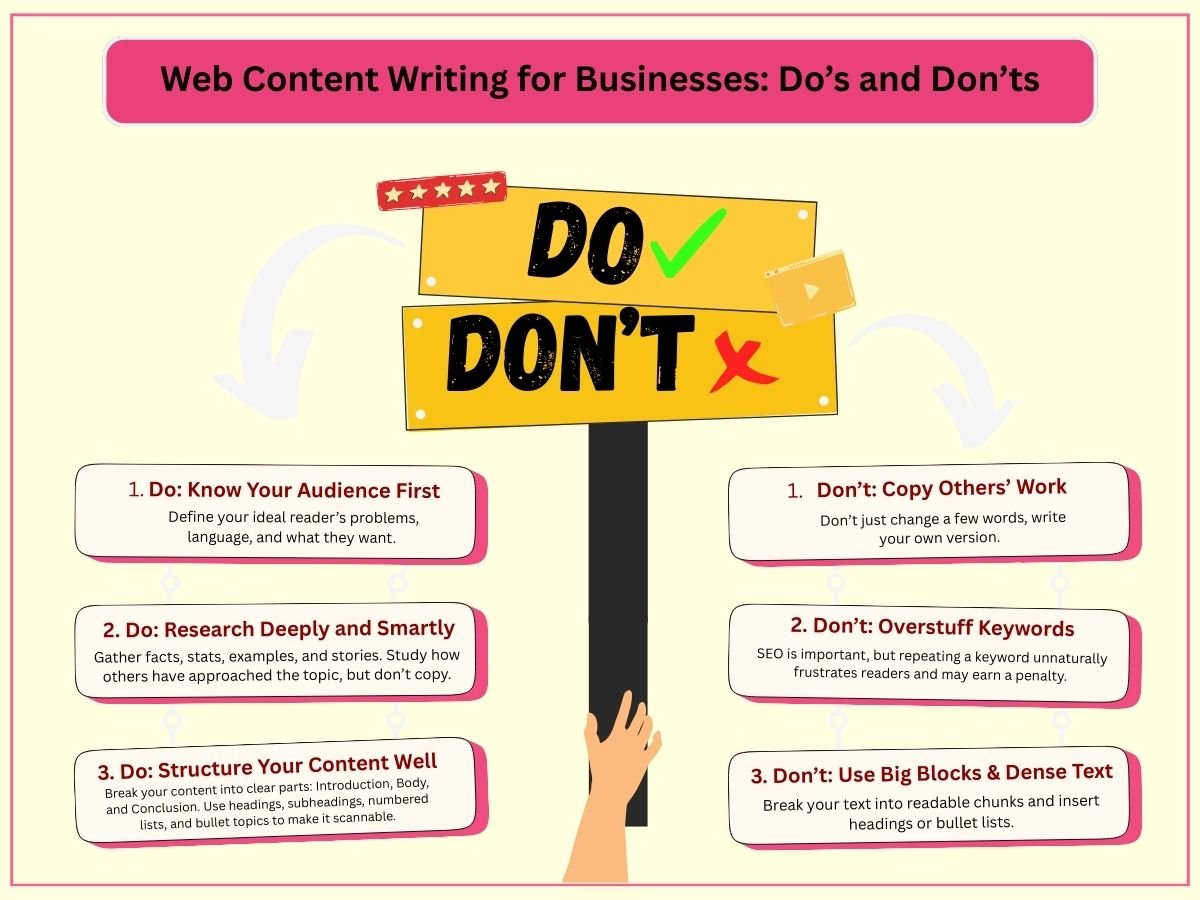
        1. Do: Know Your Audience First

        Before typing a single word, ask: Who is reading this?

        Define your ideal reader’s problems, language, and what they want. Use those cues in your writing. Make them the hero of your story, not you.

        Good copy connects with readers’ needs. Use “you,” address their pain, and show how your content or product solves it.

        1. Do: Research Deeply and Smartly

        Strong content starts with solid research. Gather facts, stats, examples, and stories. Study how others have approached the topic, but don’t copy them. 

        Also, research SEO: your keywords, search volume, and related terms. Weave them naturally, not forcefully. 

        1. Do: Structure Your Content Well

        Break your content into clear parts: Introduction, Body, and Conclusion. Use headings, subheadings, numbered lists, and bullet topics to make it scannable.

        Short paragraphs (one to three sentences) help readers flow smoothly. Avoid giant blocks of text. 

        Begin with a hook: a story, a question, a bold fact, or a scenario. Grab attention in the first few lines. 

        1. Do: Use Active Voice, Simple Language

        Active voice makes your writing direct and powerful: “You will get results,” not “Results will be obtained by you.” Even MyTasker recommends this for e-commerce content. 

        mytasker.com

        Avoid big, fancy words or jargon. Write like you talk, with clarity.

        1. Do: Focus on Value, Not Fluff

        Your readers are busy. Give them something useful, tips, solutions, insight. Don’t stuff your content with fluff or vague statements to increase word count.

        Link to credible external sources, and also within your site. That helps readers dig deeper and boosts your SEO. 

        1. Do: Edit, Proofread, Revise

        Millions of errors lurk in drafts. Always recheck your content after writing. Read it aloud. Use grammar tools. Get a fresh pair of eyes to review. 

        Take a break before final editing. Fresh eyes spot missing pieces.

        Don’ts of Content Writing

        1. Don’t: Copy Others’ Work

        Plagiarism ruins credibility and SEO. Don’t just change a few words; write your own version. 

        Even meta descriptions or similar phrases can get flagged. 

        1. Don’t: Overstuff Keywords

        SEO is important, but repeating a keyword unnaturally frustrates readers and may earn a penalty. 

        Use keyword variations and synonyms to keep it natural.

        1. Don’t: Use Big Blocks & Dense Text

        Long paragraphs discourage reading. Use white space wisely. 

        Break your text into readable chunks and insert headings or bullet lists.

        1. Don’t: Talk Too Much About Yourself

        Your content should not be all about “we” or “our brand.” Make the reader the focus. Show how you help them. 

        Even in “About Us” pages, talk benefits first, then your story.

        1. Don’t: Ignore Design & Readability

        Good writing gets ruined if it’s crammed in a bad layout or unclear format. 

        Use headings, text size, spacing, and visuals to support your content.

        1. Don’t: Rush to Publish Immediately

        It’s unusual that your first draft is flawless. Let it rest. Come back with new insights. Grammar, tone, and flow in Polish. 

        Test several headlines or calls to action to determine which ones perform better.

        Here’s how you can string these dos and don’ts into a flow:

        • Start with a hook: “Imagine someone landing on your blog—but leaving in 5 seconds.”
        • Address the reader: “You want to keep people on your page. Let me show you how.”
        • Show structure: Use headings like “Research → Write → Edit.”
        • Give value under each heading: short tips, examples, dos and don’ts
        • Weave in a mini case or stat to strengthen your point
        • End with a call to action: “Try these tips in your next post. See the difference.”

        Final Thoughts

        Being straightforward, relatable, and helpful is more important when writing for the web than being creative. A well-written post has the power to convert visitors into clients, supporters, or devoted readers.

        To achieve that, keep the balance between creativity and strategy. Research deeply, write with purpose, edit ruthlessly, and respect your audience’s time.

        When your words reflect honesty, clarity, and understanding, they build trust. Trust leads to engagement, and engagement brings growth.

        The best content doesn’t sound like marketing; it sounds like conversation. So write as if you’re talking to one person who truly matters. That’s when your content begins to work. That’s exactly whatContentFayah delivers through expert web content writing. Schedule your free strategy session today and transform your website copy into conversations that convert.

        FAQs

        1. What are the most important do’s for web content writing?

        Know your audience first, research deeply with SEO keywords, structure content for scannability using headings and short paragraphs, and focus on delivering real value through actionable insights.

        2. What common mistakes should businesses avoid in website content?

        Don’t copy others’ work or overstuff keywords, avoid dense text blocks and excessive “we” language, and never rush publishing without thorough editing and proofreading.

        3. How can businesses balance creativity and strategy in web content?

        Research thoroughly for credibility, write conversationally with active voice and simple language, edit ruthlessly for clarity, and always prioritize reader benefits over brand promotion.

        Categories
        Content Marketing

        What Is Thought Leadership Content?

        Did you know that nearly 75% of executives have explored products or services they weren’t initially considering after engaging with quality thought leadership content? Thought leadership is now one of the most trusted ways to learn about a company’s expertise and value, far beyond traditional ads. It helps brands and experts share real knowledge and fresh ideas through posts, blogs, podcasts, or even books. This builds trust, opens new opportunities, and connects you with the right audience. 

        This blog will guide you through everything you need to know to successfully create and use thought leadership content to boost your brand and influence.

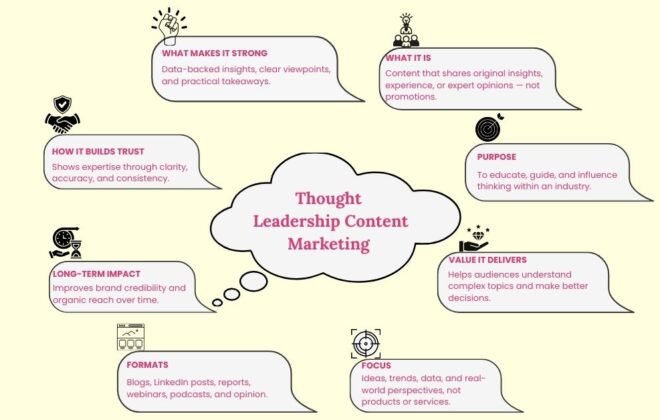
        What Is Thought Leadership Content Marketing?

        Thought leadership content marketing is when a brand shares useful, high-quality information from experts who really know their field. These experts, known as thought leaders, use formats like articles, infographics, videos, or social media posts to share their knowledge and help others learn something valuable. For brands, this type of content helps build trust, grow credibility, and strengthen their reputation in the industry.

        7 types of thought leadership content

        Sharing thought leadership content is one of the best ways to show your expertise and connect with your audience. Here are seven popular formats that top leaders use to share their ideas and make a real impact.

        1. LinkedIn/Twitter 

        LinkedIn is great for building your professional reputation and connecting with key decision-makers, like CEOs and business leaders. You can share useful industry info, post regularly, join conversations, and mix your own ideas with interesting articles. Twitter is faster and more casual, lets you share quick thoughts, join trending chats, and reach a wider group, including journalists and influencers. Using both together helps you get noticed, build trust, and grab more opportunities in different ways.

             2. Newsletters and blogs

        If you have more to say, start a blog or newsletter. These platforms let you share deeper insights and talk directly to your audience without dealing with social media algorithms. Email marketing also offers strong returns, so it’s worth the effort. The challenge is keeping your content engaging and growing your audience over time. This is where a content agency can help maintain quality and consistency.

            3. Op-eds and bylines

        If you publish your ideas in respected outlets like Forbes and The Wall Street Journal, it can greatly boost your visibility. A byline lets you speak directly to large audiences while strengthening your personal brand. The more people see your name next to well-known media brands, the more credible your expertise becomes. Partnering with professionals who know how to pitch to editors can help you get your ideas published.

            4. Podcasts

        Podcasts are booming, with hundreds of millions of listeners. Starting your own show or appearing as a guest helps share your expertise in an informal, conversation-style setting. It’s perfect for connecting with niche or engaged audiences. If you host your own, be patient and consistent; it takes a while to grow an audience. Joining existing podcasts, however, can quickly expand your reach.

            5. Media interviews and profiles

        Being featured in news articles or industry interviews can expose your ideas to much wider audiences , and it boosts trust, since earned media is often seen as more credible than ads. The trick is to stay on message and build good relationships with journalists. If you team up with an agency that already has media contacts, it’s much easier to get noticed and ensure your point of view comes through clearly.

            6. Speeches and presentations

        Speaking at events, webinars, or panels positions you as an expert to a ready audience. These opportunities help you create credibility and grow your professional network. Also, data reveals that the speaking gigs can bring a strong return on investment. People will want to hear more from you as you speak, creating a positive cycle of influence and recognition. 

            7. Books

        Book publishing shows deep knowledge of your field and offers you an everlasting way to share your ideas. It’s more substantial than a post or an article, and it can even generate passive income. Books help build authority and connect you with decision-makers who respect well-thought-out, long-form ideas. Whether self-published or traditionally released, a book can be a powerful piece of your thought leadership strategy.

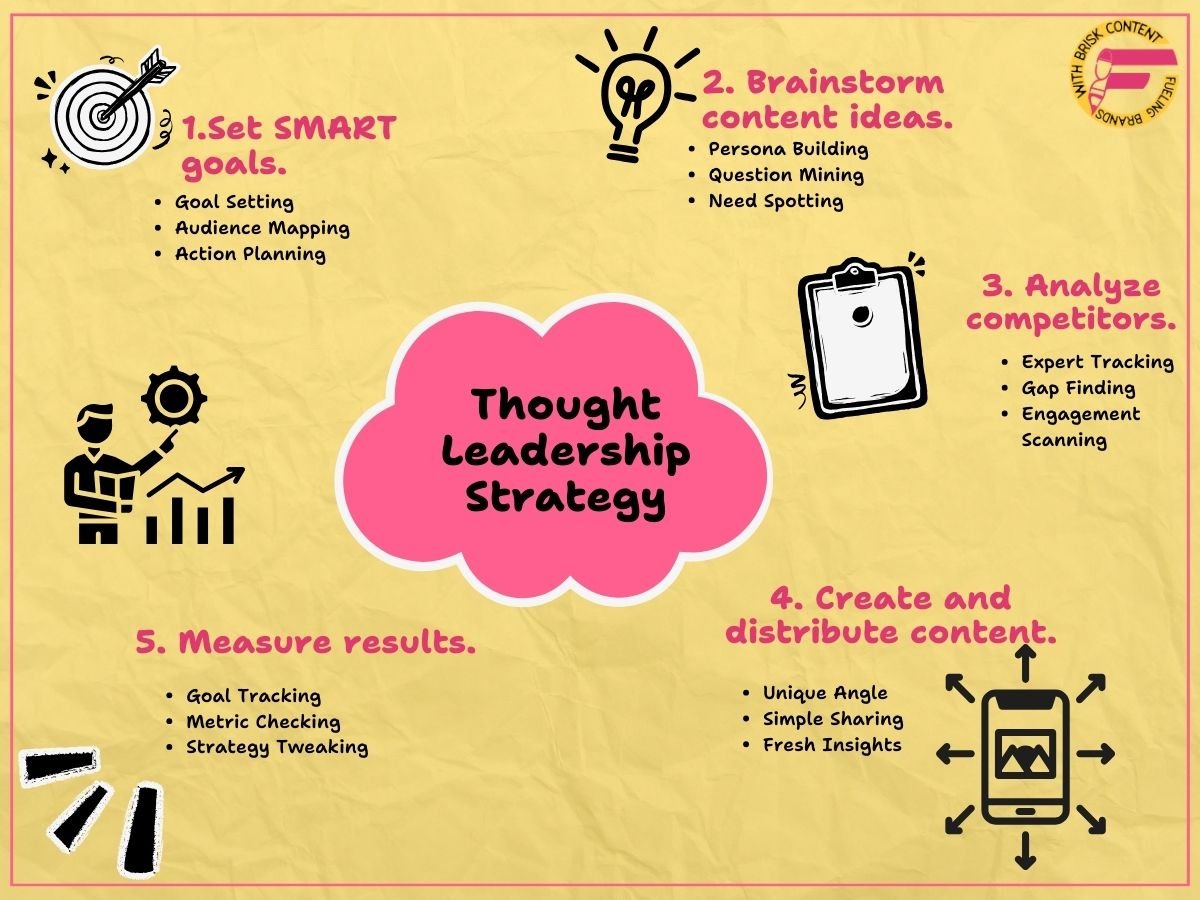
        Thought Leadership Strategy!

        A thought leadership strategy is about building your reputation as an expert, not just pushing sales. It focuses on creating content that answers your audience’s important questions and shows your deep knowledge.

        Step 1: Set SMART goals.
        Break your big goal into smaller parts using SMART criteria, make your goals Specific, Measurable, Attainable, Relevant, and Timely. For example, aim to attract five new leads in three months. Then list the actions to reach that goal, like starting a blog or growing LinkedIn followers, prioritising what your audience prefers.

        Step 2: Brainstorm content ideas.
        Think about your audience personas and what they want to read or watch. Look for questions they ask on social media or forums like Reddit. Focus on creating content that meets their real needs.

        Step 3: Analyze competitors.
        Find out who your audience turns to now and what content they consume. Identify gaps where their needs aren’t met, and check which competitor posts get lots of likes or shares to inspire your ideas.

        Step 4: Create and distribute content.
        Make your content stand out by sharing your unique view and personality. Keep it easy to understand and share. Avoid copying popular content; instead, bring fresh insights so social media algorithms and readers notice you.

        Step 5: Measure results.
        Track how your content is doing based on the goals you set. Use relevant metrics to see if your strategy is bringing the impact you want and adjust as needed.

        Why You Need Thought Leadership in Your Content Strategy

        Thought leadership is important and a must-have in your content strategy because it helps your brand stand out by showing real expertise and building trust with your targeted audience. Instead of just selling, thought leadership focuses on providing valuable insights and answers that your audience is searching for, which forms deeper connections. Such type of content boosts your credibility, attracts new opportunities, and makes you stand out from competitors by positioning you as a go-to expert in your field. Using thought leadership can also help your brand’s image and, over time, make people more interested and loyal to it.

        Final Thoughts

        Think of thought leadership content like your trusted guide in a crowded marketplace. In 2025, 73% of decision-makers trust this kind of content more than traditional ads or brochures. They spend significant time digging into thoughtful articles and insights because they want real value, not sales talk.​

        But here’s the catch: 85% say a lot of content out there misses the mark by lacking fresh ideas or depth. So, it’s not about just pumping out posts; it’s about sharing smart, original ideas that answer real questions. When you nail this, you don’t just build credibility; you open doors to new opportunities and become a go-to expert that people want to engage with and do business with.ContentFayah helps brands master this exact balance through expert content writing that turns insights into influence. Schedule your free strategy call today and elevate your thought leadership game.

        FAQs

        1. How can I make my thought leadership stand out?

        Focus on sharing fresh ideas or new angles that others aren’t talking about. Original research or stories from real experiences really catch attention.

        2. Who should be involved in creating thought leadership content?

        It’s best to involve experts or leaders in your company who truly understand the topics. Their insights make the content more reliable.

        3. How often should I publish thought leadership content?

        Consistency matters more than quantity. By posting regularly, even if small, you keep your audience engaged and help build your reputation over time.

        Categories
        Content Marketing

        10 Game-Changing Tips for Crafting Email Subject Lines That Work

        Do you know the average email open rate across industries was about 35.63% in 2025? Which means one in three emails are opened, it is pretty much clear that your subject line is your main hero, on which it is decided whether your message gets noticed or not. Your subject line is the gateway to your message, so it is very important to craft it properly to boost engagement and help you improve email marketing success.

        But what makes a subject line irresistible enough to click? Is it personalization, urgency, curiosity, or something else? In this blog, you are gonna discover 10 practical tips to write better subject lines. Whether you’re a marketer, a business owner, or simply trying to write better emails, these tips can help you get more people to open your messages. Let’s get started and make sure your subject lines truly catch your reader’s eye.

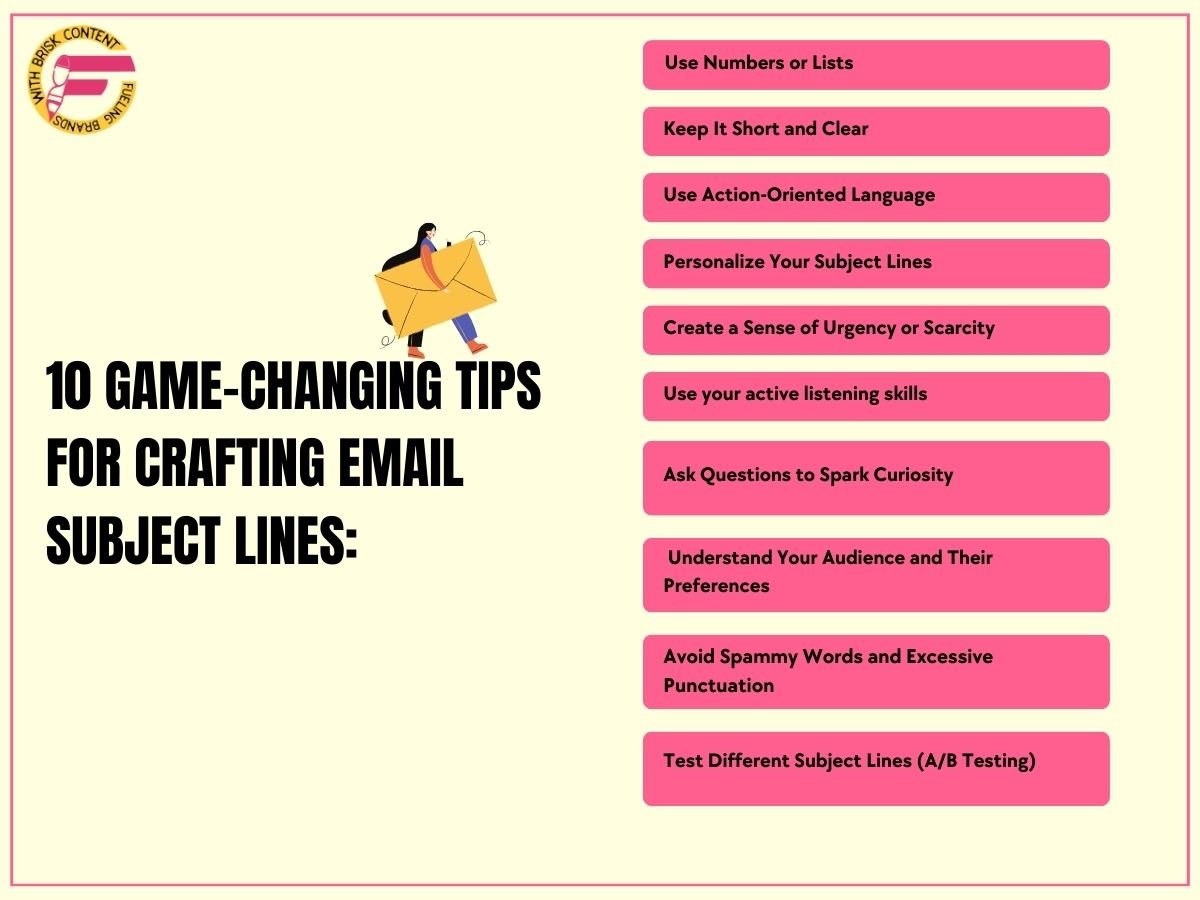
        1. Understand Your Audience and Their Preferences

        A good subject line starts with knowing your audience. Ask yourself what their preferred tone is for engaging with them, and what typically captures their interest. Check your existing data, whether it is about browsing habits, past emails, or purchase details, and also use it to shape your message. When your audience sees something that feels personal, they are more likely to click.

        1. Keep It Short and Clear

        Most people check their emails on phones where space is limited. Subject lines between 30 and 50 characters tend to perform best. Being direct about the email’s content helps readers decide quickly whether to open it. For example, “Your March Invoice is Ready” is clearer than “Important Invoice Information.”

        1. Use Action-Oriented Language

        Your subject line can convince readers to open your email if it has a powerful verb.  “Discover,” “Get,” “Unlock,” and “Join” are examples of words that pique interest and convey a sense of urgency.  These action phrases give your email a sense of importance and let readers know that it contains something worthwhile.  This easy tactic can significantly increase your open rates and increase the number of people who interact with your content.

        1. Personalize Your Subject Lines

        A person’s name or other personal details can help increase open rates. People are more likely to open emails that feel directed at them. Just be careful not to overuse personalization, because it can come across as too much.

        1. Create a Sense of Urgency or Scarcity

        Short deadlines make your email feel more urgent. A subject line such as “Only 2 Days Left” or “Last Chance to Save” tells readers they need to open it soon. Always be truthful about the offer; you will earn more trust that way. Such tactics boost open rates and conversions but should be used sparingly and honestly to avoid damaging credibility.

        1. Ask Questions to Spark Curiosity

        Questions in subject lines spark curiosity and engage readers immediately. If you ask relevant questions like “Want to Save More?” or “Looking for Better Deals?”, ask recipients to answer. When questions clearly relate to the email content, they make the message more personal and compelling, which increases the chances of opens and interactions, especially when combined with a strong CTA inside.

        1. Avoid Spammy Words and Excessive Punctuation

        Words like “FREE,” “Guarantee,” or multiple exclamation marks can set off spam filters or give the impression that you are unreliable.  Remain sincere and professional.  Avoid using ALL CAPS, which can come across as yelling, and use basic punctuation.

        1. Test Different Subject Lines (A/B Testing)

        What attracts one group may not work for another. A/B testing can help you figure this out. You can try sending different subject lines to small segments of your audience and see which one gets more opens and clicks. Once you know the winner, send that version to the rest of your list. This simple step can make your email campaigns perform better using real, clear data.

        1. Use Numbers or Lists

        Numbers grab attention and set clear expectations. Subject lines like “5 Secrets to Better Emails” or “3 Tips for Weekend Planning” show readers how much value they’ll get inside. These list-style examples, inspired by strategies like those in 17 Massive Content Marketing Examples to Boost Your Brand, make content easy to scan and promise actionable insights.

        1. Align Subject Lines With Your Email Content

        Make sure your subject line accurately represents the email’s content. Misleading subject lines may get opens, but damage your brand’s trust long-term. Honor the reader’s time by being honest and clear about what’s inside.

        Conclusion

        Email subject lines can make a major difference in how well your campaign performs. A compelling subject line draws readers in, piques their interest, and demonstrates why your email is worthwhile.  Your message is more likely to stand out in a busy inbox when you include components like personalization, urgency, or insightful inquiries.  Just bear in mind to deliver on your promises; high-quality content fosters trust and maintains viewer engagement.

        Testing different subject lines is also key. It helps you to continue developing your strategy by revealing what really resonates with your audience.  Every phrase in the subject line counts because it is your first opportunity to attract attention and convince someone to read your email.  Strong subject lines have the potential to boost open rates and foster enduring relationships when used effectively. Start using these tips today, and you’ll notice more people paying attention to your emails.

        If you’re ready to take your subject lines to the next level, teams like Content Fayah specialize in email copywriting that blends these proven strategies with authentic storytelling. Start with their free subject line audit to see instant improvements.

        FAQs

        1. How long should my email subject line be?

        You should aim for 30-50 characters to ensure full visibility on mobile devices. Short, clear subject lines capture attention quickly.

        2. Is personalization always effective?

        Yes, but it should feel natural. Personalize when you have meaningful data like name or location. Avoid overdoing it to prevent looking spammy.

        3. Why is A/B testing essential for subject lines?

        A/B testing reveals what resonates with your specific audience using real data. It optimizes campaigns by identifying winners, improving opens and clicks over time.

        Categories
        Content Marketing

        Potential Pitfalls of Using AI for Marketing

        Are you wondering how AI is changing marketing? AI is transforming marketing by helping brands work faster, reach the right people, and personalize messages better than ever. But it’s not all smooth sailing. Using AI means dealing with messy data, tough tech setups, privacy rules, and making sure marketing still feels human. Many marketers struggle with these issues, from high costs and a lack of skills to keeping creativity alive. 

        Knowing these challenges is key to using AI in a way that helps your brand grow without losing what makes it special. Let’s dive into the real pitfalls marketers face with AI and how to avoid them.

        What are the common challenges marketers face when adopting AI?

        When marketers start using AI, they often face several key challenges that are important to know:

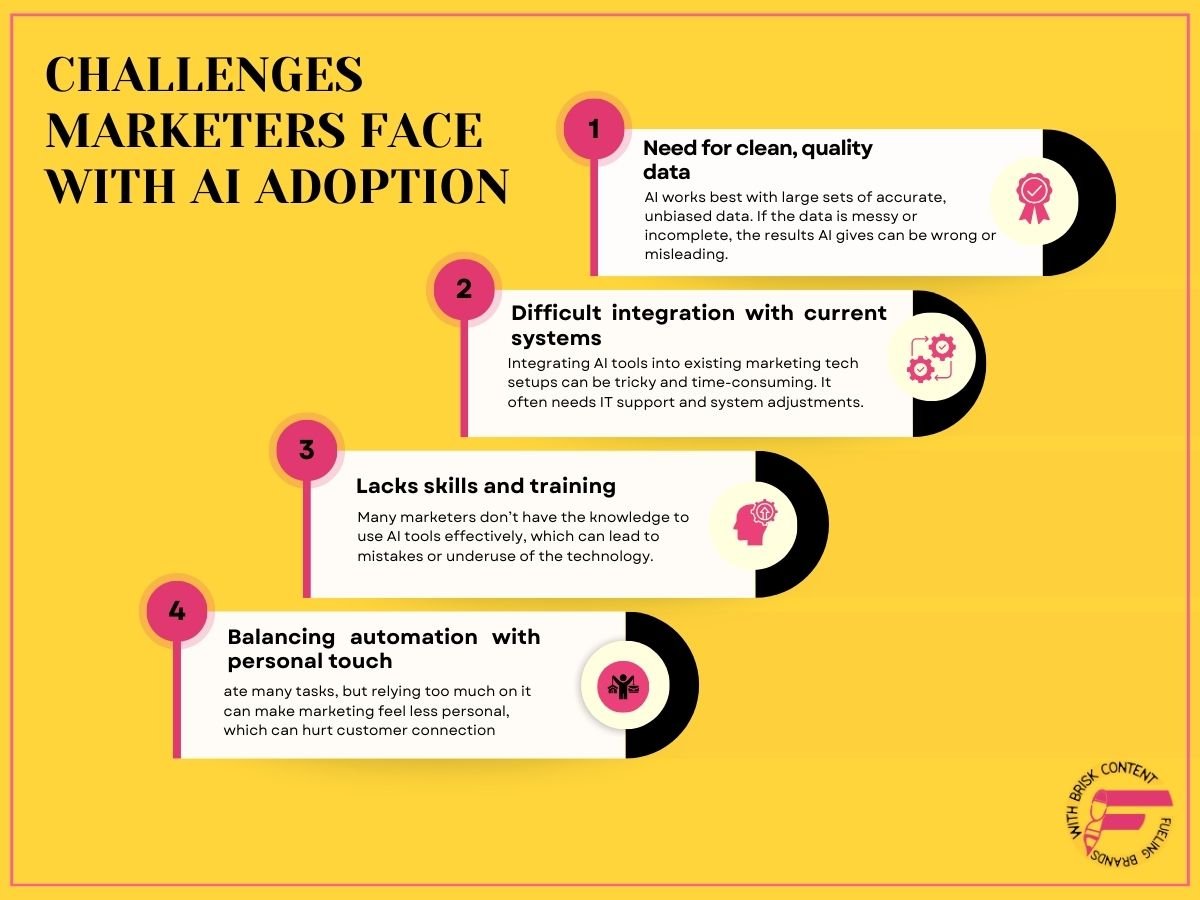
        • Need for clean, quality data
          AI works best with large sets of accurate, unbiased data. If the data is messy or incomplete, the results AI gives can be wrong or misleading.
        • Difficult integration with current systems
          Putting AI tools into existing marketing tech setups can be tricky and take a lot of time. It often needs IT support and system adjustments.
        • Lack of skills and training
          Many marketers don’t yet have the knowledge to use AI tools effectively, which can cause mistakes or underuse of the technology.
        • Balancing automation with personal touch
          AI can automate many tasks, but relying too much on it can make marketing feel less personal, which can hurt customer connection.
        • Privacy and compliance concerns
          Marketers must follow privacy laws and ethical guidelines when using AI, or they risk legal trouble and loss of customer trust.
        • High costs and ongoing support
          AI tools can be expensive to start using and require continuous maintenance, which can be difficult for smaller businesses to afford.
        • Limited creativity and emotional understanding
          AI lacks human creativity and can’t truly understand emotions, so it may not produce content that connects deeply with audiences.

        How can AI lead to the loss of human touch in marketing campaigns?

        AI can cause marketing to lose its human touch, mainly because it focuses on automation and data instead of real human feelings and understanding. Here’s why:

        • Automated messages from AI often sound generic and robotic, not warm or personal.
        • AI struggles to get human emotions right, so its content can miss the emotional connection that builds trust.
        • Relying too much on data makes marketing feel impersonal, as it doesn’t always consider individual human stories.
        • AI-driven campaigns can be predictable and lack the creative spark that humans bring.
        • When chatbots and automated emails replace real people, customers miss out on genuine human interactions.

        What risks does AI pose to brand voice and authenticity?

        Here are the risks AI poses to brand voice and authenticity, broken down simply in subpoints with explanations:

        • Generic content
          AI often creates similar-sounding messages for many brands. This can make your brand’s unique voice fade and feel less special.
        • Flat, emotionless tone
          AI struggles to catch the feelings and subtleties behind words. So, marketing messages might come off as robotic or boring instead of warm and real.
        • Inconsistent style
          Without proper controls, AI can sometimes create content that doesn’t match your brand’s usual tone. This confuses customers about who you are.
        • Too much automation
          Relying heavily on AI can make marketing feel less personal. People want to connect with real, relatable brands—not just machines.
        • Possible mistakes
          AI-generated content can have errors or ideas that don’t fit your brand well. It needs human review to keep the message right.

        How does data quality and bias affect AI marketing outcomes?

        Data quality and bias have a big effect on how well AI works in marketing. If the data is messy, outdated, or missing important details, AI can give wrong or misleading results. This can make it hard to target the right customers and waste marketing time as well as money. It’s also possible for AI to repeat or even make worse biases in data that already has them. This is unfair and can hurt trust. So, having clean, accurate, and unbiased data is key to getting good results from AI in marketing.

        What privacy and ethical concerns arise from using AI in marketing?

        Here are the privacy and ethical concerns that come with using AI in marketing:

        1. Collecting personal data
          AI collects a lot of customer info, so businesses must be careful to handle it responsibly and keep it safe.
        2. Following privacy laws
          Marketers need to follow rules like GDPR to make sure they’re using data legally and respecting customer rights.
        3. Avoiding data breaches
          If data isn’t protected well, it can be leaked or hacked, which hurts customer trust and damages brands.
        4. Preventing bias and unfairness
          AI systems can inherit biases from data, leading to unfair treatment of certain groups. This needs to be managed carefully.
        5. Being transparent
          Customers should know when AI is used in marketing and how their data is being handled to build trust.
        6. Using data ethically
          It’s important not to misuse data or manipulate customers in ways that feel invasive or dishonest.

        Can over-reliance on AI tools harm marketing creativity?

        If you depend too much on AI tools, it can sometimes hold back marketing creativity because AI tends to stick to the same patterns and data, making campaigns feel similar and expected. It lacks the fresh, unique and creative ideas that come from human imagination. But when used well, AI actually helps by taking care of boring tasks and giving marketers more time to get creative. It can even inspire new ideas and help tailor content quickly. So really, AI should team up with humans, letting marketers focus on big creative thinking and storytelling.

        What legal issues should marketers consider when using AI content?

        Here are some of the legal issues marketers need to be aware of while using AI content:

        1. First, copyright and ownership. It can be tough. AI content might not be legally owned until enough human creativity is involved, so you could lose exclusive rights.
        2. Next, plagiarism is a big risk. AI sometimes produces work too close to existing material, which could lead to lawsuits.
        3. Data privacy laws are another big one. You must follow rules about using personal info for AI training and marketing.
        4. Transparency is important too. Let your audience know when AI creates content so you don’t mislead them.
        5. Avoid false or exaggerated claims in AI-generated content because that can cause legal problems under advertising laws.
        6. You also need to carefully read and follow the terms of use for any AI tool or platform you use.
        7. Watch out for trademark risks—AI might accidentally use logos or branding that belong to others.
        8. Lastly, check for defamation or inaccurate statements in AI content before publishing to protect your reputation.

        What strategies can marketers use to overcome the pitfalls of AI adoption?

        Marketers can overcome the pitfalls of AI adoption by following some straightforward strategies.

        • First, invest time in learning and training, so your team completely understands how to use AI tools properly. 
        • Always keep human creativity and judgment involved to balance AI’s automation with a personal touch. 
        • Use high-quality, unbiased data to feed AI systems for better results. 
        • Stay fair with customers about AI usage to build trust. 
        • Make sure to follow privacy laws and ethical guidelines carefully. 
        • Also, review AI-generated content before publishing to avoid mistakes. 
        • Finally, choose AI tools that fit your business needs and budget, and be patient as you adapt to the new technology. 
        • This way, you can get the best out of AI without losing what makes your marketing unique.

        Conclusion

        A.I. is quickly changing marketing by giving us tools that help us work better and connect with more people. All you have to make sure of is that the data is correct, that you protect privacy, that you deal with costs, and that you don’t miss the personal side of marketing. The winners will be the marketers who blend AI’s power with real creativity and fairness.

        Smart technology and real ties with customers that keep them coming back are both things that brands can get if they learn new skills, choose the right tools, and use AI carefully. Contact ContentFayah today for expert content writing services that blend AI efficiency with creative storytelling. Get your free strategy consultation and ignite your marketing.

        FAQs

        1. What are the biggest pitfalls of using AI in marketing?

        Common pitfalls include poor data quality leading to bad results, loss of brand authenticity, privacy risks, high costs, and over-automation that feels robotic. Balancing AI with human creativity helps avoid these.

        2. How can marketers keep the human touch when using AI?

        Always review AI outputs, add emotional storytelling, personalize beyond data, and use AI for routine tasks only. This keeps campaigns relatable and builds stronger customer connections.

        3. What steps prevent legal issues with AI-generated marketing content?

        Follow privacy laws like GDPR, disclose AI use, check for plagiarism and biases, ensure human edits for ownership, and review for false claims to stay compliant and trustworthy.

        Categories
        Content Marketing

        The Best Keyword Optimization Techniques To Try

        Are you aware that Google processes over 16 billion searches every day in 2025? With such massive search volumes, optimizing your keywords is important to make sure your content reaches the right audience. Research shows that long-tail keywords push around 70% of all search traffic, which makes particularity a key part of keyword strategy. 

        Also, nearly 95% of keywords receive very low monthly searches, which opens up opportunities to target niche phrases that competitors might overlook. Knowing how to research and apply these keywords effectively can set your content apart and boost your search rankings. This blog examines proven keyword optimization techniques that can help you stay ahead in the developing digital landscape.

        What Is Keyword Optimization and Why Does It Matter?

        Keyword optimization involves strategically choosing and placing search terms that users insert into search engines to improve a website’s visibility. When done right, it connects your content with people actively looking for what you offer. This increases organic traffic, improves user engagement, and supports higher conversion rates.

        Effective keyword optimization means not only choosing popular words but also understanding what users want, current search trends, and your competition. This helps search engines know what your content is about, making it easier to match with the right searches.

        Keyword Research: Finding the Correct Phrases to Target

        The foundation of strong keyword optimization starts with detailed keyword research. Using instruments like Google Keyword Planner, Ahrefs, and Semrush, marketers identify terms that potential customers are searching for. Learn 17 massive content marketing examples from Content Fayah showing keyword strategies in action.

        Some key tips for research are as follows:

        • Focus on long-tail keywords. These specific phrases often reveal higher intent and lower competition.
        • Consider related and semantic keywords to capture broader search intent.
        • Evaluate keyword difficulty to find phrases with a good balance of volume and achievability.
        • Use question-based keywords to target featured snippets and voice search results.
        • Staying updated on trending keywords also ensures your content remains relevant.

        Mapping Keywords to the Customer Journey

        Keywords differ, which totally depends on where the searcher is in their buying process. Grouping keywords by these stages can make your content more targeted and effective. Mapping in the manner given below helps you to attract the right audience with content that meets their needs at each phase.

        1. Awareness Stage: Broad, informational keywords that help users recognize a need or problem (e.g., “what is content marketing”).
        2. Consideration Stage: Evaluation-related keywords, often with qualifiers like “best,” “vs.,” or “review.
        3. Decision Stage: Keywords with direct buying intent, such as product names or phrases like “buy,” “discount,” or “near me.”..

        Optimizing On-Page SEO With Keywords

        On-page SEO is critical to ensure that search engines and users understand your content. You can follow the best practices that are given below:

        1. Use primary keywords naturally in titles, headings, and the first 100 words.
        2. Incorporate related keywords semantically throughout the content.
        3. Optimize meta descriptions and alt text with relevant terms.
        4. Maintain valid keyword density to avoid keyword stuffing.
        5. Use URL structures that contain target keywords for better readability and SEO value.
        6. On-page keyword placement directly impacts rankings and click-through rates.

        Utilizing Keyword Clustering for Topic Authority

        Keyword clustering groups related search terms together and forms wide content that covers multiple related queries. Search engines increasingly favor this because it provides depth and context.

        For example, instead of writing several small articles on “running shoes,” “trail running shoes,” and “best running shoes,” create a single authoritative guide covering all these terms in detail. This approach helps you build topical relevance, keeps users engaged longer and improves chances to rank for multiple keywords simultaneously. Apply clustering with tactics from Content Fayah’s 7 Content Hacks for B2B Marketing to dominate search clusters.

        Using Advanced Keyword Tools for Deeper Insights

        To help you choose the most suitable platform, here’s a comparison of some of the leading advanced keyword research tools available in 2025.

        Tool NameKey FeaturesStandout AdvantagePricing
        SemrushExtensive keyword database, competitor analysis, SERP features, keyword gap analysis, and content templates.Comprehensive all-in-one SEO suite with deep insightsStarts at $129.95/month
        AhrefsBacklink analysis, keyword difficulty scoring, click data, SERP explorerAccurate traffic potential estimates and content gap analysisStarts at $99/month
        ClearscopeInstant content ranking, keyword suggestions that are based on language understanding, and competitor content reviewAI-powered optimization based on SERP contextPricing varies by usage
        Surfer SEOReal-time content editor, keyword difficulty metrics, SERP analysis, NLP suggestionsOn-page SEO optimization with AI-based guidancePlans start around $59/month
        KWFinderKeyword difficulty, opportunity insights, search volume, and intent taggingUser-friendly interface and keyword opportunity alertsStarts at $29.90/month
        Google Keyword PlannerKeyword suggestions, search trends, and cost forecastingFree tool directly from Google for keyword ideasFree

        Refreshing Content with Updated Keyword Strategies

        SEO is not a “set and forget” effort. Regularly reviewing and updating your best-performing content to include new keywords and related terms is important. Google rewards fresh, relevant content that aligns with growing search trends.

        Adding FAQ sections, expanding on topics with new data, or optimizing for voice search by including conversational phrases can keep your rankings strong.

        Optimizing for Voice and Mobile Search

        As voice-based technology grows rapidly, especially on smartphones and smart speakers, keywords need to adapt. Voice searches tend to be longer and more conversational. The approaches given below align your content with how people speak and use devices, helping you capture voice search traffic effectively. Techniques to optimize for voice and mobile search include:

        1. Targeting long-tail, conversational keywords that reflect natural speech.
        2. Creating FAQ pages that answer common questions clearly.
        3. Using structured data markup allows search engines to understand your content.
        4. Improving page load speed for a smooth mobile experience.
        5. Ensuring your website is fully mobile-friendly and responsive.
        6. Focusing on local SEO with location-based keywords.
        7. Creating content that matches natural language patterns and voice-related queries.
        8. Optimizing for featured snippets and zero-click searches to capture voice assistant responses.

        Measuring Success: Tracking Keyword Performance

        Tracking the following key areas allows you to make informed decisions that boost your website’s performance and effectiveness in search results. If you measure your keyword success, it helps you adjust your SEO strategy by focusing on several important metrics, such as:

        • Organic traffic growth
        • Keyword ranking positions
        • Bounce rates and time spent on page
        • Conversion rates from organic search

        Conclusion

        Good keyword optimization is an ongoing process that needs constant research, changes, and the right tools to succeed. By choosing keyword strategies that match what users want, you can increase your content’s visibility and attract visitors who are genuinely interested. Advanced keyword tools give valuable information to improve your plan and stay ahead of your competitors. 
        To keep up, update keywords regularly, optimize for new trends like voice search, and align keywords with the buyer’s journey. Businesses that aim to improve their SEO and content marketing will see better results by working with experienced professionals. Ready to implement winning keyword strategies? Contact Content Fayah today for expert SEO content that ranks and converts.

        FAQs

        1. How do short-tail and long-tail keywords differ from each other?

        Short-tail keywords are broad and high volume, while long-tail keywords are more specific with lower volume but higher conversion potential.

        2. How often should I update my keyword strategy?

        Review your keywords at least quarterly or when significant algorithm changes happen to stay relevant.

        3. Are keywords still important with AI and voice search growing?

        Yes, but optimization now includes natural language and conversational phrases suited for voice queries.

        4. What’s the best free tool for keyword research?

        The best free tools for keyword research are Google Search Console and  Google Keyword Planner, which help you to start keyword research effectively.

        Categories
        Content Marketing

        Law Firm Content Writing: Do You Really Need It?

        According to the 2024 Edelman Trust Barometer, 94% of customers are more likely to trust a law firm that provides original, informative content on its website. Effective legal content showcases your expertise and reliability. 89% of law firms consider frequently updating their website with good quality content as a ‘very important’ part of their digital marketing strategy to stay competitive. 

        This blog explores why your law firms need to post content regularly and what kind of content would drive more client leads for your firm. It further explores how hiring a professional legal content writer translates into substantial business growth.

        Why Do Law Firms Need to Post Content?

        Consistently posting high-quality, relevant content helps law firms establish trust with prospective clients. About 96% of potential clients begin their search for legal assistance online, often using Google to find an attorney nearby. When someone searches for a “criminal lawyer near me” or “best personal injury attorney,” the law firms that appear on the first page of search results are those that maintain active and meaningful content.

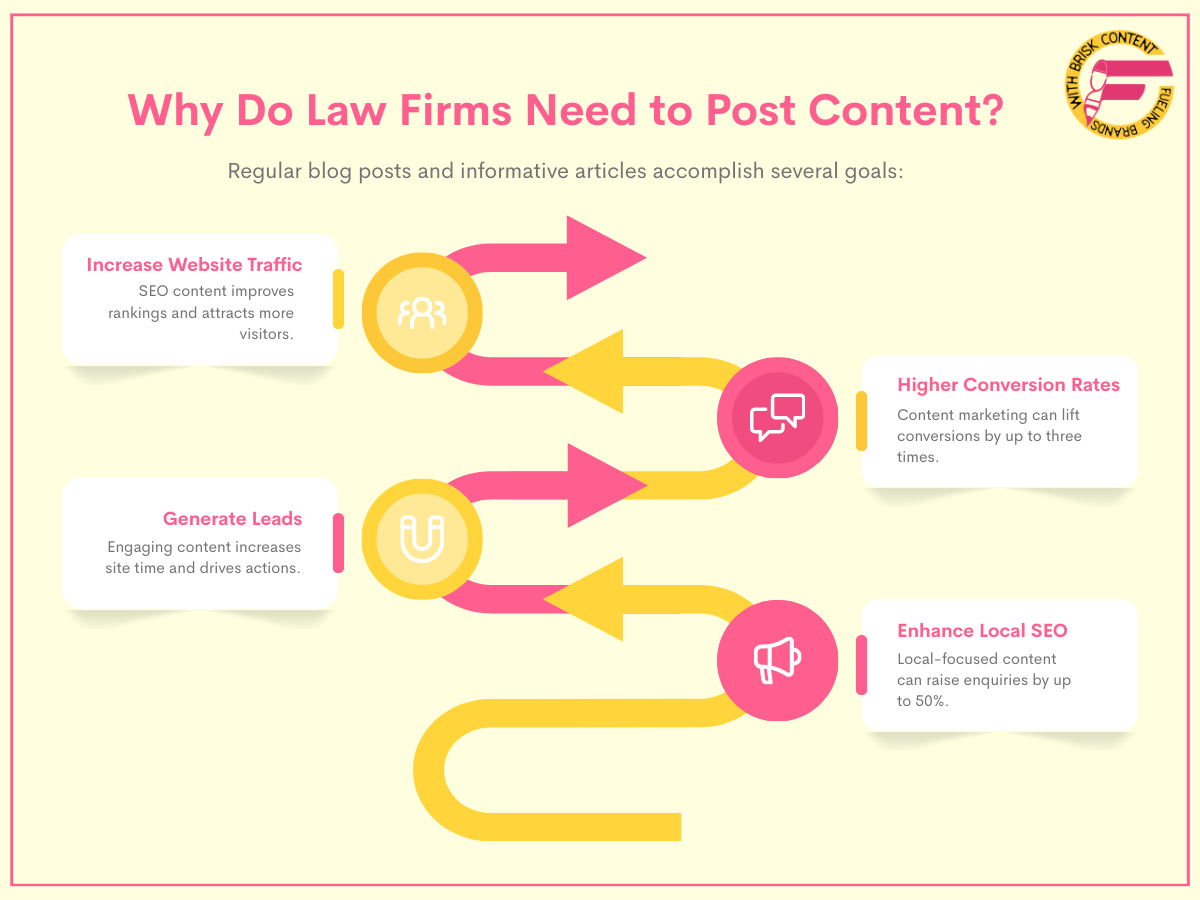
        Regular blog posts and informative articles accomplish several goals:

        • Increase Website Traffic: Search Engine Optimised (SEO) content drives organic traffic to your site. It helps your pages rank higher in search results, increasing organic traffic.
        • Higher Conversion Rates: According to the latest Content Marketing Institute stats, firms that invest in content marketing see conversion rates up to 3 times higher.
        • Build Trust and Authority: Content educates potential clients, making complex legal concepts easier to understand. This positions the firm as a knowledgeable partner ready to guide clients through difficult legal matters.
        • Enhance Local SEO: According to the 2024 Local SEO Industry Report by BrightLocal, legal content that integrates local SEO can increase client inquiries by 50%. Creating content relevant to your practice area’s local laws improves your search engine rankings in your area, helping you connect with nearby clients.
        • Generate Leads: Engaging content increases the time visitors spend on your site. Embedding calls to action in your pieces can lead to new customers.

        Top 9 Content Formats That Drive Client Leads for Law Firms

        To attract potential clients, you can take advantage of a variety of content formats suited to your audience’s needs. Here are the top content formats that drive client leads for law firms:

        1. Blog Posts: 88% of law firms actively update their blog post for client growth. Consistent, informative blog posts that answer common legal questions, explain procedures, and address client concerns improve SEO rankings and position your firm as an expert. 
        2. Practice Area Pages: Dedicated pages for each area of law your firm practices. These pages help clients quickly find relevant services and boost search engine visibility.
        3. Attorney Bios: Well-drafted attorney profiles build trust by highlighting your team’s credentials and experience. Bios with professional achievements help humanize your firm.
        4. FAQs: Sections that address typical client queries in simple language improve SEO performance by targeting relevant keywords.
        5. Case Studies: Stories of successful outcomes demonstrate your firm’s expertise and provide proof that builds reliability and trust.
        6. Short Videos: Videos that explain legal concepts and related procedures that help educate clients can help you become their trusted law firm.
        7. Ebooks and Guides: Offering downloadable resources, such as legal guides or checklists, in exchange for contact information is an effective lead-generation tactic.
        8. Social Media Posts: Regular posts on platforms such as LinkedIn, Facebook, and Twitter extend your reach, share snippets of legal advice, and promote your blog content.
        9. Email Newsletters: Email campaigns nurture leads by delivering valuable legal insights, and the latest news related to Law and Order keeps your firm top-of-mind when clients need help.

        Why Hire a Content Writer?

        While many attorneys are accomplished writers in legal contexts, writing effective law firm SEO content requires a different skill set. Here’s why hiring a professional content writer will help your firm in the long run:

        • Simplifies Complex Jargon: Professional content creators convert dense legal language into easy-to-understand language that an average reader can understand. This makes legal information accessible to a broader audience and helps clients feel more confident.
        • Employs Strategic SEO: Content creators use SEO best practices to optimize your content and format it for readability. By targeting relevant keywords, they help clients who are actively searching for legal help.
        • Saves Time and Resources: Outsourcing your content creation ensures a steady flow of fresh content. This will allow your firm to concentrate on core legal responsibilities while maintaining a powerful online presence.
        • Maintains Website Health: Content writing companies often conduct continuous audits to update and improve websites. This will help keep your website relevant and aligned with the latest standards.
        • Injects Empathy: Law firm content writers recognize that legal content is not just informational but also emotional. This human-centered approach fosters trust and encourages potential clients to reach out.
        • Measurable ROI Growth: Investing in high-quality legal content leads to tangible business results. Law firms that have invested in online marketing have achieved a 526% ROI in just three years. SEO ensures ongoing, cost-effective visibility compared to paid ads.

        Conclusion

        Law firm content writing transforms websites into powerful lead-generation engines, building trust and driving sustainable growth in competitive markets. Professional writers from ContentFayah deliver SEO-optimized, empathetic content that simplifies legal jargon and maximizes ROI through proven strategies, including the 526% returns top firms achieve.

        Ready to dominate local search and convert more clients? Contact ContentFayah today for a free content audit and start publishing high-impact legal content that positions your firm as the go-to authority.

        1. What types of content work best for law firms?

        Blog posts, practice area pages, attorney bios, FAQs, case studies, videos, ebooks, social posts, and email newsletters drive the most client leads.

        2. How much does law firm content writing cost?

        Pricing varies by word count and complexity, but ContentFayah offers packages starting with blog posts at competitive rates. Request a custom quote for your needs.

        3. How long until we see ROI from legal content?

        Most firms see traffic increases within 3-6 months, with conversion improvements following consistent publishing and SEO optimization.

        Categories
        Content Marketing

        What Is Share of Search? Definition, Best Practices?

        Have you ever wondered how many people searching online are actually looking for your brand compared to your competitors? Share of Search answers this exact question by measuring what percentage of searches in your product category are specifically for your brand. In 2025, Google processes around 9.5 million searches every minute, with over 60% 

        happening on mobile devices.

        Tracking your brand’s Share of Search can provide valuable insights into consumer interest and predict your future market share, with some studies showing it accounts for up to 83% of it. Understanding this metric helps marketers focus their efforts on boosting brand visibility where it truly matters.

        How does Share of Voice differ from Share of Search?

        When comparing brand metrics, it is important to understand the difference between Share of Voice and Share of Search, as both provide amazing insights into your market presence and consumer behavior.

        AspectShare of Voice (SOV)Share of Search (SOS)
        DefinitionThis measures brand presence across paid and organic media channels, such as advertising, social mentions, and PR.Measures the percentage of brand-related searches within a product category on search engines.
        FocusBrand visibility and media exposure across multiple channels.Consumer search behavior and branded search interest online
        Measurement BasisVolume of ads, impressions, social media mentions, and overall media share.Number of searches for the brand versus competitors in a category.
        ReflectsMarketing spend and brand awareness efforts (input metric).Actual consumer intent and interest (outcome metric).
        Funnel StageTypically, the upper funnel shows brand awareness.Closer to the lower funnel, indicating a stage of purchasing consideration.
        UsageTo gauge media dominance and advertising effectiveness.To predict market share and understand real buyer interest.
        Data FrequencyOften periodic, based on advertising campaigns and media reports.Continuously updated, real-time search data.

        What tools and software can measure Share of Search effectively?

        Several tools can help you measure Share of Search consistently and accurately. Best practice is to use these tools regularly to capture seasonal trends and campaign effects. Some of the popular options include:

        • Google Keyword Planner and Google Trends for tracking search volume.​
        • SEO platforms like SEMrush, Ahrefs, and Mangools allow deep keyword analysis, brand search monitoring, and competitive comparisons.​
        • Mangools provides a simple dashboard to compare multiple brands side by side for organic search, ideal for benchmarking.​

        How can Share of Search inform your SEO and content marketing strategies?

        Share of Search reveals the portion of your digital audience that is looking for your brand versus your competitors, providing marketers with insight for planning effective campaigns. If your Share of Search goes up, your SEO and content efforts are likely paying off.​ By measuring the metrics/ changes below over time, marketing teams can see what works in creating brand presence.

        1. Set content priorities: Focus on terms linked to high search interest for your brand. Check out our blog on the best SEO content writing software to create optimized content that boosts your Share of Search.
        2. Spot gaps and opportunities: If your Share of Search lags, adjust your content topics, backlink strategy, or landing page messaging.
        3. Gauge real impact: Track how new blog posts, PR, or ad campaigns lift Share of Search.

        What are the common pitfalls or challenges when analyzing Share of Search?

        Fix the following issues by routinely updating keyword lists, cross-verifying data, and segmenting Share of Search reports. Tracking Share of Search sounds simple, but comes with a few common challenges:

        • Not defining category scope: Results are only relevant if category terms are clear and competitors are accurately listed.​
        • Ignoring keyword variations and brand misspellings: These can skew the actual percentage.
        • Overlooking seasonal spikes in interest can give a misleading picture of long-term trends.
        • Relying only on one data source or looking at Share of Search in isolation from other metrics like conversion rates.

        How to Choose the Right Keywords for Measuring Share of Search?

        Selecting the right keywords is the foundation of accurate Share of Search analysis. A focused keyword list gives a reliable picture of consumer interest and helps you see how your brand stacks up against competitors. Here is a simple and effective way to build that list.

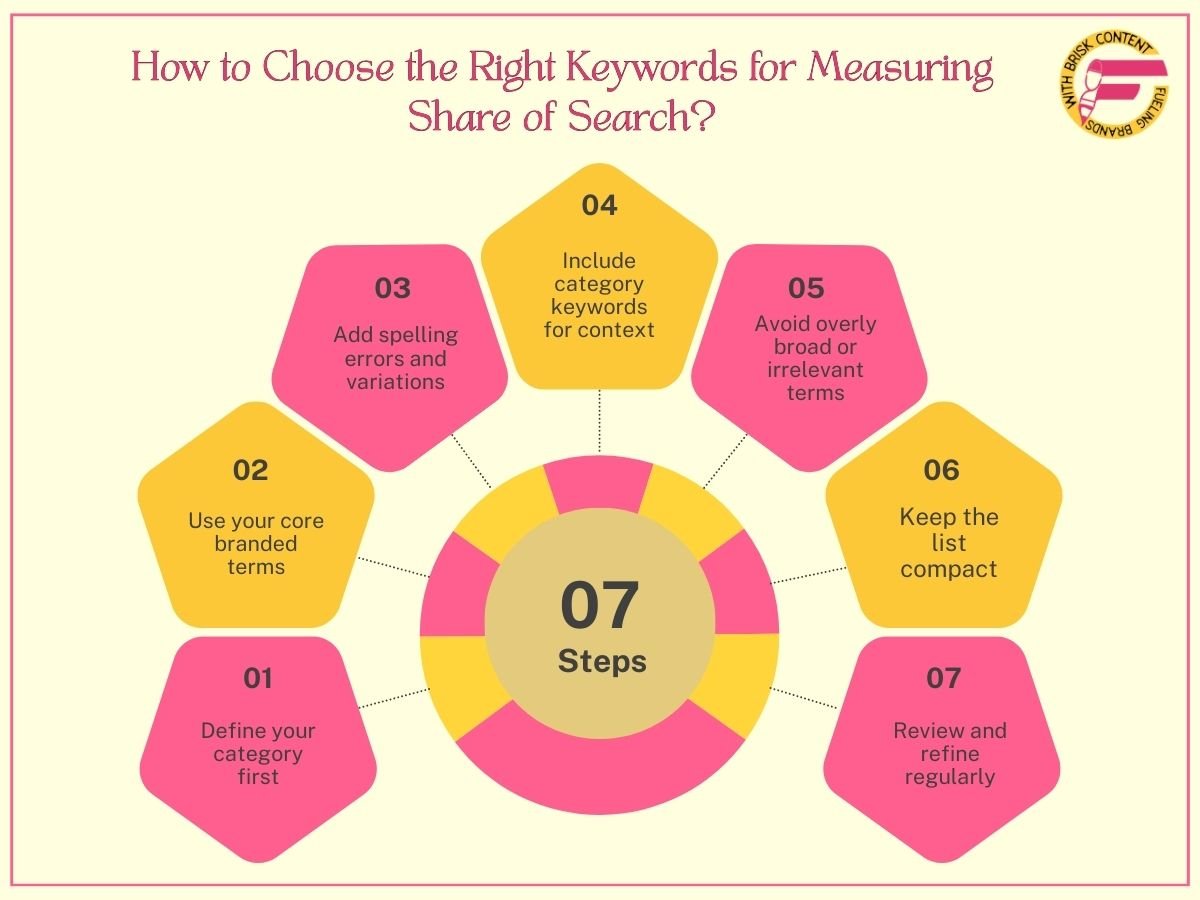
        1. Define your category first

        Start by clarifying the product category you operate in. A clear category scope ensures you compare your brand against the right competitors and avoid noisy data.

        1. Use your core branded terms

        Branded keywords should be at the centre of your list. Include your brand name, product names, and any well-known variants. These terms reveal true intent and direct brand interest.

        1. Add spelling errors and variations

        Users often misspell brand names. Add the most common variations so you capture full search behaviour and avoid under-reporting your actual share.

        1. Include category keywords for context

        Category terms help you understand overall search volume and validate whether interest in your market is rising or falling. Keep these terms specific and relevant.

        1. Avoid overly broad or irrelevant terms

        Generic keywords may inflate your numbers and give a false impression of interest. Stick to terms that clearly relate to your brand or category.

        1. Keep the list compact

        A concise keyword list reduces noise and gives cleaner trends. A small, well-selected set of terms works better than a long list filled with marginal keywords.

        1. Review and refine regularly

        Search behaviour changes with launches, campaigns, and market shifts. Update your keyword list from time to time to keep your Share of Search data accurate. Learn more about content marketing trends shaping search in 2026 to stay ahead of keyword evolution.

        How can Share of Search predict future sales or market trends?

        Share of Search is often a strong leading indicator. Research suggests that shifts in Share of Search can predict up to 83% of future market share for some industries. When more people search for your brand versus the competition, it signals rising interest and intent.​

        This is useful for planning inventory, measuring campaign impact, or anticipating quarterly sales trends. While not guaranteed, an uptick in Share of Search usually means more people are considering your brand, often before sales numbers reflect those changes.

        What industries benefit the most from tracking Share of Search?

        Categories where purchase consideration starts with an online search will see the largest impact from monitoring Share of Search. Industries with high competition and frequent changes tend to gain the most, including:

        1. Consumer goods (e.g., beverages, snacks, electronics).
        2. Automotive and travel markets.
        3. Technology and software brands.
        4. Health and finance products.

        How do offline marketing efforts influence online Share of Search?

        Traditional ads, sponsorships, and even PR activities can impact Share of Search. Offline campaigns may generate curiosity or buzz that leads people to look up your brand online. For this reason, align your online and offline campaigns and look for jumps in Share of Search after major TV ads, events, or press coverage.

        Can Share of Search be applied to social media or other digital platforms?

        Share of Search has traditionally focused on search engines, but similar concepts can extend to social platforms. Tools are available for Facebook, Instagram, and YouTube to measure branded search or hashtag usage.

        However, intent differs by platform. Search engines show active interest, while social media may track passive engagement or brand mentions.

        How can small businesses leverage Share of Search insights compared to larger brands?

        Share of Search is not just for big brands. Small businesses can use simple keyword tracking tools to see how local search interest changes and compare against nearby competitors. Smaller brands can act quickly if data shows a drop, switching up content, ads, or community engagement strategies to regain share.

        You just need to focus on:

        1. Location-based tracking.
        2. Seasonal campaigns (e.g., holiday or event-driven spikes for local services).
        3. Niche keyword clusters that reflect your specialties.

        Conclusion

        Clear insights into how consumers search for your brand versus competitors open a new window of opportunity for marketers. Share of Search provides a fresh perspective on brand awareness by focusing on actual consumer purpose rather than just media presence. This clarity helps in informed decision-making in SEO, content, and marketing plans. Creating your strategy around these insights can help bridge the gap between digital visibility and real engagement. 

        For businesses aiming to promote their brand’s online impact and drive meaningful growth, professional content marketing can make a significant difference. Dig out how expert guidance can transform your marketing efforts by visiting Content Fayah. Let data-driven content strategies be the cornerstone of your path to capturing and retaining consumer attention in a competitive landscape.

        1. How often should Share of Search be measured?

        Monthly is best, with additional checks during or after major campaigns for accuracy.

        2. Can Share of Search help in launching new products?

        Yes, tracking search trends lets you gauge early audience interest and adjust marketing plans fast.

        3. Is a drop in the Share of Search always bad?

        Not always, it can be due to seasonality, competitor launches, or temporary trends. Investigate closely before making changes.

        4. Are there free tools to monitor Share of Search?

        Free options include Google Trends and Mangools’ dashboard. Paid tools offer deeper insights and reporting features.