
Categories
Content Marketing

Crafting Content Briefs: How to Customize for Every Format

Did you know that content marketing generates over 3 times as many leads as outbound marketing tactics, and guess what: it’s 62% less expensive. Only 89% of marketers with strategic planning (like detailed content briefs) actively use it to drive demand. Imagine you are spinning your wheels on blogs, videos, and emails that collapse because they are not dialed in to each format, wasting time and resulting in zero conversions. Sound familiar? That’s where the content brief, your behind-the-scenes hero, turns chaos into content gold. 

In this blog, we will unpack what a content brief is, reveal a content brief template, and walk through how to write a content brief, from content brief primary keyword research and competing URLs content analysis to crafting a flawless content brief structure. Learn to customize content brief formats, grab content brief examples, and amp up your content brief SEO. Time to craft content that converts.

What Is a Content Brief?

A content brief is your roadmap for creating content that beats the mark every time. You can think of it as a fraud sheet that aligns your team’s vision with audience needs and SEO goals. Unlike an uncertain outline, it details everything from content briefs and primary keywords to tone, structure, and calls to action, ensuring consistency across formats such as blogs, videos, and infographics.

 It saves hours of revision time by front-loading research, making it easy to customize content brief formats for any channel. Whether you’re a solo creator or leading a team, a strong foundation in content briefs turns chaotic ideas into polished, high-performing pieces that rank and convert.

What to Include in a Content Brief?

A solid content brief template includes essential pieces that steer writers while leaving room for their creative spark. Start with your content brief primary keyword and secondary keywords for SEO focus as detailed in The Ultimate Guide to Content Marketing in 2025. Add a reader profile (pain points, demographics), content brief structure outline (H2s, bullet points), estimated word count, and tone guidelines. 

Include competing URLs’ content analysis perceptions, unique angles from original research or expert interviews, and CTAs. Visuals, such as suggested images or data charts, round it out. This checklist makes sure your brief is comprehensive, adaptable, and ready to create content brief magic across formats.

How to Write a Content Brief?

A content brief follows a simple step-by-step process. Start with primary keyword research (Ahrefs/SEMrush for volume/intent). Add secondary keywords. Analyze top-competing URLs for gaps. Set word count by format (2,000+ blogs). Build a reader profile, add original research or expert interviews, then craft a suggested structure with headings/FAQs. Follow this how-to write a content brief path for SEO wins and reader love.

  1. Research the Primary Keyword

Start with your main keyword, the star of your brief. Use tools to check search volume, difficulty, and intent (like informational or buying-focused). Select terms with strong traffic but low competition, such as “content brief template.” This sets up your content brief SEO from the start.

  1. Identify Relevant Secondary Keywords

Support your star with 5-10 secondary keywords, such as “content brief example” or “customize content brief formats.” These expand coverage, boost topical authority, and capture related searches without keyword stuffing.

  1. Analyze the Top-Competing URLs

Check the top 10 ranking pages: their length, layout, and links. Spot gaps like missing data or weak visuals, then plan to beat them. This gives you a clear advantage.

  1. Calculate the Estimated Word Count

Fit the length to your format and competitors: 1,500-3,000 words for blog posts, shorter for social posts. Add more depth for guides. It keeps content full while remaining easy to read.

  1. Add a Reader Profile

Paint a vivid picture: Age, job, challenges (e.g., “Busy marketer struggling with SEO”). Tailor tone and examples to them for deeper resonance and higher engagement.

  1. Perform Original Research

Just don’t go through Google survey readers, crunch fresh stats, or test tools. This adds credibility and shareability, setting your content apart in content brief SEO.

  1. Interview In-House Experts

Talk to your team for real insights. Quotes and stats from SMEs make your brief authoritative and authentic.

  1. Create a Suggested Structure

Outline H1-H3s, intros, lists, and CTAs. Suggest transitions and FAQs for the flow. A sound content brief structure makes writing effortless.

3 Effective Content Brief Examples (+ Why They Work)

Have you ever wondered how top brands create content that ranks well and keeps readers hooked? Real examples show the way. Backlinko adds solid data and smart keywords to drive significant traffic. Relato creates short-story-style email briefs that achieve very high open rates. Beam makes video briefs with clear timings and attractive visuals for short, fast clips. They do well because they combine SEO skills, audience understanding, and the right content format, much like the B2B hacks in 7 Content Hacks for a Successful B2B Marketing. Use their approach to strengthen your content.

Example 1: Backlinko

Backlinko’s briefs are SEO stars. They check top pages, add charts, and break things into steps. This lands them #1 by filling gaps others skip.

Example 2: Relato

Relato does great story briefs for emails and social posts. They hook readers with simple flows. Result? Lots of likes and shares, without pushy sales.

Example 3: Beam

Beam’s video briefs outline hooks within the first 5 seconds, additional clips, and next steps. Built for YouTube, they grow watch time and fans fast.

Conclusion

Content briefs are your shortcut to blogs, videos, and emails that hit home every time. They line up the best keywords, map out reader needs, and sketch a clear path so nothing falls through the cracks. Simple steps like identifying top pages and fresh ideas help everyone move faster with fewer changes. Top brands like Backlinko prove that strong briefs mean more visitors and real impact. Pick up a basic template today, adjust it for your style, and see your content climb charts while pulling in loyal fans. No more wasted effort; just smart, steady wins. Ready to try? Contact Content Fayah now to build your first brief and share your results in the comments. We love to hear how it goes.

FAQs

1. What is a content brief?

A content brief is a short guide with keywords, reader information, and structure to make content easier and more effective.

2. How to write a content brief?

To write a content brief, you need to research keywords, check rivals, add a reader profile, and outline the structure step by step.

3. Why use a content brief template?

It keeps teams aligned, boosts SEO, and cuts revisions to deliver better results faster.

Categories
Content Marketing

Guide to Effective Content Ideation Techniques

In simple terms, content ideation is the process of generating, selecting and developing engaging content ideas in line with your content strategy. As content creation gets competitive, maintaining a steady flow of original ideas is a challenge content creators frequently face. So, how do we stay ahead of the competition? How do we ensure we never run out of creative content ideas?

Following Effective Content Ideation Techniques can help you overcome creative blocks by stimulating your imagination. These research-backed techniques will cover every avenue for idea discovery, every method of idea generation, and every source of inspiration or collaboration that can spark fresh content ideas.

In this blog, we will first examine why content ideation is so essential for content creators. Then we will explore techniques for generating fresh content ideas and discuss tools to streamline and enhance the process. As a bonus, we will further examine why human factors should never be underestimated in the ideation process for creating content that is relevant and grounded in reality.

Why is content ideation essential?

Let’s have a look at some stats by the Content Marketing Institute to understand the importance of Content Marketing today:

  • 91% of  B2B marketer use content marketing to reach their customers 
  • 72% of content marketers say that regularly updated, relevant content helps improve their lead generation.
  • Email campaigns and academic content are the top content marketing methods.

These statistics make it clear that content marketing is the backbone of the marketing strategy and cannot be underestimated. 

Effective content marketing requires a steady stream of engaging content posted on time. The first step to creating content is to come up with an idea for the content. This is where the role of content ideation comes into play. The ideation process helps streamline the generation and development of ideas needed to create fresh content and, therefore, is an indispensable part of a content marketing strategy. 

The first step in the ideation process is generating ideas. Let’s explore some of the most effective content ideation techniques that will ensure you always have enough fresh ideas at your disposal.

Top 7 Effective Content Ideation Techniques

1) Brainstorming

    A group exercise that can generate an extensive volume of ideas quickly. It encourages free thinking and allows team members to build upon each other’s ideas. The goal is to explore a wide range of options before narrowing down to the best options. Brainstorming sessions facilitate wild and quirky ideas, where no final decisions have to be made instantly. Fresh ideas should be jotted down, even if they feel ‘weird,’ as they could spark innovative solutions later. Including people from other departments ensures diverse perspectives and fosters collaboration that drives creative and practical outcomes.

    Miro AI, Claude, HyperWrite, and IdeaMap are some AI tools for brainstorming and idea generation.

    2) Competitor Analysis

      You can generate new ideas for your content by monitoring your rivals to detect gaps where your content can shine more brightly. Survey their topics, keywords, and rankings to uncover what pushes their traffic and where they fall short. Repurpose their high-performing content by adding missed angles and deeper insights to capture more search visibility. 

      AI tools for competitor analysis, such as those from Ahrefs or SEMrush, will help you easily uncover competitors’ top-ranking pages, organic keywords, and total traffic.

      3) Social Listening

        New ideas can also be generated by tracking what your users and potential customers discuss on social media platforms related to your products and services. Monitoring online forums and communities will make you aware of the conversation around your industry. This technique will help you better understand your customers’ preferences and their current concerns. When you create content around these trends and concerns, it will automatically resonate with your audience and help your content rank higher.

        AI tools like Heygen AI and Surfer SEO can help you analyse the data collected to generate optimized organic keywords for your content. 

             4) Customer Surveys and Feedback

        Another way to generate ideas from your customers is to examine product reviews and gather feedback. These often reveal unmet needs and areas that require guidance. These insights can be converted into targeted content, such as FAQs or how-to guides, that address specific concerns and build trust. 

        Alternatively, you can conduct a quick survey or poll via email and social media to gauge preferences and uncover fresh ideas directly. Use open-ended questions such as “What’s your biggest challenge with [product]?” to spark rich, detailed responses across multiple topics. Share survey results as standalone content pieces, such as infographics, to boost engagement and generate even more ideas. This will also help you keep your content calendar audience-focused.

        5) Search Behaviors

        New content ideas can also be generated using keyword tools like Google Keyword Planner or Semrush to uncover what people actually search for. Check auto-suggests and trends to align topics with high-intent queries your audience types daily. This valuable information will reveal relevant topics and popular keywords to inspire you to create SEO content that drives organic traffic. 

        6) Leverage Seasonal Events

        Festivals and holiday seasons can also provide ideas for new content. Keep track of national and international events and festivals. You can boost engagement by aligning content with these seasonal events and tapping into audience excitement.

        Plan ahead with a calendar of key dates, prioritizing high-impact ones for your niches, such as travel and finance. This keeps your content timely and shareable, and boosts conversions year-round.

        7) Keep an Idea Journal

        You can jot down every spark, random notes, overheard chats, or late-night thoughts into a simple app or notebook for later. Review weekly to connect dots across entries and spot patterns for content series. Tag by theme or urgency to build a personal idea bank that never runs dry. Share snippets in team huddles to develop solo ideas into something solid. 

        Adding the Human Touch

        There are a number of AI tools that will help you generate ideas without using any techniques, but these ideas overlook the Human factor. Adding the human touch to content ideation means valuing all the human stakeholders who make that content and for whom the content is made. 

        Genuine ideas emerge from collaboration, avoiding disconnected themes. For example, Airbnb’s cross-team sessions turned host stories into “Experiences” content, growing bookings 25%. We make content for our audience, so it is imperative that we never ignore audience feedback. HubSpot analyzes support tickets to create “How-to” guides that promote engagement by 30%. Trending topics are important, but never undervalue evergreen topics like “SEO Basics” that drive steady traffic. Focus on empathetic storytelling, addressing real challenges, and use customer testimonials to spark global conversations and sales uplift. 

        Conclusion

        Content ideation techniques form the foundation of successful marketing strategies that deliver consistent results. Teams that master brainstorming, social listening, competitor analysis, and customer feedback maintain a year-round pipeline of fresh, audience-focused ideas. These methods, backed by tools like Ahrefs, SEMrush, and Miro AI, eliminate creative blocks while ensuring content aligns with search trends and real user needs. Statistics from Content Marketing Institute confirm 91% of B2B marketers rely on content marketing, with 72% seeing improved lead generation from regular, relevant posts. The human touch remains irreplaceable, blending AI efficiency with empathetic storytelling for authentic connections.

        Ready to build an unstoppable content pipeline? ContentFayah specializes in turning ideation into high-ROI campaigns. Schedule your free strategy session today and get a custom content calendar plus 3 ready-to-publish ideas tailored to your brand. Transform scattered thoughts into steady growth. Start now.

        FAQs

        1. What are the most effective content ideation techniques for 2026?

        Brainstorming, competitor analysis, social listening, and customer surveys top the list. Tools like Ahrefs, SEMrush, and Miro AI streamline the process while human collaboration ensures ideas stay authentic and audience-focused.

        2. How can AI tools enhance content ideation without losing the human touch?

        AI excels at competitor analysis (Ahrefs), keyword research (SEMrush), and brainstorming (Miro AI), but human insight adds empathy. Combine AI-generated data with customer feedback and team brainstorming to create content that ranks high and resonates deeply.

        3. How often should content creators practice ideation techniques?

        Weekly brainstorming sessions plus daily social listening keep ideas flowing. Review your idea journal every Friday and align monthly with seasonal events. Consistency across techniques prevents creative blocks and maintains fresh, SEO-optimized content.

        Categories
        Content Marketing

        Web Content Writing for Businesses: Do’s and Don’ts

        Your website’s content can make or break your brand’s reputation. You may get a visitor to land on your page, but will they stay? Will they act? That depends on how well your content speaks to them. 
        While boring or jargon-filled lines drive you away, interesting, simple-to-understand content keeps you interested. Your website can stand out in the highly competitive Indian digital market, where users have short attention spans and sharp content is essential. Without sacrificing creativity or quality, let’s get into the fundamental dos and don’ts of content writing for websites.

        Why Quality Content Matters

        The content of your website serves as your digital greeting. Well-written content reflects your professionalism, increases search engine exposure, and helps you draw in, hold on to, and convert visitors. Conversely, poor content undermines confidence and causes users to quickly abandon a website.

        Dos of Content Writing

        1. Do: Know Your Audience First

        Before typing a single word, ask: Who is reading this?

        Define your ideal reader’s problems, language, and what they want. Use those cues in your writing. Make them the hero of your story, not you.

        Good copy connects with readers’ needs. Use “you,” address their pain, and show how your content or product solves it.

        1. Do: Research Deeply and Smartly

        Strong content starts with solid research. Gather facts, stats, examples, and stories. Study how others have approached the topic, but don’t copy them. 

        Also, research SEO: your keywords, search volume, and related terms. Weave them naturally, not forcefully. 

        1. Do: Structure Your Content Well

        Break your content into clear parts: Introduction, Body, and Conclusion. Use headings, subheadings, numbered lists, and bullet topics to make it scannable.

        Short paragraphs (one to three sentences) help readers flow smoothly. Avoid giant blocks of text. 

        Begin with a hook: a story, a question, a bold fact, or a scenario. Grab attention in the first few lines. 

        1. Do: Use Active Voice, Simple Language

        Active voice makes your writing direct and powerful: “You will get results,” not “Results will be obtained by you.” Even MyTasker recommends this for e-commerce content. 

        mytasker.com

        Avoid big, fancy words or jargon. Write like you talk, with clarity.

        1. Do: Focus on Value, Not Fluff

        Your readers are busy. Give them something useful, tips, solutions, insight. Don’t stuff your content with fluff or vague statements to increase word count.

        Link to credible external sources, and also within your site. That helps readers dig deeper and boosts your SEO. 

        1. Do: Edit, Proofread, Revise

        Millions of errors lurk in drafts. Always recheck your content after writing. Read it aloud. Use grammar tools. Get a fresh pair of eyes to review. 

        Take a break before final editing. Fresh eyes spot missing pieces.

        Don’ts of Content Writing

        1. Don’t: Copy Others’ Work

        Plagiarism ruins credibility and SEO. Don’t just change a few words; write your own version. 

        Even meta descriptions or similar phrases can get flagged. 

        1. Don’t: Overstuff Keywords

        SEO is important, but repeating a keyword unnaturally frustrates readers and may earn a penalty. 

        Use keyword variations and synonyms to keep it natural.

        1. Don’t: Use Big Blocks & Dense Text

        Long paragraphs discourage reading. Use white space wisely. 

        Break your text into readable chunks and insert headings or bullet lists.

        1. Don’t: Talk Too Much About Yourself

        Your content should not be all about “we” or “our brand.” Make the reader the focus. Show how you help them. 

        Even in “About Us” pages, talk benefits first, then your story.

        1. Don’t: Ignore Design & Readability

        Good writing gets ruined if it’s crammed in a bad layout or unclear format. 

        Use headings, text size, spacing, and visuals to support your content.

        1. Don’t: Rush to Publish Immediately

        It’s unusual that your first draft is flawless. Let it rest. Come back with new insights. Grammar, tone, and flow in Polish. 

        Test several headlines or calls to action to determine which ones perform better.

        Here’s how you can string these dos and don’ts into a flow:

        • Start with a hook: “Imagine someone landing on your blog—but leaving in 5 seconds.”
        • Address the reader: “You want to keep people on your page. Let me show you how.”
        • Show structure: Use headings like “Research → Write → Edit.”
        • Give value under each heading: short tips, examples, dos and don’ts
        • Weave in a mini case or stat to strengthen your point
        • End with a call to action: “Try these tips in your next post. See the difference.”

        Final Thoughts

        Being straightforward, relatable, and helpful is more important when writing for the web than being creative. A well-written post has the power to convert visitors into clients, supporters, or devoted readers.

        To achieve that, keep the balance between creativity and strategy. Research deeply, write with purpose, edit ruthlessly, and respect your audience’s time.

        When your words reflect honesty, clarity, and understanding, they build trust. Trust leads to engagement, and engagement brings growth.

        The best content doesn’t sound like marketing; it sounds like conversation. So write as if you’re talking to one person who truly matters. That’s when your content begins to work. That’s exactly whatContentFayah delivers through expert web content writing. Schedule your free strategy session today and transform your website copy into conversations that convert.

        FAQs

        1. What are the most important do’s for web content writing?

        Know your audience first, research deeply with SEO keywords, structure content for scannability using headings and short paragraphs, and focus on delivering real value through actionable insights.

        2. What common mistakes should businesses avoid in website content?

        Don’t copy others’ work or overstuff keywords, avoid dense text blocks and excessive “we” language, and never rush publishing without thorough editing and proofreading.

        3. How can businesses balance creativity and strategy in web content?

        Research thoroughly for credibility, write conversationally with active voice and simple language, edit ruthlessly for clarity, and always prioritize reader benefits over brand promotion.

        Categories
        Content Marketing

        What Is Thought Leadership Content?

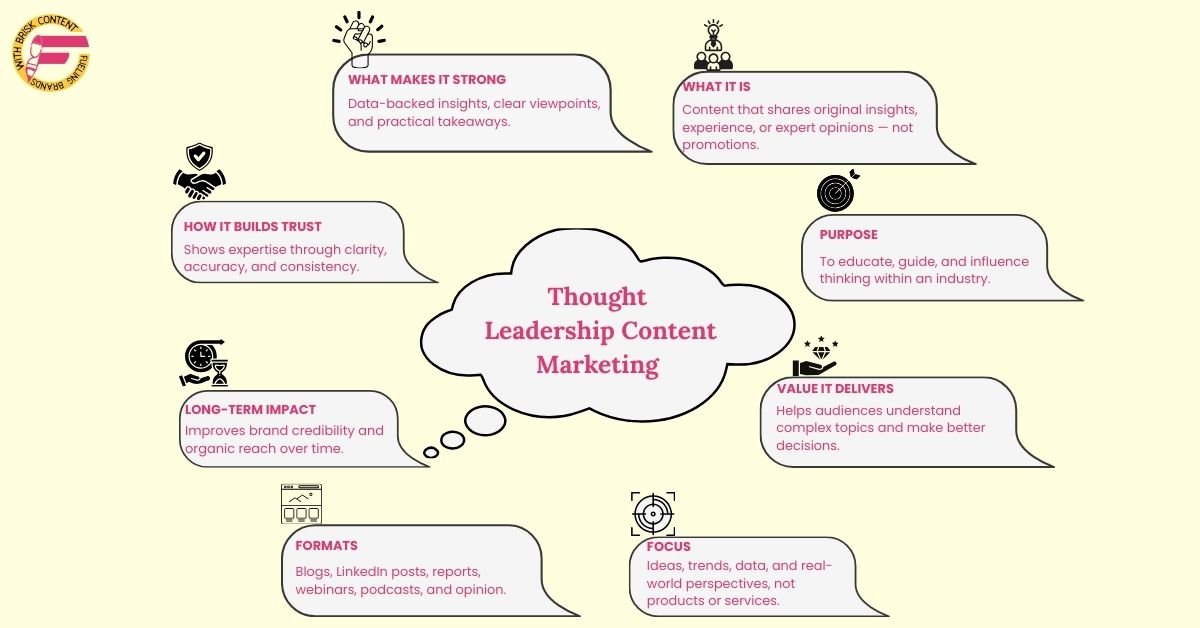
        Did you know that nearly 75% of executives have explored products or services they weren’t initially considering after engaging with quality thought leadership content? Thought leadership is now one of the most trusted ways to learn about a company’s expertise and value, far beyond traditional ads. It helps brands and experts share real knowledge and fresh ideas through posts, blogs, podcasts, or even books. This builds trust, opens new opportunities, and connects you with the right audience. 
        This blog will guide you through everything you need to know to successfully create and use thought leadership content to boost your brand and influence.

        What Is Thought Leadership Content Marketing?

        Thought leadership content marketing is when a brand shares useful, high-quality information from experts who really know their field. These experts, known as thought leaders, use formats like articles, infographics, videos, or social media posts to share their knowledge and help others learn something valuable. For brands, this type of content helps build trust, grow credibility, and strengthen their reputation in the industry.

        7 types of thought leadership content

        Sharing thought leadership content is one of the best ways to show your expertise and connect with your audience. Here are seven popular formats that top leaders use to share their ideas and make a real impact.

        1. LinkedIn/Twitter 

        LinkedIn is great for building your professional reputation and connecting with key decision-makers, like CEOs and business leaders. You can share useful industry info, post regularly, join conversations, and mix your own ideas with interesting articles. Twitter is faster and more casual, lets you share quick thoughts, join trending chats, and reach a wider group, including journalists and influencers. Using both together helps you get noticed, build trust, and grab more opportunities in different ways.

             2. Newsletters and blogs

        If you have more to say, start a blog or newsletter. These platforms let you share deeper insights and talk directly to your audience without dealing with social media algorithms. Email marketing also offers strong returns, so it’s worth the effort. The challenge is keeping your content engaging and growing your audience over time. This is where a content agency can help maintain quality and consistency.

            3. Op-eds and bylines

        If you publish your ideas in respected outlets like Forbes and The Wall Street Journal, it can greatly boost your visibility. A byline lets you speak directly to large audiences while strengthening your personal brand. The more people see your name next to well-known media brands, the more credible your expertise becomes. Partnering with professionals who know how to pitch to editors can help you get your ideas published.

            4. Podcasts

        Podcasts are booming, with hundreds of millions of listeners. Starting your own show or appearing as a guest helps share your expertise in an informal, conversation-style setting. It’s perfect for connecting with niche or engaged audiences. If you host your own, be patient and consistent; it takes a while to grow an audience. Joining existing podcasts, however, can quickly expand your reach.

            5. Media interviews and profiles

        Being featured in news articles or industry interviews can expose your ideas to much wider audiences , and it boosts trust, since earned media is often seen as more credible than ads. The trick is to stay on message and build good relationships with journalists. If you team up with an agency that already has media contacts, it’s much easier to get noticed and ensure your point of view comes through clearly.

            6. Speeches and presentations

        Speaking at events, webinars, or panels positions you as an expert to a ready audience. These opportunities help you create credibility and grow your professional network. Also, data reveals that the speaking gigs can bring a strong return on investment. People will want to hear more from you as you speak, creating a positive cycle of influence and recognition. 

            7. Books

        Book publishing shows deep knowledge of your field and offers you an everlasting way to share your ideas. It’s more substantial than a post or an article, and it can even generate passive income. Books help build authority and connect you with decision-makers who respect well-thought-out, long-form ideas. Whether self-published or traditionally released, a book can be a powerful piece of your thought leadership strategy.

        Thought Leadership Strategy!

        A thought leadership strategy is about building your reputation as an expert, not just pushing sales. It focuses on creating content that answers your audience’s important questions and shows your deep knowledge.

        Step 1: Set SMART goals.
        Break your big goal into smaller parts using SMART criteria, make your goals Specific, Measurable, Attainable, Relevant, and Timely. For example, aim to attract five new leads in three months. Then list the actions to reach that goal, like starting a blog or growing LinkedIn followers, prioritising what your audience prefers.

        Step 2: Brainstorm content ideas.
        Think about your audience personas and what they want to read or watch. Look for questions they ask on social media or forums like Reddit. Focus on creating content that meets their real needs.

        Step 3: Analyze competitors.
        Find out who your audience turns to now and what content they consume. Identify gaps where their needs aren’t met, and check which competitor posts get lots of likes or shares to inspire your ideas.

        Step 4: Create and distribute content.
        Make your content stand out by sharing your unique view and personality. Keep it easy to understand and share. Avoid copying popular content; instead, bring fresh insights so social media algorithms and readers notice you.

        Step 5: Measure results.
        Track how your content is doing based on the goals you set. Use relevant metrics to see if your strategy is bringing the impact you want and adjust as needed.

        Why You Need Thought Leadership in Your Content Strategy

        Thought leadership is important and a must-have in your content strategy because it helps your brand stand out by showing real expertise and building trust with your targeted audience. Instead of just selling, thought leadership focuses on providing valuable insights and answers that your audience is searching for, which forms deeper connections. Such type of content boosts your credibility, attracts new opportunities, and makes you stand out from competitors by positioning you as a go-to expert in your field. Using thought leadership can also help your brand’s image and, over time, make people more interested and loyal to it.

        Final Thoughts

        Think of thought leadership content like your trusted guide in a crowded marketplace. In 2025, 73% of decision-makers trust this kind of content more than traditional ads or brochures. They spend significant time digging into thoughtful articles and insights because they want real value, not sales talk.​

        But here’s the catch: 85% say a lot of content out there misses the mark by lacking fresh ideas or depth. So, it’s not about just pumping out posts; it’s about sharing smart, original ideas that answer real questions. When you nail this, you don’t just build credibility; you open doors to new opportunities and become a go-to expert that people want to engage with and do business with.ContentFayah helps brands master this exact balance through expert content writing that turns insights into influence. Schedule your free strategy call today and elevate your thought leadership game.

        FAQs

        1. How can I make my thought leadership stand out?

        Focus on sharing fresh ideas or new angles that others aren’t talking about. Original research or stories from real experiences really catch attention.

        2. Who should be involved in creating thought leadership content?

        It’s best to involve experts or leaders in your company who truly understand the topics. Their insights make the content more reliable.

        3. How often should I publish thought leadership content?

        Consistency matters more than quantity. By posting regularly, even if small, you keep your audience engaged and help build your reputation over time.

        Categories
        Content Marketing

        Content Marketing Trends that are Working in 2026

        Remember when posting twice a week on Instagram, running some Facebook ads, and sending a monthly newsletter seemed enough for digital marketing? Those days are over.

        As 2026 unfolds, content marketing trends 2026 are reshaping how brands connect with people. Technology is advancing fast, privacy laws are tighter, and audiences now jump between platforms faster than ever.

        But it’s not just about technology. It’s about trust, relevance, and connection. Whether you work with a digital marketing agency or run your own campaigns, these shifts define the future of content marketing.

        AI-Driven Content Creation and Personalisation

        Artificial Intelligence has matured. Tools like ChatGPT, Jasper, and Copy.ai are far smarter than before. They now adapt to tone, style, and brand voice, helping marketers produce more tailored and consistent content.

        Still, 2026 is not about letting AI take over. The winning formula is clear: use AI-driven content creation for speed and scale, but keep humans in charge of creativity. People can detect when content feels robotic. That’s why the best brands use AI to enhance, not replace, authentic storytelling.

        Smart marketers also use AI for customer data analysis, campaign testing, and trend prediction—saving time while personalising at scale. The key is balance: let technology optimize efficiency and keep people handling empathy and emotional connection.

        Search Is No Longer Just Google

        Search habits are changing. Nearly 40% of Gen Z users now search using Instagram Reels or YouTube Shorts instead of Google. Add to that the growth of tools like Perplexity.ai and voice-enabled devices, and search is now everywhere.

        For brands, SEO must evolve into generative engine optimization (GEO). This entails producing content that is recognized, referenced, and remembered by AI models. Ranking in Google results is no longer the only consideration. It’s about conversational tools and AI systems that remember and mention you.

        Marketers need to take into account a variety of channels when releasing content:

        • Long-form reviews or blog posts for traditional search.
        • Short, snappy videos for visual search.
        • Conversational content for AI assistants and chat-based engines.

        Voice Search Optimization

        Voice search optimization continues to grow in 2026 as more people use devices like Alexa, Siri, and Google Assistant. To succeed, brands must create content that matches how people talk.

        Here’s what works now:

        • Use natural, conversational keywords.
        • Build FAQ pages answering real questions.
        • Optimise for featured snippets using bullet points or tables.
        • Use schema markup to help AI assistants extract answers.
        • Focus on local SEO because many voice searches include “near me.”
        • Keep sites fast and mobile-friendly.

        Another big shift is optimizing for Answer Engine Optimization (AEO) and Generative Engine Optimization (GEO). This ensures your brand shows up in AI-generated summaries. Voice and AI search are merging, so the clearer and more direct your content, the better your visibility.

        The Rise of Community-Driven Content

        The most powerful marketing in 2026 is community-focused. Brands are no longer just broadcasting messages; they are building two-way conversations.

        Community-driven marketing strengthens relationships through spaces like Discord servers, Slack groups, or private brand communities. These communities give loyal customers a place to connect, share user-generated content, and exchange ideas.

        This approach offers real benefits:

        Builds long-term loyalty.

        • Creates authentic user content (UGC).
        • Generates valuable customer feedback.
        • Turns customers into advocates.

        In an advertising-filled world, actual customer feedback is unique. Engaged communities encourage dialogue rather than just clicks, which keeps brands relevant and promotes organic growth.

        Algorithm Volatility: The New Normal in 2026

        Algorithms now change faster than ever, and AI integration into social platforms has made visibility unpredictable. Algorithm volatility 2026 means that what works one month might fail the next.

        Success now comes from adaptability. Marketers must combine automation with creativity, using AI to manage personalization while humans focus on storytelling.

        At the same time, misinformation is rising. Brands must invest in monitoring false narratives, correcting them quickly, and being transparent. Building credibility before problems arise is the best defence.

        The Micro-Influencer Advantage

        Big celebrity endorsements are losing power. Instead, micro-influencer marketing dominates digital marketing trends 2026.

        Micro-influencers have smaller followings but stronger trust. Their recommendations feel more genuine, and they engage in niche or private online spaces where real discussions happen.

        Brands now prefer forming long-term relationships with these creators rather than one-off sponsored posts. Authentic partnerships deliver better engagement, credibility, and brand storytelling.

        Content Scale vs. Authenticity

        AI now helps marketers automate reports and analyse trends. Many agencies use it to scale fast, but speed can’t replace substance.

        AI-driven tools sometimes produce bland messages that lack emotional depth. That’s why content authenticity is becoming marketing’s most valuable asset.

        Stories with heart, emotion, and real meaning stand out. Even in an AI-driven environment, people still want connection. In 2026, authentic storytelling that is grounded in human experience and supported by analytics will be the key to brand success.

        The GEO Revolution: Redefining Visibility in 2026

        A major shift in content marketing trends 2026 is Generative Engine Optimization (GEO). Unlike SEO, which focuses on search rankings, GEO is about becoming part of AI’s memory.

        AI systems such as ChatGPT and Gemini don’t just list results; they also recall the most credible sources. Hence, visibility now depends on being cited and recognised by AI.

        The stories that AI “remembers” are those most shared and referenced across media. To stay visible, brands must build strong reputations, produce credible content, and ensure their voices are represented in trusted, editorial-quality spaces.

        Being “recalled” by generative engines will soon carry more weight than backlinks or social mentions.

        Strategic Implications: Preparing for 2026

        The marketing environment of 2026 calls for more intelligent AI utilization, authentic storytelling, and more robust trust-building techniques. Agility, ethics, and authenticity are three areas where agencies and internal teams need to modify their approaches. Below is a summary of the main goals and common needs.

        PriorityAgency FocusIn-House FocusShared Need
        AI IntegrationAutomation and reporting to scale efficiency for several clients (more than 60% of international agencies)Personalized content creation tailored to customer behaviour (~40%) ​Maintain human oversight for creativity and ethical AI use
        ChallengesHandling algorithm changes and combating misinformationTying marketing results directly to revenue growth and ROIStrengthening authenticity and transparency in messaging
        InfluencersClose relationships with micro-influencers (who are preferred by 75% of respondents over celebrities)Lower dependency on influencer marketing, focusing on brand-owned narrativeBuilding credibility and community trust over reach
        MeasurementFollowing stories in exclusive, invite-only online areasConnecting metrics to customer retention and business resultsConverting conversion and reputation data into unified performance scorecards

        Beyond 2026: The Long Arc of Marketing Transformation

        As digital environments grow, content marketing will be built on the three pillars of authenticity, adaptability, and audience interaction.

        Technology will keep transforming how we create and distribute content, but the human desire for honest communication will never fade. The brands that balance AI efficiency with human warmth will lead in 2026 and beyond.

        Stay ahead of the curve with Content Fayah’s latest insights on content marketing trends and strategies for 2026. Subscribe now and empower your brand with the tools and knowledge to succeed in the rapidly evolving digital landscape.

        1. What are the top content marketing trends for 2026?

        AI-driven personalization, Generative Engine Optimization (GEO), voice search, micro-influencer partnerships, and community-driven content lead 2026 trends for authentic engagement and visibility.

        2. How does GEO differ from traditional SEO in 2026?

        GEO optimizes content for AI platforms like ChatGPT and Perplexity to get cited in answers. SEO focuses on Google rankings. Both work together for maximum visibility across search types.

        3. Why is authenticity important in 2026 content marketing?

        AI scales content fast, but audiences crave human connection. Authentic storytelling builds trust, differentiates brands, and outperforms robotic content despite algorithm changes.