Categories
Content Marketing

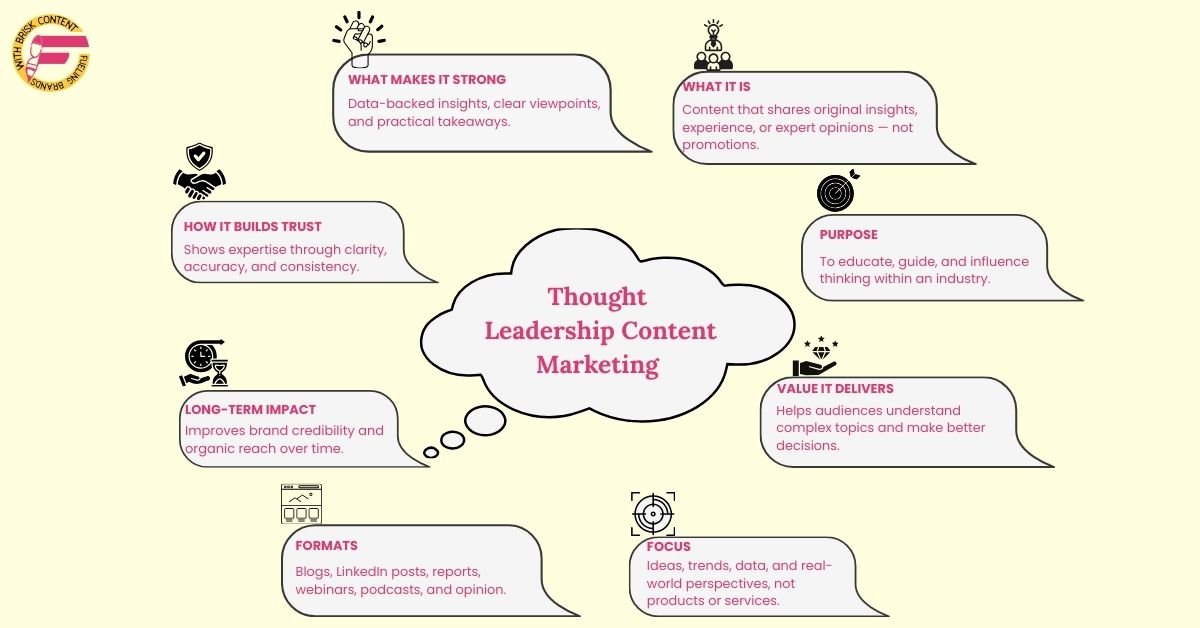
What Is Thought Leadership Content?

Did you know that nearly 75% of executives have explored products or services they weren’t initially considering after engaging with quality thought leadership content? Thought leadership is now one of the most trusted ways to learn about a company’s expertise and value, far beyond traditional ads. It helps brands and experts share real knowledge and fresh ideas through posts, blogs, podcasts, or even books. This builds trust, opens new opportunities, and connects you with the right audience. 

This blog will guide you through everything you need to know to successfully create and use thought leadership content to boost your brand and influence.

What Is Thought Leadership Content Marketing?

Thought leadership content marketing is when a brand shares useful, high-quality information from experts who really know their field. These experts, known as thought leaders, use formats like articles, infographics, videos, or social media posts to share their knowledge and help others learn something valuable. For brands, this type of content helps build trust, grow credibility, and strengthen their reputation in the industry.

7 types of thought leadership content

Sharing thought leadership content is one of the best ways to show your expertise and connect with your audience. Here are seven popular formats that top leaders use to share their ideas and make a real impact.

  1. LinkedIn/Twitter 

LinkedIn is great for building your professional reputation and connecting with key decision-makers, like CEOs and business leaders. You can share useful industry info, post regularly, join conversations, and mix your own ideas with interesting articles. Twitter is faster and more casual, lets you share quick thoughts, join trending chats, and reach a wider group, including journalists and influencers. Using both together helps you get noticed, build trust, and grab more opportunities in different ways.

     2. Newsletters and blogs

If you have more to say, start a blog or newsletter. These platforms let you share deeper insights and talk directly to your audience without dealing with social media algorithms. Email marketing also offers strong returns, so it’s worth the effort. The challenge is keeping your content engaging and growing your audience over time. This is where a content agency can help maintain quality and consistency.

    3. Op-eds and bylines

If you publish your ideas in respected outlets like Forbes and The Wall Street Journal, it can greatly boost your visibility. A byline lets you speak directly to large audiences while strengthening your personal brand. The more people see your name next to well-known media brands, the more credible your expertise becomes. Partnering with professionals who know how to pitch to editors can help you get your ideas published.

    4. Podcasts

Podcasts are booming, with hundreds of millions of listeners. Starting your own show or appearing as a guest helps share your expertise in an informal, conversation-style setting. It’s perfect for connecting with niche or engaged audiences. If you host your own, be patient and consistent; it takes a while to grow an audience. Joining existing podcasts, however, can quickly expand your reach.

    5. Media interviews and profiles

Being featured in news articles or industry interviews can expose your ideas to much wider audiences , and it boosts trust, since earned media is often seen as more credible than ads. The trick is to stay on message and build good relationships with journalists. If you team up with an agency that already has media contacts, it’s much easier to get noticed and ensure your point of view comes through clearly.

    6. Speeches and presentations

Speaking at events, webinars, or panels positions you as an expert to a ready audience. These opportunities help you create credibility and grow your professional network. Also, data reveals that the speaking gigs can bring a strong return on investment. People will want to hear more from you as you speak, creating a positive cycle of influence and recognition. 

    7. Books

Book publishing shows deep knowledge of your field and offers you an everlasting way to share your ideas. It’s more substantial than a post or an article, and it can even generate passive income. Books help build authority and connect you with decision-makers who respect well-thought-out, long-form ideas. Whether self-published or traditionally released, a book can be a powerful piece of your thought leadership strategy.

Thought Leadership Strategy!

A thought leadership strategy is about building your reputation as an expert, not just pushing sales. It focuses on creating content that answers your audience’s important questions and shows your deep knowledge.

Step 1: Set SMART goals.
Break your big goal into smaller parts using SMART criteria, make your goals Specific, Measurable, Attainable, Relevant, and Timely. For example, aim to attract five new leads in three months. Then list the actions to reach that goal, like starting a blog or growing LinkedIn followers, prioritising what your audience prefers.

Step 2: Brainstorm content ideas.
Think about your audience personas and what they want to read or watch. Look for questions they ask on social media or forums like Reddit. Focus on creating content that meets their real needs.

Step 3: Analyze competitors.
Find out who your audience turns to now and what content they consume. Identify gaps where their needs aren’t met, and check which competitor posts get lots of likes or shares to inspire your ideas.

Step 4: Create and distribute content.
Make your content stand out by sharing your unique view and personality. Keep it easy to understand and share. Avoid copying popular content; instead, bring fresh insights so social media algorithms and readers notice you.

Step 5: Measure results.
Track how your content is doing based on the goals you set. Use relevant metrics to see if your strategy is bringing the impact you want and adjust as needed.

Why You Need Thought Leadership in Your Content Strategy

Thought leadership is important and a must-have in your content strategy because it helps your brand stand out by showing real expertise and building trust with your targeted audience. Instead of just selling, thought leadership focuses on providing valuable insights and answers that your audience is searching for, which forms deeper connections. Such type of content boosts your credibility, attracts new opportunities, and makes you stand out from competitors by positioning you as a go-to expert in your field. Using thought leadership can also help your brand’s image and, over time, make people more interested and loyal to it.

Final Thoughts

Think of thought leadership content like your trusted guide in a crowded marketplace. In 2025, 73% of decision-makers trust this kind of content more than traditional ads or brochures. They spend significant time digging into thoughtful articles and insights because they want real value, not sales talk.​

But here’s the catch: 85% say a lot of content out there misses the mark by lacking fresh ideas or depth. So, it’s not about just pumping out posts; it’s about sharing smart, original ideas that answer real questions. When you nail this, you don’t just build credibility; you open doors to new opportunities and become a go-to expert that people want to engage with and do business with.ContentFayah helps brands master this exact balance through expert content writing that turns insights into influence. Schedule your free strategy call today and elevate your thought leadership game.

FAQs

1. How can I make my thought leadership stand out?

Focus on sharing fresh ideas or new angles that others aren’t talking about. Original research or stories from real experiences really catch attention.

2. Who should be involved in creating thought leadership content?

It’s best to involve experts or leaders in your company who truly understand the topics. Their insights make the content more reliable.

3. How often should I publish thought leadership content?

Consistency matters more than quantity. By posting regularly, even if small, you keep your audience engaged and help build your reputation over time.

Categories
Content Marketing

Potential Pitfalls of Using AI for Marketing

Are you wondering how AI is changing marketing? AI is transforming marketing by helping brands work faster, reach the right people, and personalize messages better than ever. But it’s not all smooth sailing. Using AI means dealing with messy data, tough tech setups, privacy rules, and making sure marketing still feels human. Many marketers struggle with these issues, from high costs and a lack of skills to keeping creativity alive. 
Knowing these challenges is key to using AI in a way that helps your brand grow without losing what makes it special. Let’s dive into the real pitfalls marketers face with AI and how to avoid them.

What are the common challenges marketers face when adopting AI?

When marketers start using AI, they often face several key challenges that are important to know:

  • Need for clean, quality data
    AI works best with large sets of accurate, unbiased data. If the data is messy or incomplete, the results AI gives can be wrong or misleading.
  • Difficult integration with current systems
    Putting AI tools into existing marketing tech setups can be tricky and take a lot of time. It often needs IT support and system adjustments.
  • Lack of skills and training
    Many marketers don’t yet have the knowledge to use AI tools effectively, which can cause mistakes or underuse of the technology.
  • Balancing automation with personal touch
    AI can automate many tasks, but relying too much on it can make marketing feel less personal, which can hurt customer connection.
  • Privacy and compliance concerns
    Marketers must follow privacy laws and ethical guidelines when using AI, or they risk legal trouble and loss of customer trust.
  • High costs and ongoing support
    AI tools can be expensive to start using and require continuous maintenance, which can be difficult for smaller businesses to afford.
  • Limited creativity and emotional understanding
    AI lacks human creativity and can’t truly understand emotions, so it may not produce content that connects deeply with audiences.

How can AI lead to the loss of human touch in marketing campaigns?

AI can cause marketing to lose its human touch, mainly because it focuses on automation and data instead of real human feelings and understanding. Here’s why:

  • Automated messages from AI often sound generic and robotic, not warm or personal.
  • AI struggles to get human emotions right, so its content can miss the emotional connection that builds trust.
  • Relying too much on data makes marketing feel impersonal, as it doesn’t always consider individual human stories.
  • AI-driven campaigns can be predictable and lack the creative spark that humans bring.
  • When chatbots and automated emails replace real people, customers miss out on genuine human interactions.

What risks does AI pose to brand voice and authenticity?

Here are the risks AI poses to brand voice and authenticity, broken down simply in subpoints with explanations:

  • Generic content
    AI often creates similar-sounding messages for many brands. This can make your brand’s unique voice fade and feel less special.
  • Flat, emotionless tone
    AI struggles to catch the feelings and subtleties behind words. So, marketing messages might come off as robotic or boring instead of warm and real.
  • Inconsistent style
    Without proper controls, AI can sometimes create content that doesn’t match your brand’s usual tone. This confuses customers about who you are.
  • Too much automation
    Relying heavily on AI can make marketing feel less personal. People want to connect with real, relatable brands—not just machines.
  • Possible mistakes
    AI-generated content can have errors or ideas that don’t fit your brand well. It needs human review to keep the message right.

How does data quality and bias affect AI marketing outcomes?

Data quality and bias have a big effect on how well AI works in marketing. If the data is messy, outdated, or missing important details, AI can give wrong or misleading results. This can make it hard to target the right customers and waste marketing time as well as money. It’s also possible for AI to repeat or even make worse biases in data that already has them. This is unfair and can hurt trust. So, having clean, accurate, and unbiased data is key to getting good results from AI in marketing.

What privacy and ethical concerns arise from using AI in marketing?

Here are the privacy and ethical concerns that come with using AI in marketing:

  1. Collecting personal data
    AI collects a lot of customer info, so businesses must be careful to handle it responsibly and keep it safe.
  2. Following privacy laws
    Marketers need to follow rules like GDPR to make sure they’re using data legally and respecting customer rights.
  3. Avoiding data breaches
    If data isn’t protected well, it can be leaked or hacked, which hurts customer trust and damages brands.
  4. Preventing bias and unfairness
    AI systems can inherit biases from data, leading to unfair treatment of certain groups. This needs to be managed carefully.
  5. Being transparent
    Customers should know when AI is used in marketing and how their data is being handled to build trust.
  6. Using data ethically
    It’s important not to misuse data or manipulate customers in ways that feel invasive or dishonest.

Can over-reliance on AI tools harm marketing creativity?

If you depend too much on AI tools, it can sometimes hold back marketing creativity because AI tends to stick to the same patterns and data, making campaigns feel similar and expected. It lacks the fresh, unique and creative ideas that come from human imagination. But when used well, AI actually helps by taking care of boring tasks and giving marketers more time to get creative. It can even inspire new ideas and help tailor content quickly. So really, AI should team up with humans, letting marketers focus on big creative thinking and storytelling.

What legal issues should marketers consider when using AI content?

Here are some of the legal issues marketers need to be aware of while using AI content:

  1. First, copyright and ownership. It can be tough. AI content might not be legally owned until enough human creativity is involved, so you could lose exclusive rights.
  2. Next, plagiarism is a big risk. AI sometimes produces work too close to existing material, which could lead to lawsuits.
  3. Data privacy laws are another big one. You must follow rules about using personal info for AI training and marketing.
  4. Transparency is important too. Let your audience know when AI creates content so you don’t mislead them.
  5. Avoid false or exaggerated claims in AI-generated content because that can cause legal problems under advertising laws.
  6. You also need to carefully read and follow the terms of use for any AI tool or platform you use.
  7. Watch out for trademark risks—AI might accidentally use logos or branding that belong to others.
  8. Lastly, check for defamation or inaccurate statements in AI content before publishing to protect your reputation.

What strategies can marketers use to overcome the pitfalls of AI adoption?

Marketers can overcome the pitfalls of AI adoption by following some straightforward strategies.

  • First, invest time in learning and training, so your team completely understands how to use AI tools properly. 
  • Always keep human creativity and judgment involved to balance AI’s automation with a personal touch. 
  • Use high-quality, unbiased data to feed AI systems for better results. 
  • Stay fair with customers about AI usage to build trust. 
  • Make sure to follow privacy laws and ethical guidelines carefully. 
  • Also, review AI-generated content before publishing to avoid mistakes. 
  • Finally, choose AI tools that fit your business needs and budget, and be patient as you adapt to the new technology. 
  • This way, you can get the best out of AI without losing what makes your marketing unique.

Conclusion

A.I. is quickly changing marketing by giving us tools that help us work better and connect with more people. All you have to make sure of is that the data is correct, that you protect privacy, that you deal with costs, and that you don’t miss the personal side of marketing. The winners will be the marketers who blend AI’s power with real creativity and fairness.

Smart technology and real ties with customers that keep them coming back are both things that brands can get if they learn new skills, choose the right tools, and use AI carefully. Contact ContentFayah today for expert content writing services that blend AI efficiency with creative storytelling. Get your free strategy consultation and ignite your marketing.

FAQs

1. What are the biggest pitfalls of using AI in marketing?

Common pitfalls include poor data quality leading to bad results, loss of brand authenticity, privacy risks, high costs, and over-automation that feels robotic. Balancing AI with human creativity helps avoid these.

2. How can marketers keep the human touch when using AI?

Always review AI outputs, add emotional storytelling, personalize beyond data, and use AI for routine tasks only. This keeps campaigns relatable and builds stronger customer connections.

3. What steps prevent legal issues with AI-generated marketing content?

Follow privacy laws like GDPR, disclose AI use, check for plagiarism and biases, ensure human edits for ownership, and review for false claims to stay compliant and trustworthy.

Categories
Uncategorized

What is Bottom-of-the-Funnel Content and How to Create it?

Starting your journey to boost sales means focusing on what really works when buyers are ready to commit. Bottom-of-the-Funnel (BoFu) content does exactly that—it gives your prospects the confidence and proof they need to choose your product over others. 

Companies like Reloadly have increased sales by giving buyers clear product demos, interesting case studies, and simple price pages that stick in their minds. Another smart tactic is showing customer testimonials or hosting webinars to address last-minute questions. This kind of content doesn’t just inform; it helps buyers see real value and removes doubts, pushing them to take action confidently.

What Is Bottom-of-the-Funnel Content?

Bottom of the Funnel (BoFu) is the final stage in the buyer’s journey where potential customers are ready to make a purchase decision. At this point, they have already researched their options, compared different brands or products, and are now deciding which one to choose.

BoFu content and marketing concentrate on helping these prospects take the last step to become paying customers by giving information that builds trust and shows clear value, such as demos, consultations, case studies, or customer testimonials. Essentially, it’s about turning interested leads into buyers by answering their final questions and making the buying process easy and convincing.

Why Is Bottom-of-the-Funnel Content Important?

Bottom-of-the-Funnel (BoFu) content is important because it targets people who are ready to buy, helping you turn visits into real sales and grow your business faster.

1. Different Content, Different Buyer Intent

  • BoFu content targets buyers who are ready to make a purchase decision.
  • Unlike general content that attracts curious visitors, BoFu content helps people who are comparing options and are serious about buying.

2. Quality Over Quantity

  • BoFu content may get less traffic, but it attracts high-quality visitors with clear buying intent.
  • It focuses on converting these visitors into customers, which is more valuable than just increasing overall pageviews.

3. Higher Conversion Rates

  • BoFu content converts at much higher rates — up to 10 times more than top-of-the-funnel content.
  • This means more of your website visitors become paying customers.

4. Bigger and More Valuable Deals

  • Sales coming from BoFu content tend to be larger and more profitable.
  • For example, comparison posts (a common BoFu content type) often bring in not just more customers but also bigger deals.

5. Focus on Business Results

  • Investing in BoFu content first helps you get real business results much faster.
  • It ensures you’re creating content that actually drives sales and revenue, rather than just traffic.

6. Boosts Confidence and Removes Doubts

  • BoFu content answers final questions, provides proof like case studies or demos, and helps buyers feel confident in their decision.

Differences Between Top, Middle, and Bottom-of-the-Funnel Content

Let’s understand the difference between the three stages of the content marketing funnel:

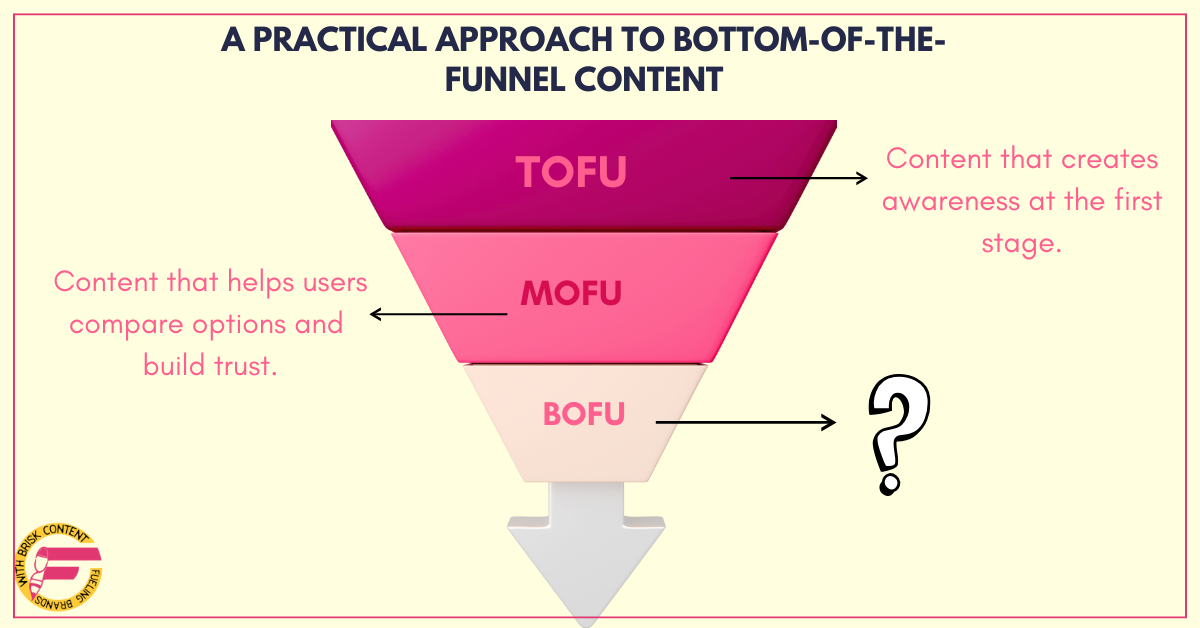
  • At the Top of the Funnel (ToFu), your goal is to grab people’s attention. This is where they first hear about your brand and realize they might have a problem. The content here is simple and broad, designed to educate or entertain, like blog posts or social media updates.
  • Moving to the Middle of the Funnel (MoFu), people know their problem and start looking for solutions. They compare options and want to know how your product or service can help. Content here dives deeper with guides, webinars, and case studies to build trust.
  • Finally, at the Bottom of the Funnel (BoFu), people are ready to buy. They need clear reasons to pick your product and proof that it works. BoFu content includes product demos, free trials, pricing details, and customer reviews to help them make the final decision.

Types of Bottom-of-the-Funnel Content That Converts

Here are some types of Bottom-of-the-Funnel content that really help you convert visitors into customers:

  1. Case Studies — These tell real stories about how your product helped someone solve a problem. They show proof that your product works and can give your visitors confidence to buy.
  2. Product Demos — Videos or tutorials that show your product in action. When people see how easy or useful something is, they feel more sure about choosing it.
  3. Customer Testimonials and Reviews — Hearing from happy customers builds trust. It’s like a friend recommending something—it makes your product feel more reliable.
  4. Comparison Posts — When people are deciding between options, comparison articles or pages help them see why your product is the best choice.
  5. Pricing Pages — Clear, simple info about costs and plans helps buyers decide quickly without confusion.
  6. Free Trials or Consultations — Letting people try your product or talk to you without risk gives them a nudge to commit.

How to Create Effective BOFU Content: Step-by-Step Guide

Here’s a simple step-by-step guide to help you create effective Bottom-of-the-Funnel (BoFu) content:

  1. Know who your ideal customer is and what will make them buy.
  2. Share real success stories that prove your product works.
  3. Show your product in action through demos or videos.
  4. Make it easy for people to compare your product with others.
  5. Clearly show pricing so buyers can decide what fits their budget.
  6. Offer free trials or consultations to reduce buyer risk.
  7. Use strong calls to action that tell visitors what to do next.
  8. Keep track of how your content performs and improve it regularly.

This simple approach will help you create BoFu content that converts visitors into customers.

Best Practices for BOFU Content Creation

  1. Focus on One Buyer at a Time
    Make your content for a specific type of buyer who is ready to make a decision. Use keywords that show they want to buy, not just browse.
  2. Be Clear and Direct
    Tell your readers exactly what to do next—like “Start Your Free Trial” or “Request a Demo.” Focus on your product and how it helps, but always keep it helpful.
  3. Build Trust
    Use real customer reviews, testimonials, and success stories to show others have had a good experience. Share awards or credentials that prove you’re reliable.
  4. Write Persuasive and Helpful Copy
    Explain how your product benefits the buyer, not just what it does. Create urgency by mentioning special deals or limited stock. Answer common doubts right away.
  5. Make It Easy to Find and Enjoy
    Use strong images and videos to keep people interested. Optimize your content in a way that it shows up in search engines when buyers look for last-minute info. Keep your content updated with fresh examples.

Measuring the Success of Your BOFU Content

Measuring the success of your Bottom-of-the-Funnel (BoFu) content means looking at how well it helps turn interested leads into paying customers. You want to focus on key signs like conversion rates — how many people sign up for free trials, request demos, or make purchases.

Also, check the ratio of leads turning into customers and the revenue your BoFu campaigns bring in. Other useful measures include tracking assisted conversions, spotting where people drop out of your sales funnel, and collecting direct feedback to see how your content influences the final buying decision. This way, you’ll know exactly how your content is performing and where to improve for better results.

Examples of Effective BOFU Content

Effective BoFu content includes comparison pages that help buyers see how your product stacks up against others, and case studies that share real success stories from customers. Product demos and testimonials build trust by showing your product in action and with happy users. Free trials let buyers test your product risk-free, while clear pricing pages make it easy for them to understand costs. Other great examples are personalized sales calls, webinars, and “best of” or “alternative” product lists that guide prospects in choosing the right fit.

Common Mistakes to Avoid in BOFU Content Creation

Avoid these common mistakes to make your Bottom-of-the-Funnel content clear, trustworthy, and effective at turning visitors into customers.

  1. Buyer confusion: Not clearly understanding who your buyer is and what they need.
  2. Weak messaging: Being unclear or hesitant in your sales approach.
  3. Missing CTAs: Not telling people what step to take next.
  4. No trust builders: Leaving out testimonials or proof that your product works.
  5. Too much info: Overwhelming buyers with unnecessary details.
  6. Poor SEO/user experience: Making it hard to find or use your content.
  7. Lack of teamwork: Not involving sales or product teams to cover buyer questions.

Conclusion

Bottom-of-the-Funnel (BoFu) content helps ready-to-buy customers confidently choose your product by providing clear proof, demos, and testimonials that remove final doubts. It’s about guiding buyers smoothly to “yes” with case studies, pricing clarity, and risk-free trials.
Ready to create high-converting BoFu content that closes sales? Content Fayah specializes in funnel-optimized content that turns prospects into customers. From case studies to demo videos, our experts craft BoFu strategies that deliver ROI. Get started today for content that converts.

1. What is Bottom-of-the-Funnel (BoFu) content?

BoFu content targets ready-to-buy prospects with case studies, demos, testimonials, pricing, and free trials. It builds trust and removes final doubts to convert visitors into customers.

2. How does BoFu content differ from ToFu and MoFu?

ToFu attracts and educates, MoFu nurtures with solutions, BoFu closes sales with proof like demos and testimonials. Each stage matches a different buyer intent for maximum conversion.

3. What are the best types of BoFu content?

Case studies, product demos, customer testimonials, comparison pages, clear pricing, and free trials work best. They provide social proof and reduce buyer risk effectively.

Categories
Content Marketing

GEO in 2026 – A Complete Guide for Beginners

In 2026, search is changing fast. With over 79% of users turning to AI tools like ChatGPT, Gemini, and Perplexity, businesses can’t rely only on old SEO methods. Gartner predicts that regular search traffic may drop by 25% as more people use AI for quick answers.
This is where Generative Engine Optimization (GEO) comes in. GEO helps your brand show up in AI-generated results, not just on Google. It focuses on clear, factual, and easy-to-understand content that AI tools can trust, cite, and share — keeping your brand visible in the new age of intelligent search.

What Is Generative Engine Optimization (GEO)?

Generative Engine Optimization (GEO) means improving your website content so it appears in results from AI-based search tools like ChatGPT, Perplexity, Gemini, Copilot, and Google AI Overviews.

GEO helps your brand show up when people use these tools to look for topics related to your products, services, or expertise.

As more people use AI to search, it’s important for your brand to show up in AI answers. This helps you reach the right customers and connect with them, wherever they start their search.

The main goal of GEO is to help more people discover your website, increase targeted visitors, and turn them into loyal followers who keep coming back.

Why GEO matters in 2026?

Generative Engine Optimization, or GEO, is becoming a big deal as AI-powered search keeps growing fast. The early buzz around AI is now turning into trust and stability, and these tools are getting smarter every day.

Search isn’t just about Google anymore. Bing’s AI, ChatGPT, Perplexity, and other platforms are stepping up and changing how people find information online.

What’s Happening to Organic Search?

AI is now reshaping how search works. Businesses can’t rely only on traditional SEO now — they need to think differently. Gartner predicts that by 2026, regular search traffic might drop by 25%, and organic visits could fall by over 50% as more people move to AI tools for answers.

Plus, 79% of users are expected to use AI search soon, and 70% already trust the results. To stay visible, brands must start using GEO — it’s the key to showing up in AI-driven results and keeping people’s attention.

How Search Behavior Is Changing?

People are now beginning their searches on AI platforms — whether they’re looking for facts, comparing products, or deciding what to buy.

ChatGPT already has more than 180 million monthly users, and Perplexity’s traffic jumped by 858% last year, with around 10 million active users. This shows that people want quick, accurate, and personalized answers.

When you optimize your content from these channels, your brand shows up wherever people search. GEO helps your brand stay visible and easy to find in AI answers.

How GEO and SEO Work Together?

GEO and SEO work hand in hand to improve your online presence. SEO will make sure your website ranks higher on search engines like Google and brings more visitors to your site. GEO, on the other hand, makes your content easy for AI tools to understand and include in their answers. When you use both together, your brand gets noticed in traditional search results and AI-generated responses, helping you reach more people in different ways.

GEO vs. SEO: What’s the Difference?

Let us understand how search engines and AI platforms handle their content differently. Here’s a quick comparison between SEO and GEO to show how each works and what they aim to achieve:

PointSEO (Search Engine Optimization)GEO (Generative Engine Optimization)
GoalGet higher rankings on Google or BingAppear in AI-generated answers like ChatGPT, Gemini, or Perplexity
How It WorksOptimizes web pages with keywords and backlinksAppear in AI-generated answers like ChatGPT, Gemini, or Perplexity
How It WorksOptimizes web pages with keywords and backlinksOptimizes content to be understood and cited by AI tools
Action of the user Users click your website’s linkUsers see your brand mentioned in AI responses
Main FocusKeywords, content quality, and backlinksStructured data, clear context, and reliable citations
Result Typelistings in search resultsQuick answers with your content included
MeasurementTrack rankings, traffic, and clicksTrack brand mentions and visibility in AI answers
Primary BenefitsGets a direct visit to the website Builds trust and awareness via AI exposure
Main PracticeUse proper SEO structure and stronger linksWrite clear, factual content optimized for AI learning

How is it revolutionizing digital marketing?

GEO is totally changing digital marketing. Earlier, brands focused on SEO and tried to rank high on Google or Bing. But now, people ask AI tools like ChatGPT, Perplexity, and Gemini for quick answers instead of browsing websites.

That’s where GEO comes in. It helps AI understand and trust your content so your brand shows up in those answers. When that happens, users discover your business instantly — even before visiting your site.

So today, marketing isn’t just about keywords or backlinks anymore. It’s about creating clear, helpful, and factual content that AI can easily read, cite, and recommend.

7 ways for businesses to begin with Generative AI Optimization

  1. Understand AI Search Behavior
    Explore how people use tools like ChatGPT, Perplexity, and Google AI Overviews. See what kind of answers show up and what tone or detail they prefer.
  1. Create Clear, Fact-Based Content
    Write simple, reliable, and well-structured content that answers real questions directly. AI tools value clarity, facts, and context.
  1. Use Structured Data
    Add schema markup and structured meta information. This helps AI engines easily identify your brand, products, and services.
  1. Build Strong Author Profiles
    A trustworthy author or brand identity increases the chances of your content being referenced by AI models. Add bios, credentials, and a transparent source.
  1. Focus on Context, Not Just Keywords
    GEO isn’t about stuffing keywords. It’s about giving AI content that truly makes sense. Use related terms and explain topics naturally.
  1. Track AI Mentions and Visibility
    Start observing where your brand appears in AI-generated answers. New analytics tools like Glimpse or BrightEdge can help.
  1. Combine GEO with SEO
    Don’t drop SEO — combine it with GEO. Optimize for web rankings while ensuring AI engines can read and recommend your content too.

The Future of GEO, SEO, and AI Search

As we move into 2026 and beyond, GEO will become a key part of every marketing strategy. SEO isn’t going away, but it’s expanding. Search optimization will now happen in two spaces: traditional search engines and generative AI platforms. Brands that adapt early will gain more visibility, stronger trust, and closer customer connections. The lines between “search” and “conversation” will blur, and content that’s helpful, human, and data-backed will succeed.

Ready to future-proof your brand for AI search dominance? Content Fayah specializes in GEO + SEO strategies that get your brand cited by ChatGPT, Perplexity, and Gemini. Get started today for visibility that scales across all search platforms.

1. What is Generative Engine Optimization (GEO)?

GEO optimizes content to appear in AI-generated answers from ChatGPT, Perplexity, and Gemini. Unlike SEO for Google rankings, GEO focuses on structured, factual content that AI tools cite directly.

2.  How does GEO differ from traditional SEO?

SEO targets Google/Bing rankings with keywords and backlinks. GEO makes content AI-readable for instant answers. Use both: SEO drives clicks, GEO builds instant brand awareness.

3. Why is GEO important for businesses in 2026?

With 79% of users shifting to AI search and organic traffic dropping 25%, GEO ensures your brand stays visible. Early adopters gain trust and authority across AI platforms.

Categories
Content Marketing

What Is a Content Calendar? How To Plan Your Content

In 2025, more than 60% of marketers create new content every day, helping businesses grow their audiences and leads. Email marketing paired with smart scheduling tools can generate $44 for every $1 spent, showing how important planning is for success. The marketing calendar software market will grow from $15 billion this year to over $28 billion by 2034, proving that more companies rely on smart content calendars every day. 
With billions of users using social media, planning posts with a content calendar saves time, avoids mistakes, and lets brands post consistently to keep their audience engaged and growing. In this blog, we will cover what a content calendar is, why it matters, and how you can plan content step by step for better results.

What Is a Content Calendar?

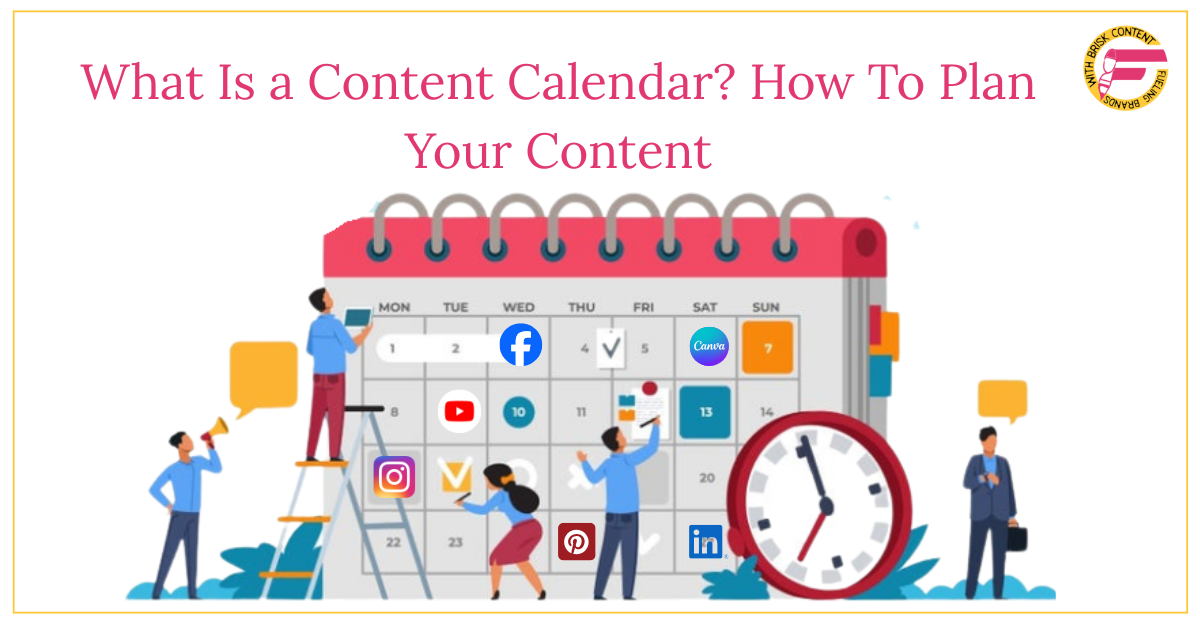
A content calendar is a simple plan that shows when and where you will share your content. It helps you organize everything: blogs, social posts, videos, and emails in one place. With a content calendar, you will not have to rush at the last moment or miss important dates. It keeps your schedule clear and helps you know what to work on next.

Why Every Brand Needs a Content Calendar?

Every brand, big or small, can benefit from a content calendar. It helps you stay organized and make sure you don’t forget important posts. When you post regularly, your audience begins to trust and expect your content. A calendar also helps your team work well together because everyone knows what to do and when. Plus, you can see which posts work best and improve your planning over time.

Components of an Effective Content Calendar

A good content calendar has a few main parts. This shows the sort of content, like a blog, social media post, email, or video. It also has the date and time to post. It also shows who will create or post the content. The calendar notes the channel where the content will occur. It shows the status, like writing, ready, or published. You can add notes about your goals, keywords, or your target audience. Use simple tools like Google Sheets or other software to keep everything clear and easy to find.

How To Plan Your Content Step-by-Step

Planning your content calendar is easy if you follow these steps:

  1. Set your goals: Know what you want, more website visitors, sales, or followers.
  2. Know your audience: Understand who you want to reach and what they like.
  3. Brainstorm topics: Write ideas that match your goals and the audience’s interests.
  4. Choose channels: Decide where you will post: blogs, Instagram, Facebook, and emails.
  5. Make a schedule: Spread your content over days or weeks with different types of posts.
  6. Assign tasks: Give each post to a person or do it yourself.
  7. Fill your calendar: Enter all details in a planner or tool.
  8. Use schedule features: Automate posts to save time.
  9. Review and adapt: Check your calendar often and make changes when needed.

Choosing the Right Content Calendar Tools

Using the right tools will make your content planning simple. Here are good options for 2025:

  • Google Sheets or Calendar: Easy and good for beginners.
  • Trello or Asana: Great for teams to share and manage tasks.
  • WordPress: Best if blogging is your main focus.
  • CoSchedule or Monday.com: Strong apps for scheduling, reminders, and teamwork.

Tips for Keeping Your Calendar Consistent & Flexible

Here are tips to keep your calendar working well:

  • Make content in groups to stay ahead.
  • Leave days open for trending or urgent posts.
  • Check your calendar every week to stay on track.
  • Use reminders for deadlines.
  • Have backup team members in case someone is busy.
  • Mark special days like holidays and product launches.

Common Mistakes To Avoid When Planning Content

When you plan content, try to avoid some common mistakes. Always keep your calendar updated and don’t miss your deadlines. Make sure your content matches your goals so your work stays focused. Ask your team for ideas to get better topics. Check how your posts are doing to know what works best. Use a calendar tool to stay organised. Avoiding these mistakes will make your plan smooth, successful and on time.

Example of a Content Calendar

Here is a simple example of a monthly calendar:

DatePlatformContent TypeTopicStatusOwner
Nov 4BlogArticleStep-by-step guideDraftAlex
Nov 6InstagramSocial PostBehind-the-scenesReadyJamie
Nov 8FacebookVideoProduct launchEditingPriya
Nov 12NewsletterEmailMonthly highlightsScheduledTeam Lead

One Last Thing

A content calendar helps you work with more control and less stress. It gives you time to create better content instead of rushing at the last minute. When your team uses a calendar, everyone knows what to do and when to do it, which makes teamwork easier. 

A clear plan like this keeps your messages steady, so your audience trusts you more. It also helps you spot what works well and where you can improve. Using a content calendar isn’t just about planning; it’s about making your work smarter and your marketing stronger each and every day. If you want help building a clear, results-driven content calendar, Content Fayah can help you plan, create, and manage content that stays consistent and delivers real impact.

1. How often should I update my content calendar?

 You should review your calendar weekly and update it whenever priorities, trends, or goals change.

2. Can a content calendar work for small businesses?

Yes. Even small businesses benefit from content calendars because they save time, reduce stress, and improve consistency.

3. Do I need paid tools to manage a content calendar?

No. Free tools like Google Sheets or Calendar work well. Paid tools are helpful for larger teams or frequent posting.

.

Categories
Content Marketing

Content Pillar Examples To Boost Your Brand on Social Media

If you find it hard to keep your social media content fresh and on track, content pillars can help. Consider them as the main concepts or themes that help shape everything you post. This will help you stay consistent and connected with your audience. With clear pillars, your content feels purposeful, your brand voice shines, and planning becomes a breeze. 

Whether it’s educating your followers, inspiring them, showcasing behind-the-scenes moments, or gently promoting your products, content pillars keep your strategy strong and engaging. In this blog, we’ll explore what content pillars are, why they matter, and how to use them to boost your brand’s presence online.

What Are Content Pillars and Why Do They Matter?

Content pillars are the main topics or themes your brand focuses on across its social media channels. Think of them as your brand’s core ideas or “content buckets.” Every post you create should fit into one of these pillars. This makes your content fresh, aligned with your brand, and easier to plan. Whether you’re posting on Instagram, LinkedIn, or Facebook, these pillars ensure your messages stay consistent and relevant.

Why do they matter? When you have strong content pillars, you don’t have to scramble for ideas every day. They also help you build trust with your audience by consistently delivering value on topics your audience cares about. Plus, strong content pillars boost your brand’s authority and visibility with both your followers and search engines.

How Educational Content Builds Trust and Value

Educational content is one of the best ways to build trust and add real value to your brand. When you share useful tips, how-to guides, and interesting facts about your niche, you don’t just sell; you become a trusted expert that people want to listen to. This shows your audience you care about their needs and want to help solve their problems.

Key benefits of educational content:

  • Builds your brand’s credibility
  • Helps followers feel confident in choosing you
  • Creates long-lasting loyalty
  • Use easy, straightforward language and real examples
  • Differentiates your brand and helps it stand out from competitors. Discover the best SEO content writing software to create high-performing posts quickly.

How to Inspire Your Audience with Motivational Posts

Here’s how you can inspire your audience with motivational posts:

  • Share Positive Quotes: Use optimistic quotes that resonate with your brand and the targeted audience.
  • Tell Success Stories: Showcase moving stories of success, whether they come from customers, workers, or the journey of your brand.
  • Create Actionable Challenges: Encourage followers to join simple challenges that motivate progress or positivity.
  • Use Visuals: Pair messages with eye-catching images or videos to make them more impactful.
  • Celebrate Small Wins: Share weekly or monthly wins to keep the energy positive and encouraging.
  • Express Gratitude: Show appreciation for your community to build stronger emotional connections.
  • Ask Questions: Prompt your audience to share what inspires or motivates them to foster engagement and conversation.

Tips for Promoting Your Products Without Overwhelming Followers

Here’s a simple step-by-step guide on how to promote your products without overwhelming your followers:

Step 1: Start by mixing your posts. Don’t just share product promos. To keep your feed interesting, add fun stories, useful tips, or other useful material.

Step 2: Focus on showing how your product helps solve problems or makes life easier for your audience. Talk more about benefits than just features.

Step 3: Tell stories about your product in action. Share customer experiences, behind-the-scenes looks, or how your product is made to build a connection.

Step 4: Use clear, friendly calls to action. Invite followers gently with phrases like “Check this out” or “Try it today.”

Step 5: Avoid posting too many product promotions in a row. Give your audience some breaks to keep things fresh.

Step 6: Offer exclusive deals or early access to your followers to keep them excited about your products.

Step 7: Engage with your audience. Reply to comments and questions quickly to build trust and show you care.

Strategies to Grow Your Community with Engaging Content

These are some important strategies that can help you grow your community with engaging content:

  1. Understand your audience deeply to create content that truly interests and helps them.
  2. Share valuable, fun, and relatable content consistently to keep followers coming back.
  3. Use interactive posts like polls, questions, and live videos to encourage participation.
  4. Share behind-the-scenes looks to show that your brand has a real side. and spotlighting community members.
  5. Host contests, challenges, or giveaways to motivate active engagement and excitement.
  6. Answer comments and texts quickly and personally to build trust and keep conversations going.
  7. Collaborate with social media influencers or like-minded brands to reach a wider, relevant audience.

How to Find Content Pillars That Fit Your Brand

To find the right content pillars, you have to start by understanding your brand task, values, and your audience’s interests. Ask yourself these questions:

  • What expertise or value can my brand offer?
  • What topics do my followers engage with the most?
  • What goals do I want to achieve? (e.g., awareness, sales, engagement)

Look at your past posts to see what worked well. Combine this insight with your brand personality to pick 3 to 5 pillars that feel authentic and offer variety, but keep your messaging consistent.

How to Track and Improve Your Content Pillars’ Impact

Once you start posting based on your content pillars, it’s important to track which post types get the most likes, comments, shares, and clicks. Use your social media platform insights or tools like Google Analytics to monitor performance.

Keep an eye on what your audience likes most, and change your pillars over time to focus more on those themes. This data-driven approach helps you grow your brand and get better results with less guesswork.

Conclusion

Content pillars are a powerful tool to bring focus and consistency to your social media presence. They help your brand deliver clear, valuable messages while saving time on content planning. With well-chosen pillars, each post serves a purpose, whether educating, inspiring, connecting, or promoting,g making your brand more recognizable and trustworthy.

By tracking how your pillars perform, you can improve your approach over time. This data-driven method strengthens your social media without guesswork. Embrace content pillars to create meaningful, consistent content that connects with your audience and drives business goals like growth and engagement.

If you’re ready to build a high-impact strategy that delivers real results, Content Fayah can help. Our expert team specializes in data-backed content marketing that boosts visibility, builds authority, and fuels growth. Get started today for tailored content that works.

How many content pillars do I need?

Start with 3–5 key pillars. This keeps your social media content organized, consistent, and relevant while giving you enough variety to engage different audience interests.

How often should I post under each pillar?

Maintain balance by rotating your pillars weekly. This ensures your feed stays diverse, engaging, and aligned with your brand’s goals without overwhelming your audience.

Can I change my content pillars later?

Yes, review them every few months. As your brand grows or your audience’s needs shift, adjust your pillars to reflect new goals and improve overall engagement.