Categories
Uncategorized

How to Create a Powerful Brand Voice for Your Business

You can have a great product, a sleek logo, and a clever tagline and still lose a customer to a competitor. When it is hard to find out why a customer chooses a similar product from a different brand despite competitive marketing and pricing, in most cases, that’s a powerful brand voice at work.

This article explores the secret of creating a powerful brand voice for your business that drives sales and builds long-lasting loyalty.

What Is a Brand Voice?

Brand voice is the deliberate effort to make a company feel like a person with a point of view, a set of values, and a distinct way of communicating.

Brand personality is built from human traits such as health-conscious, adventurous, carefree, humorous, caring, luxurious or rebellious. These traits are chosen to mirror the personality of the customer the brand wants to attract.

Think about Thums Up versus Limca. Both are cola-category beverages, both owned by the same parent company, yet they speak to completely different people. Thums Up advertising is all adrenaline aimed at people who see themselves as bold risk-takers. Limca, on the other hand, is calm and easy. Two brand voices, two entirely different emotional vibes. That is the power of a well-defined brand voice.

People do not connect with products. Instead, they connect, trust, and stay loyal to the brand’s voice or personality.

Comparing brand voices of thums up and Limca targetting different consumer behavioral traits

How Brand Voice Helps Drive Sales and Customer Loyalty

Most brand-voice articles discuss how to differentiate the brand through its voice. But the one question that actually matters in business is, does it drive sales?

The answer is yes, but not in the way discounts or special offers do. Brand voice works on a slower, deeper level to make an emotional connection that heavily influences the buying decision.

Studies show consistent brand voice can increase revenue by 23% to 33%, and many companies report double-digit revenue gains after improving consistency.

When two products are virtually identical in quality and price, the customer will choose the brand they feel emotionally aligned with. A well-executed brand voice makes the customer feel, “This brand reflects my values and my attitude towards the world.”

Amul has built one of India’s most loved brand voices through its iconic ‘Amul Girl’. It’s ads on billboards and in newspapers that are witty, warm, and Indian. That voice has kept Amul relevant across generations and built trust that is hard to compete with.

When you have made space in a customer’s heart by connecting emotionally, competitors find it very difficult to steal that customer on price alone. Consistency in voice, paired with consistency in quality, builds trust that is hard to compete with.

Spreading Awareness with Lightheartedness for decades - Amul is a masterclass in brand voice consistency

5 Actionable Steps to Create a Brand Voice

So let’s answer the big question: how do we actually build a brand voice that will bind customers to your brand forever?

1. Define Your Core Brand Personality Traits

Start by choosing three to five human personality traits that your brand will embody. Ask yourself: if my brand walked into a room, how would it speak, dress, and treat people? For instance, “Professional” is too vague; instead,  “Warmly authoritative, like a trusted family doctor” is a brand voice. 

2. Understand Your Audience Deeply

Your brand voice must mirror your ideal customer’s values and self-image. Perform an intense research on who they are, not just demographically, but psychologically. Find out what their values are. What kind of humor do they like? And what are their pain points?

Dove’s “Real Beauty” campaign succeeded globally because it spoke directly to the insecurities and aspirations of real women. The voice was empathetic yet honest and bold. Most importantly, it reflected what the modern woman (their target audience) believed and felt.

Real Beauty campaign by Dove target consumer pain points around beauty standards and self-acceptance

3. Choose Your Spokesperson Strategically

One of the fastest ways to build a brand voice is to attach it to a human personality that already represents it. When Lux roped in Kareena Kapoor, it was not just because of her fame; it was tapping her aura of glamour, confidence, and luxury and transferring it onto the brand. Her fans and admirers naturally began associating those qualities with Lux. There is a vast difference between merely endorsing a brand and becoming an inseparable part of it, as Kohli and Dhoni are for RCB and CSK.

4. Let Your Voice Live in Your Events and Actions

Ask yourself what events, causes, or communities your brand should be visibly part of. Make your visibility felt in places and events your target audience attends. 

You can go one step further by hosting events entirely of your own. For instance, Nykaa’s Women of Worth initiatives celebrate women entrepreneurs in the beauty and wellness space. For Nykaa, a brand founded by a woman and built largely on women’s ambitions, these events are proof of its brand voice: women supporting women

5. Document Your Brand Voice

Create a Brand Voice Guide for your brand. This guide should be a clear document that includes your brand’s personality traits, explanations, tone across different situations (social media, customer service, advertising), the types of words to use and those to avoid, and real examples of your voice done right. This document should be mandatory reading for every new writer, designer, and marketer who joins your team.

How to Maintain a Consistent Brand Voice

Consistency is as important as building a brand voice, because only when you are consistent will you be able to make a place in customers’ hearts and minds. Here is a framework to follow to keep your brand voice consistent:

Audit brand messaging regularly: Every quarter, review your content across all channels, such as social media, packaging, ads and emails and ask whether it all sounds like the same brand. Inconsistency hurts the impact of the brand voice.

Train your team, not just your agency: Your customer service executive and your social media intern both represent your brand voice. Invest in training teams thoroughly across all sectors.  Briefing just your ad agency once a year is not enough.

Evolve without abandoning: A brand voice should remain consistent but can mature over time. Cadbury Dairy Milk India advertisement created by Late Piyush Pandey is a masterclass in deliberate voice evolution. It began its campaign as a children’s brand, which was sweet, innocent and celebratory. Then came the iconic 1990s “Real Taste of Life” drive with a girl dancing on a cricket field. This heartwarming ad deliberately shifted the voice toward carefree, spontaneous joy for young adults. Over the next two decades, it deepened further into warmth and togetherness with “Kuch Meetha Ho Jaaye,” positioning chocolate as the way to celebrate happy moments. Each evolution expanded the target audience without abandoning the emotional core: ‘celebration through sweetness’.

Listen to your customers. Your audience will tell you when your voice rings true and when it feels fake. Customer feedback in the form of reviews, comments, and direct conversations is the most honest brand audit you will ever get. The brands that last are the ones that keep listening and evolving.

Conclusion

Building a powerful brand voice with a lasting impact is about deciding, with clarity and conviction, who your brand is and then living that identity out loud, consistently, across every touchpoint. The brands that do this well do not just attract customers; they build loyalty, which is the most sought-after competitive advantage in business.

You do not need a massive budget to build a powerful brand voice. You just need clarity and courage to show up the same way every single time — on every platform, in every post, and through every customer interaction.

Maintaining an effective brand voice is all about being in control of what it says and saying it consistently enough to be remembered. 

FAQ’s

Q1. How long does it take to build a recognizable brand voice?

There is no fixed timeline, but most brands begin to see recognizable traction between 12 and 18 months of consistent, deliberate effort across all touchpoints.

Q2. Can a small business or startup have a brand voice, or is it only for big brands?

Brand voice is arguably more important for small businesses than large ones. A startup cannot compete on advertising budgets, but it absolutely can compete on personality, warmth, and relatability. In fact, many small Indian D2C brands like Boat and Mamaearth built fierce customer loyalty through a clearly defined brand voice long before they had the budgets to match larger competitors.

Q3. What is the distinction between brand voice and brand tone? 

Brand voice is your brand’s consistent personality, which does not change. Brand tone is how that personality adapts to different situations. For example, Amul’s brand voice is always witty and warm, but its tone on a lighthearted topical billboard is playful. In contrast, its tone in response to more serious political issues would be warmer and more empathetic. 

Found this useful? Share it with a fellow founder or marketer who is still figuring out their brand voice. And if you want to go deeper, explore our other articles on brand strategy and content marketing.
Read More Articles
Categories
Uncategorized

What is Bottom-of-the-Funnel Content and How to Create it?

Starting your journey to boost sales means focusing on what really works when buyers are ready to commit. Bottom-of-the-Funnel (BoFu) content does exactly that—it gives your prospects the confidence and proof they need to choose your product over others. 

Companies like Reloadly have increased sales by giving buyers clear product demos, interesting case studies, and simple price pages that stick in their minds. Another smart tactic is showing customer testimonials or hosting webinars to address last-minute questions. This kind of content doesn’t just inform; it helps buyers see real value and removes doubts, pushing them to take action confidently.

What Is Bottom-of-the-Funnel Content?

Bottom of the Funnel (BoFu) is the final stage in the buyer’s journey where potential customers are ready to make a purchase decision. At this point, they have already researched their options, compared different brands or products, and are now deciding which one to choose.

BoFu content and marketing concentrate on helping these prospects take the last step to become paying customers by giving information that builds trust and shows clear value, such as demos, consultations, case studies, or customer testimonials. Essentially, it’s about turning interested leads into buyers by answering their final questions and making the buying process easy and convincing.

Why Is Bottom-of-the-Funnel Content Important?

Bottom-of-the-Funnel (BoFu) content is important because it targets people who are ready to buy, helping you turn visits into real sales and grow your business faster.

1. Different Content, Different Buyer Intent

  • BoFu content targets buyers who are ready to make a purchase decision.
  • Unlike general content that attracts curious visitors, BoFu content helps people who are comparing options and are serious about buying.

2. Quality Over Quantity

  • BoFu content may get less traffic, but it attracts high-quality visitors with clear buying intent.
  • It focuses on converting these visitors into customers, which is more valuable than just increasing overall pageviews.

3. Higher Conversion Rates

  • BoFu content converts at much higher rates — up to 10 times more than top-of-the-funnel content.
  • This means more of your website visitors become paying customers.

4. Bigger and More Valuable Deals

  • Sales coming from BoFu content tend to be larger and more profitable.
  • For example, comparison posts (a common BoFu content type) often bring in not just more customers but also bigger deals.

5. Focus on Business Results

  • Investing in BoFu content first helps you get real business results much faster.
  • It ensures you’re creating content that actually drives sales and revenue, rather than just traffic.

6. Boosts Confidence and Removes Doubts

  • BoFu content answers final questions, provides proof like case studies or demos, and helps buyers feel confident in their decision.

Differences Between Top, Middle, and Bottom-of-the-Funnel Content

Let’s understand the difference between the three stages of the content marketing funnel:

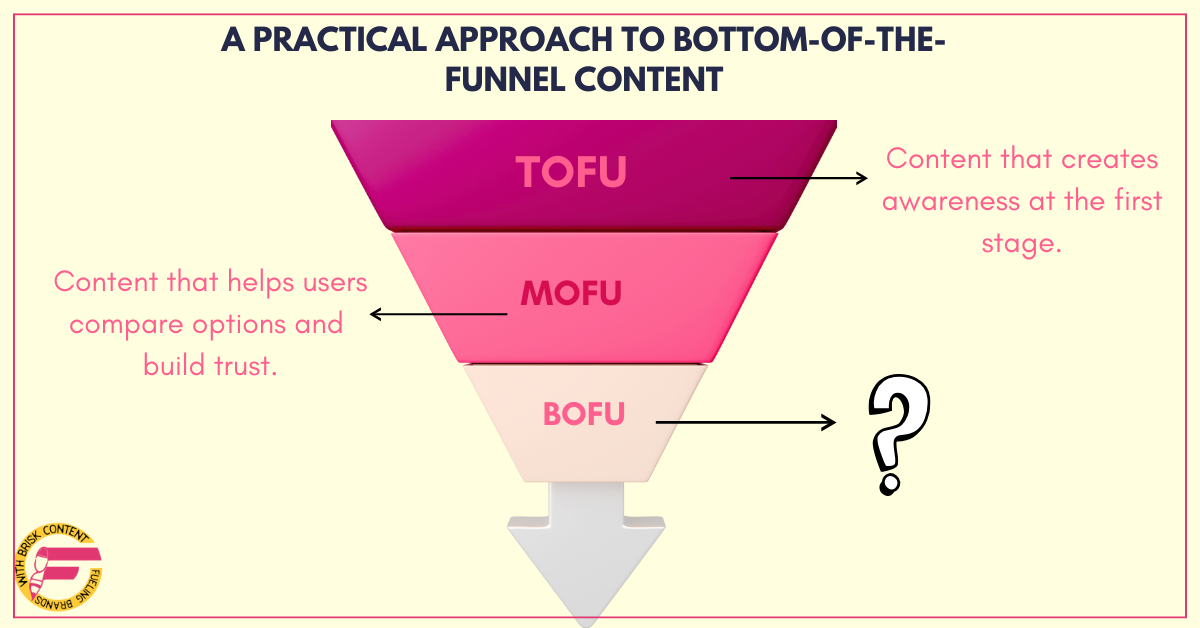
  • At the Top of the Funnel (ToFu), your goal is to grab people’s attention. This is where they first hear about your brand and realize they might have a problem. The content here is simple and broad, designed to educate or entertain, like blog posts or social media updates.
  • Moving to the Middle of the Funnel (MoFu), people know their problem and start looking for solutions. They compare options and want to know how your product or service can help. Content here dives deeper with guides, webinars, and case studies to build trust.
  • Finally, at the Bottom of the Funnel (BoFu), people are ready to buy. They need clear reasons to pick your product and proof that it works. BoFu content includes product demos, free trials, pricing details, and customer reviews to help them make the final decision.

Types of Bottom-of-the-Funnel Content That Converts

Here are some types of Bottom-of-the-Funnel content that really help you convert visitors into customers:

  1. Case Studies — These tell real stories about how your product helped someone solve a problem. They show proof that your product works and can give your visitors confidence to buy.
  2. Product Demos — Videos or tutorials that show your product in action. When people see how easy or useful something is, they feel more sure about choosing it.
  3. Customer Testimonials and Reviews — Hearing from happy customers builds trust. It’s like a friend recommending something—it makes your product feel more reliable.
  4. Comparison Posts — When people are deciding between options, comparison articles or pages help them see why your product is the best choice.
  5. Pricing Pages — Clear, simple info about costs and plans helps buyers decide quickly without confusion.
  6. Free Trials or Consultations — Letting people try your product or talk to you without risk gives them a nudge to commit.

How to Create Effective BOFU Content: Step-by-Step Guide

Here’s a simple step-by-step guide to help you create effective Bottom-of-the-Funnel (BoFu) content:

  1. Know who your ideal customer is and what will make them buy.
  2. Share real success stories that prove your product works.
  3. Show your product in action through demos or videos.
  4. Make it easy for people to compare your product with others.
  5. Clearly show pricing so buyers can decide what fits their budget.
  6. Offer free trials or consultations to reduce buyer risk.
  7. Use strong calls to action that tell visitors what to do next.
  8. Keep track of how your content performs and improve it regularly.

This simple approach will help you create BoFu content that converts visitors into customers.

Best Practices for BOFU Content Creation

  1. Focus on One Buyer at a Time
    Make your content for a specific type of buyer who is ready to make a decision. Use keywords that show they want to buy, not just browse.
  2. Be Clear and Direct
    Tell your readers exactly what to do next—like “Start Your Free Trial” or “Request a Demo.” Focus on your product and how it helps, but always keep it helpful.
  3. Build Trust
    Use real customer reviews, testimonials, and success stories to show others have had a good experience. Share awards or credentials that prove you’re reliable.
  4. Write Persuasive and Helpful Copy
    Explain how your product benefits the buyer, not just what it does. Create urgency by mentioning special deals or limited stock. Answer common doubts right away.
  5. Make It Easy to Find and Enjoy
    Use strong images and videos to keep people interested. Optimize your content in a way that it shows up in search engines when buyers look for last-minute info. Keep your content updated with fresh examples.

Measuring the Success of Your BOFU Content

Measuring the success of your Bottom-of-the-Funnel (BoFu) content means looking at how well it helps turn interested leads into paying customers. You want to focus on key signs like conversion rates — how many people sign up for free trials, request demos, or make purchases.

Also, check the ratio of leads turning into customers and the revenue your BoFu campaigns bring in. Other useful measures include tracking assisted conversions, spotting where people drop out of your sales funnel, and collecting direct feedback to see how your content influences the final buying decision. This way, you’ll know exactly how your content is performing and where to improve for better results.

Examples of Effective BOFU Content

Effective BoFu content includes comparison pages that help buyers see how your product stacks up against others, and case studies that share real success stories from customers. Product demos and testimonials build trust by showing your product in action and with happy users. Free trials let buyers test your product risk-free, while clear pricing pages make it easy for them to understand costs. Other great examples are personalized sales calls, webinars, and “best of” or “alternative” product lists that guide prospects in choosing the right fit.

Common Mistakes to Avoid in BOFU Content Creation

Avoid these common mistakes to make your Bottom-of-the-Funnel content clear, trustworthy, and effective at turning visitors into customers.

  1. Buyer confusion: Not clearly understanding who your buyer is and what they need.
  2. Weak messaging: Being unclear or hesitant in your sales approach.
  3. Missing CTAs: Not telling people what step to take next.
  4. No trust builders: Leaving out testimonials or proof that your product works.
  5. Too much info: Overwhelming buyers with unnecessary details.
  6. Poor SEO/user experience: Making it hard to find or use your content.
  7. Lack of teamwork: Not involving sales or product teams to cover buyer questions.

Conclusion

Bottom-of-the-Funnel (BoFu) content helps ready-to-buy customers confidently choose your product by providing clear proof, demos, and testimonials that remove final doubts. It’s about guiding buyers smoothly to “yes” with case studies, pricing clarity, and risk-free trials.
Ready to create high-converting BoFu content that closes sales? Content Fayah specializes in funnel-optimized content that turns prospects into customers. From case studies to demo videos, our experts craft BoFu strategies that deliver ROI. Get started today for content that converts.

1. What is Bottom-of-the-Funnel (BoFu) content?

BoFu content targets ready-to-buy prospects with case studies, demos, testimonials, pricing, and free trials. It builds trust and removes final doubts to convert visitors into customers.

2. How does BoFu content differ from ToFu and MoFu?

ToFu attracts and educates, MoFu nurtures with solutions, BoFu closes sales with proof like demos and testimonials. Each stage matches a different buyer intent for maximum conversion.

3. What are the best types of BoFu content?

Case studies, product demos, customer testimonials, comparison pages, clear pricing, and free trials work best. They provide social proof and reduce buyer risk effectively.

Categories
Uncategorized

Is Ai Generated Content Good for SEO?

Are you tired of spending countless hours creating content for your website or business, only to see little improvement in your search engine rankings? If so, you may have heard about the potential benefits of using AI-generated content to boost your SEO.

But before you jump on the bandwagon, it’s important to consider the potential drawbacks and limitations of relying solely on automated content creation tools. While AI-generated content can certainly help streamline the content creation process, it may not always produce the same level of quality and authenticity as human-written content.

In this article, we’ll explore the pros and cons of using AI-generated content for SEO, and provide insights into how to strike the right balance between automated content creation and the human touch. So, whether you’re a small business owner or a seasoned SEO professional, read on to discover the truth about AI-generated content and its impact on your search engine rankings.

The world of SEO is constantly evolving, and with the rise of AI-powered technologies, automated content creation has become a popular trend. Here, we’ll explore the benefits and drawbacks of AI-generated content for SEO and provide tips on how to incorporate it into your content strategy.

AI content SEO

Benefits of AI-generated content for SEO

One of the primary benefits of AI-generated content is its ability to produce large quantities of content quickly. This can be particularly useful for websites or businesses with a high volume of content needs, such as e-commerce sites or news outlets. Additionally, AI-generated content can help reduce costs and improve efficiency, freeing up time and resources for other important tasks.

Another advantage of AI-generated content is its potential to increase search engine rankings. By using target keywords and optimizing content for SEO, AI-generated content can help boost website traffic and visibility. However, it’s important to note that search engines prioritize quality and relevance over quantity, so it’s essential to strike the right balance between quantity and quality.

Limitations of AI-generated content for SEO

Despite the potential benefits of AI-generated content, there are also limitations to consider. One major drawback is the potential lack of authenticity and personality in the content. While AI algorithms can produce grammatically correct and coherent content, they may not be able to convey the same level of emotion or connection as human-written content. This can lead to a lack of engagement from readers and ultimately harm your SEO efforts.

Avoiding plagiarism and duplicate content

Another limitation of AI-generated content is the risk of plagiarism or duplicate content. AI algorithms may scrape content from other sources and repackage it, which can lead to penalties from search engines and damage your website’s credibility. To avoid this, it’s important to use AI-generated content as a starting point and then edit and refine it with a human touch to ensure its uniqueness.

Incorporating AI-generated content into your content strategy

To reap the benefits of AI-generated content without sacrificing authenticity and engagement, it’s important to incorporate human touch into your content strategy. One way to do this is by using AI-generated content as a starting point and then editing and refining it with a human touch. This allows you to take advantage of the efficiency and convenience of AI-generated content while still ensuring that your content is unique and engaging.

Using AI-generated content for repetitive tasks

Another way to incorporate AI-generated content into your strategy is by using it for repetitive or low-value content, such as product descriptions or social media posts. This frees up time for human writers to focus on higher-value content, such as blog posts or thought leadership pieces.

Does AI-generated Content rank on Search Engines?

Yes, but it’s crucial to optimize the content for SEO and user experience. Search engines prioritize relevance and quality, so striking the right balance between AI-generated content and human touch is important.

To ensure that AI-generated content ranks on search engines, use target keywords, make the content informative and unique, optimize for user experience, and engage with your target audience. However, it’s important to avoid plagiarism and ensure authenticity to maintain credibility.

AI-generated content can rank on search engines if optimized properly. By using AI-generated content and human touch together, you can improve search engine rankings and drive traffic to your website.

Here are some tips for using AI content tools to produce high-quality and engaging content:

  • Choose the right tool for your needs. Some of the best AI content tools in the market include GPT-3, ContentBot, Copy.ai, and Wordsmith.
  • Understand the capabilities and limitations of each tool. While they can generate content quickly and efficiently, it’s important to ensure that the content is authentic, relevant, and engaging.
  • Use the tool to generate ideas and inspiration. AI-generated content can help generate new ideas and perspectives that you may not have considered before.
  • Incorporate human touch and editing. Editing the content generated by AI tools can help ensure that it’s unique, relevant, and resonates with your audience.
  • Use the tool to enhance, not replace, human creativity. While AI-generated content can be useful, it’s important to remember that human creativity and expertise are still essential for producing high-quality content.

AI content tools can be powerful resources for content creation, but it’s important to use them wisely and incorporate the human touch. By understanding their capabilities and limitations, and using them alongside human creativity and editing, you can produce high-quality and engaging content that resonates with your audience.

In Conclusion

AI-generated content can be a powerful tool for improving SEO, but it’s important to understand its limitations and find ways to incorporate the human touch into your content strategy. By striking the right balance between efficiency and authenticity, you can harness the power of AI-generated content to boost your search engine rankings and drive traffic to your website.