Categories
Uncategorized

How to Create a Powerful Brand Voice for Your Business

You can have a great product, a sleek logo, and a clever tagline and still lose a customer to a competitor. When it is hard to find out why a customer chooses a similar product from a different brand despite competitive marketing and pricing, in most cases, that’s a powerful brand voice at work.

This article explores the secret of creating a powerful brand voice for your business that drives sales and builds long-lasting loyalty.

What Is a Brand Voice?

Brand voice is the deliberate effort to make a company feel like a person with a point of view, a set of values, and a distinct way of communicating.

Brand personality is built from human traits such as health-conscious, adventurous, carefree, humorous, caring, luxurious or rebellious. These traits are chosen to mirror the personality of the customer the brand wants to attract.

Think about Thums Up versus Limca. Both are cola-category beverages, both owned by the same parent company, yet they speak to completely different people. Thums Up advertising is all adrenaline aimed at people who see themselves as bold risk-takers. Limca, on the other hand, is calm and easy. Two brand voices, two entirely different emotional vibes. That is the power of a well-defined brand voice.

People do not connect with products. Instead, they connect, trust, and stay loyal to the brand’s voice or personality.

Comparing brand voices of thums up and Limca targetting different consumer behavioral traits

How Brand Voice Helps Drive Sales and Customer Loyalty

Most brand-voice articles discuss how to differentiate the brand through its voice. But the one question that actually matters in business is, does it drive sales?

The answer is yes, but not in the way discounts or special offers do. Brand voice works on a slower, deeper level to make an emotional connection that heavily influences the buying decision.

Studies show consistent brand voice can increase revenue by 23% to 33%, and many companies report double-digit revenue gains after improving consistency.

When two products are virtually identical in quality and price, the customer will choose the brand they feel emotionally aligned with. A well-executed brand voice makes the customer feel, “This brand reflects my values and my attitude towards the world.”

Amul has built one of India’s most loved brand voices through its iconic ‘Amul Girl’. It’s ads on billboards and in newspapers that are witty, warm, and Indian. That voice has kept Amul relevant across generations and built trust that is hard to compete with.

When you have made space in a customer’s heart by connecting emotionally, competitors find it very difficult to steal that customer on price alone. Consistency in voice, paired with consistency in quality, builds trust that is hard to compete with.

Spreading Awareness with Lightheartedness for decades - Amul is a masterclass in brand voice consistency

5 Actionable Steps to Create a Brand Voice

So let’s answer the big question: how do we actually build a brand voice that will bind customers to your brand forever?

1. Define Your Core Brand Personality Traits

Start by choosing three to five human personality traits that your brand will embody. Ask yourself: if my brand walked into a room, how would it speak, dress, and treat people? For instance, “Professional” is too vague; instead,  “Warmly authoritative, like a trusted family doctor” is a brand voice. 

2. Understand Your Audience Deeply

Your brand voice must mirror your ideal customer’s values and self-image. Perform an intense research on who they are, not just demographically, but psychologically. Find out what their values are. What kind of humor do they like? And what are their pain points?

Dove’s “Real Beauty” campaign succeeded globally because it spoke directly to the insecurities and aspirations of real women. The voice was empathetic yet honest and bold. Most importantly, it reflected what the modern woman (their target audience) believed and felt.
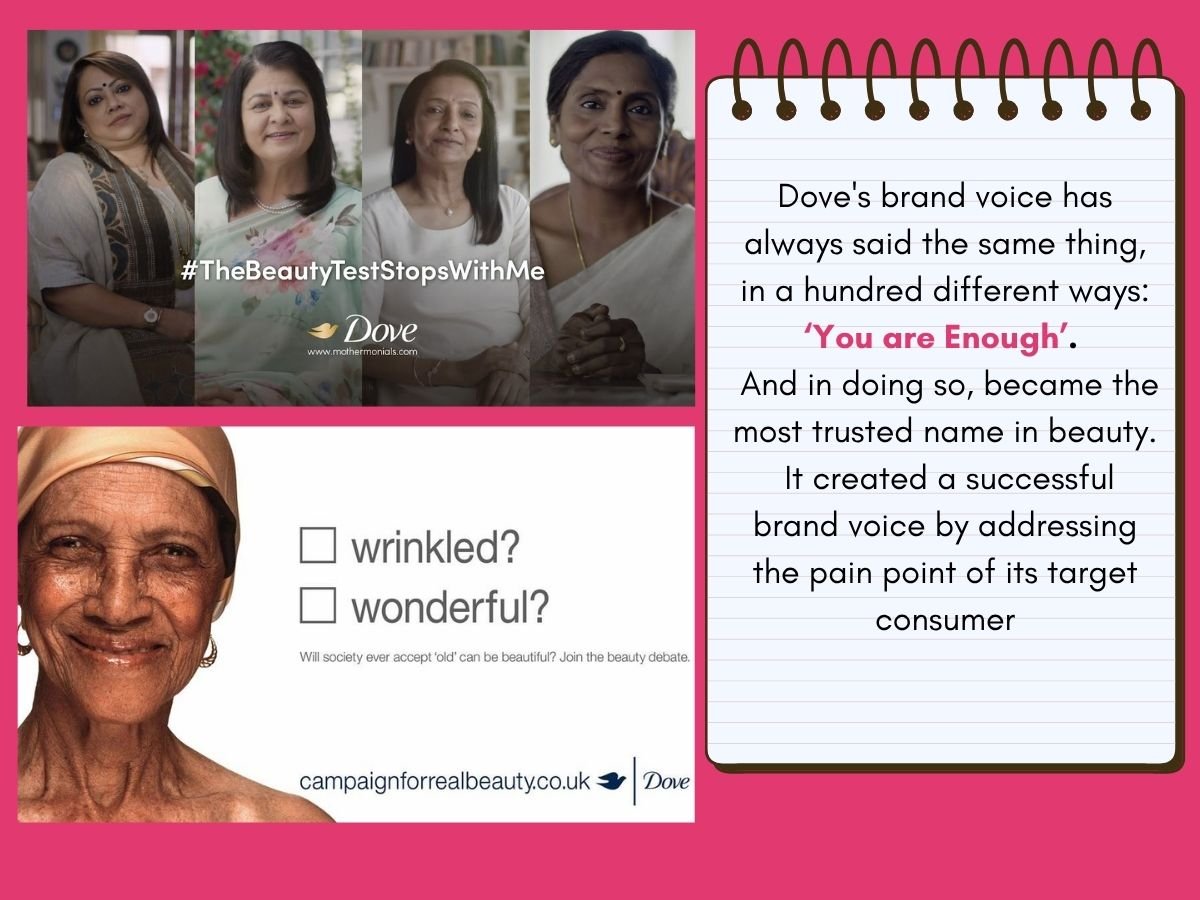
Real Beauty campaign by Dove target consumer pain points around beauty standards and self-acceptance

3. Choose Your Spokesperson Strategically

One of the fastest ways to build a brand voice is to attach it to a human personality that already represents it. When Lux roped in Kareena Kapoor, it was not just because of her fame; it was tapping her aura of glamour, confidence, and luxury and transferring it onto the brand. Her fans and admirers naturally began associating those qualities with Lux. There is a vast difference between merely endorsing a brand and becoming an inseparable part of it, as Kohli and Dhoni are for RCB and CSK.

4. Let Your Voice Live in Your Events and Actions

Ask yourself what events, causes, or communities your brand should be visibly part of. Make your visibility felt in places and events your target audience attends. 

You can go one step further by hosting events entirely of your own. For instance, Nykaa’s Women of Worth initiatives celebrate women entrepreneurs in the beauty and wellness space. For Nykaa, a brand founded by a woman and built largely on women’s ambitions, these events are proof of its brand voice: women supporting women

5. Document Your Brand Voice

Create a Brand Voice Guide for your brand. This guide should be a clear document that includes your brand’s personality traits, explanations, tone across different situations (social media, customer service, advertising), the types of words to use and those to avoid, and real examples of your voice done right. This document should be mandatory reading for every new writer, designer, and marketer who joins your team.

How to Maintain a Consistent Brand Voice

Consistency is as important as building a brand voice, because only when you are consistent will you be able to make a place in customers’ hearts and minds. Here is a framework to follow to keep your brand voice consistent:

Audit brand messaging regularly: Every quarter, review your content across all channels, such as social media, packaging, ads and emails and ask whether it all sounds like the same brand. Inconsistency hurts the impact of the brand voice.

Train your team, not just your agency: Your customer service executive and your social media intern both represent your brand voice. Invest in training teams thoroughly across all sectors.  Briefing just your ad agency once a year is not enough.

Evolve without abandoning: A brand voice should remain consistent but can mature over time. Cadbury Dairy Milk India advertisement created by Late Piyush Pandey is a masterclass in deliberate voice evolution. It began its campaign as a children’s brand, which was sweet, innocent and celebratory. Then came the iconic 1990s “Real Taste of Life” drive with a girl dancing on a cricket field. This heartwarming ad deliberately shifted the voice toward carefree, spontaneous joy for young adults. Over the next two decades, it deepened further into warmth and togetherness with “Kuch Meetha Ho Jaaye,” positioning chocolate as the way to celebrate happy moments. Each evolution expanded the target audience without abandoning the emotional core: ‘celebration through sweetness’.

Listen to your customers. Your audience will tell you when your voice rings true and when it feels fake. Customer feedback in the form of reviews, comments, and direct conversations is the most honest brand audit you will ever get. The brands that last are the ones that keep listening and evolving.

Conclusion

Building a powerful brand voice with a lasting impact is about deciding, with clarity and conviction, who your brand is and then living that identity out loud, consistently, across every touchpoint. The brands that do this well do not just attract customers; they build loyalty, which is the most sought-after competitive advantage in business.

You do not need a massive budget to build a powerful brand voice. You just need clarity and courage to show up the same way every single time — on every platform, in every post, and through every customer interaction.

Maintaining an effective brand voice is all about being in control of what it says and saying it consistently enough to be remembered. 

FAQ’s

Q1. How long does it take to build a recognizable brand voice?

There is no fixed timeline, but most brands begin to see recognizable traction between 12 and 18 months of consistent, deliberate effort across all touchpoints.

Q2. Can a small business or startup have a brand voice, or is it only for big brands?

Brand voice is arguably more important for small businesses than large ones. A startup cannot compete on advertising budgets, but it absolutely can compete on personality, warmth, and relatability. In fact, many small Indian D2C brands like Boat and Mamaearth built fierce customer loyalty through a clearly defined brand voice long before they had the budgets to match larger competitors.

Q3. What is the distinction between brand voice and brand tone? 

Brand voice is your brand’s consistent personality, which does not change. Brand tone is how that personality adapts to different situations. For example, Amul’s brand voice is always witty and warm, but its tone on a lighthearted topical billboard is playful. In contrast, its tone in response to more serious political issues would be warmer and more empathetic. 

Found this useful? Share it with a fellow founder or marketer who is still figuring out their brand voice. And if you want to go deeper, explore our other articles on brand strategy and content marketing.
Read More Articles
Categories
Blogs Content Marketing

9 Powerful Content Marketing Strategies to Hold Your Audience’s Attention

Content is everywhere today, but only the smartest brands know how to hold attention in a world full of noise. Your audience scrolls fast, skips faster, and forgets even faster. That’s why you need more than random posts. You need a content plan that grabs attention in seconds, delivers value without delay, and keeps people coming back because they genuinely enjoy what you create. An effective content marketing strategy helps you cut through the clutter, speak directly to your ideal audience, and build trust that lasts. 

When your content is clear, helpful, and memorable, you don’t have to chase customers; they follow you because they feel connected to your brand. This blog walks you through nine powerful strategies that help you do exactly that: capture attention, keep it, and turn it into long-term growth.

What is a Content Marketing Strategy?

A content marketing strategy is a basic plan for making and sharing useful information that your audience cares about. The goal is to attract people, keep them interested, build trust over time, and encourage them to take actions that help your business, such as signing up, booking a call, or making a purchase.

Instead of pushing sales through traditional ads, this approach focuses on delivering real value through blogs, videos, podcasts, emails, and social media posts. It feels helpful, not salesy.

A good strategy connects your content with your business goals, your audience’s needs, and the right platforms, such as your website, email, and social channels. When done well, it helps improve brand awareness, search rankings, and customer loyalty.

Why You Need a Content Marketing Strategy

For a firm to succeed, a clear content marketing plan is essential. It extends audience engagement, increases social media traction, builds trust, and delivers higher-quality, more valuable leads.

Engage audiences longer:

When your content is interesting and valuable, people enjoy it so much they stick around and come back for more, spending more time with your brand.

Produce more traction on social media: 

Sharing content that’s easy to like, comment on, and share helps more people see your brand and talk about it, boosting your presence on social channels.

Build trust with your audience: 

Regularly providing helpful, relevant content demonstrates that you understand your audience’s needs and care about them, which builds trust and fosters loyalty to your brand.

Generate more and higher-quality leads: 

Good content attracts the right people by addressing their needs, guiding them through their buying decision, and encouraging them to take action, such as signing up or making a purchase.

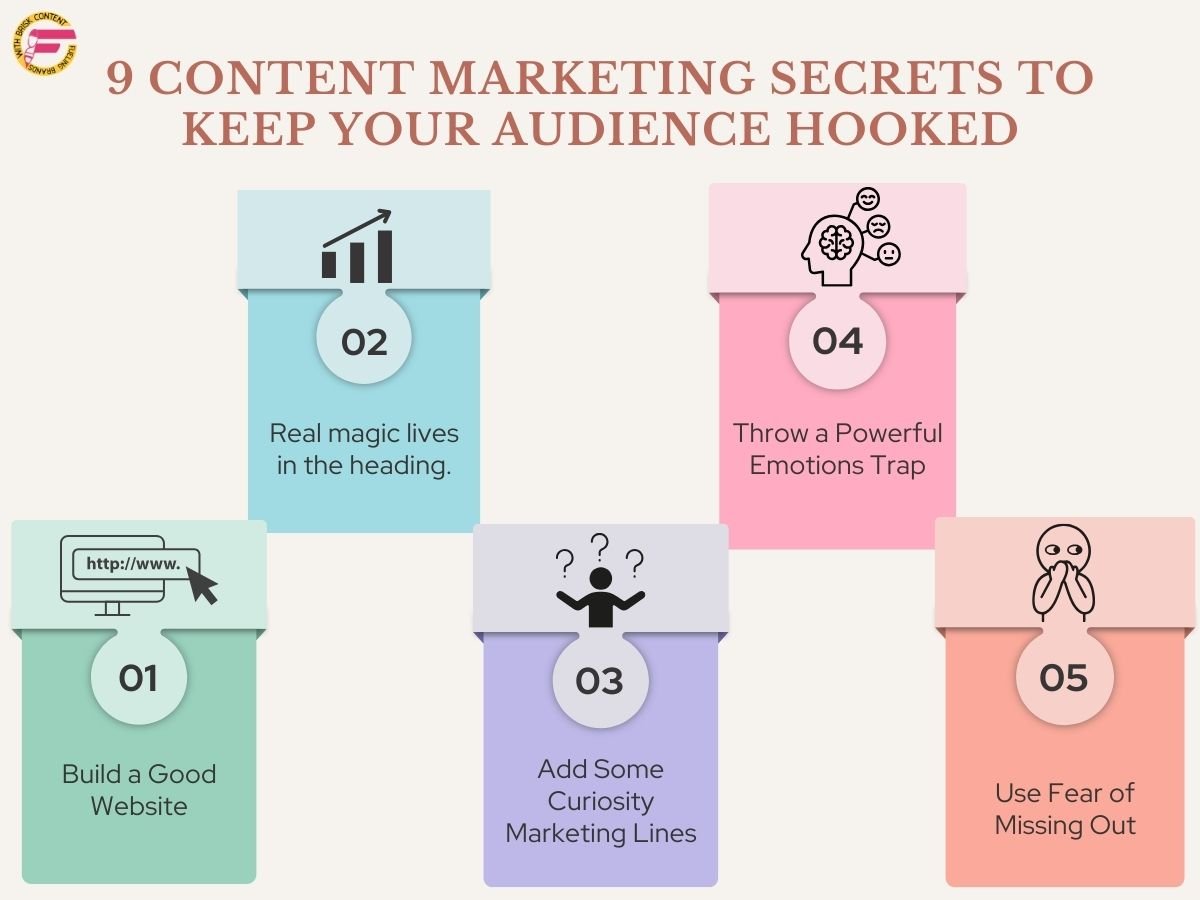
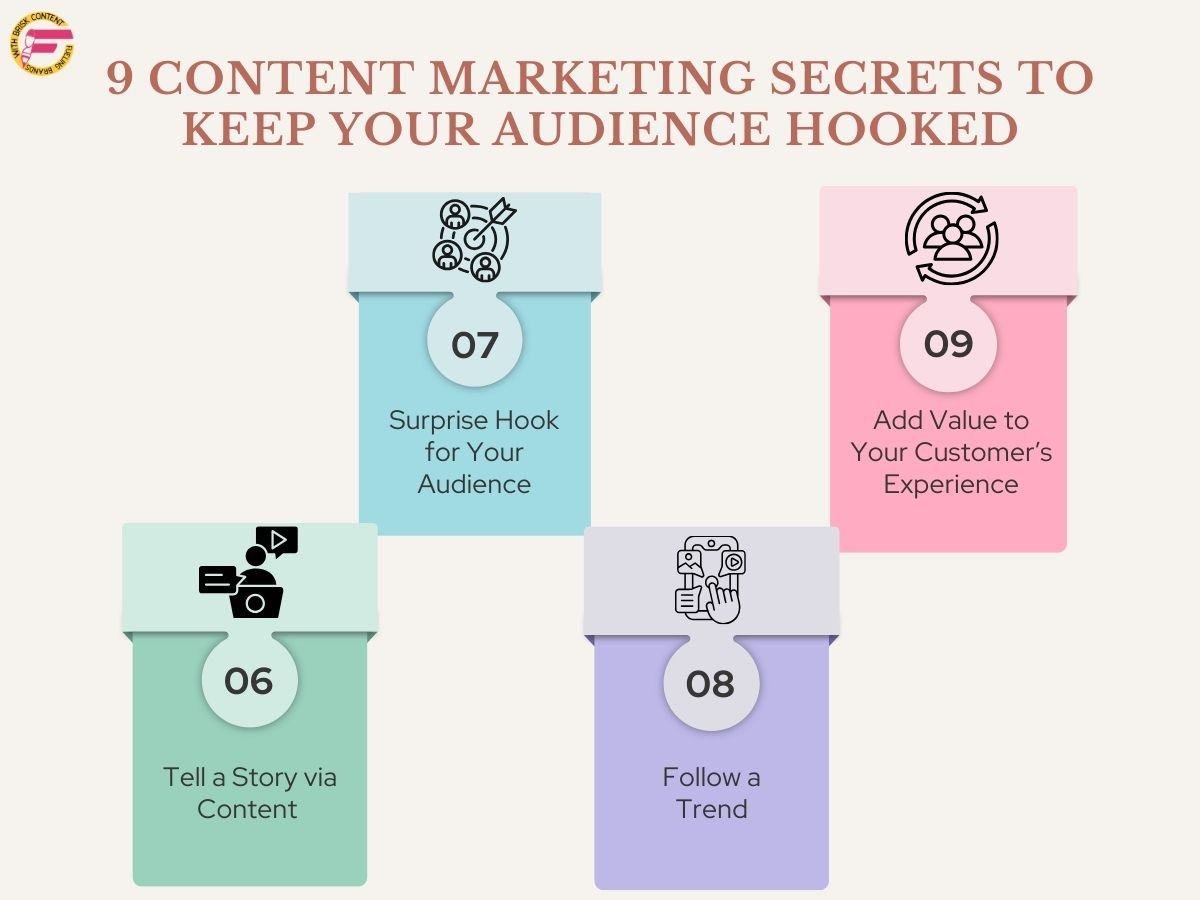
9 Content Marketing Secrets 

  1. Build a Good Website

Imagine a website that’s easy to navigate and looks great. It makes a strong first impression and encourages visitors to stay by enabling them to find what they want quickly and enjoy browsing.

  1. Actual Magic is in the Heading

Your title is the gateway to your content; if it is clear and compelling, it will immediately draw readers in and pique their interest.

  1. Add Some Curiosity Marketing Lines

Tease your audience with questions or hints that don’t give everything away, so they feel motivated to keep reading to learn the details.

  1. Throw a Powerful Emotions Trap

When your content makes people feel something, whether it’s happiness, surprise, or empathy, they’re much more likely to connect with it and share it with others.

  1. Use Fear of Missing Out

If you create a sense of urgency or exclusivity, such as “limited time offer” or “only a few spots left,” it encourages people to act now rather than wait.

  1. Tell a Story via Content 

People love hearing good stories, so share relatable experiences or journeys to make your content resonate and evoke emotion in your audience.

  1. Surprise Hook for Your Audience

Unexpected twists or facts throughout your content keep readers interested and make your message stand out from the usual.

  1. Follow a Trend

When you jump on current trends or popular topics, your content feels fresh and relevant, which naturally draws more attention and engagement.

  1. Add Value to Your Customer’s Experience

Focus on giving your audience something useful, whether it’s tips, insights, or helpful information that makes their life easier or better.

Conclusion & CTA

In the end, holding your audience’s attention isn’t about posting more; it’s about creating content that feels real, valuable, and worth their time. When you focus on clarity, emotion, curiosity, and genuine usefulness, people stay with your brand because they want to, not because you force them to. These tips will help you stand out in a crowded market and turn those who just stop by into loyal followers who trust what you say.

If you’re ready to build deeper connections and grow your brand the right way, start applying these ideas to your next piece of content. Small improvements add up fast, so take the first step today and create something your audience will remember.

1. How can I tell if my content marketing strategy is actually working?

Essential indicators, including website traffic, lead generation, social media engagement, and conversion rate, can be monitored. You can identify which information resonates with your audience and adjust your approach by regularly analyzing these metrics.

2. What type of content should I focus on to connect better with my audience?

Focus on content that provides real value, whether it’s solving a problem, answering questions, or entertaining your audience. Mixing formats like blogs, videos, and social posts tailored to your audience’s preferences works best.

3. How often should I update my content to keep my audience interested without overwhelming them?

Make an effort to stick to a regular publishing schedule that satisfies the demands of your team and your audience, such as once a week or every two weeks. Update outdated content regularly to keep your readers engaged and avoid overwhelming them.

FAQs

1. How can I tell if my content marketing strategy is actually working?

Essential indicators, including website traffic, lead generation, social media engagement, and conversion rate, can be monitored. You can identify which information resonates with your audience and adjust your approach by regularly analyzing these metrics.

2. What type of content should I focus on to connect better with my audience?

Focus on content that provides real value, whether it’s solving a problem, answering questions, or entertaining your audience. Mixing formats like blogs, videos, and social posts tailored to your audience’s preferences works best.

3. How often should I update my content to keep my audience interested without overwhelming them?

Make an effort to stick to a regular publishing schedule that satisfies the demands of your team and your audience, such as once a week or every two weeks. Update outdated content regularly to keep your readers engaged and avoid overwhelming them.

Categories
Blogs

13 CUTTING-EDGE CONTENT WRITING SERVICES YOUR BUSINESS NEEDS

Content writing services play a vital role in establishing robust groundwork for virtually every business. Research at Hubspot shows, that 56% of surveyed consumers have made a purchase from the company after reading their blog. Content services help your business by enhancing the search engine ranking of your website and pulling in new clients.

Agencies offer various content writing services to enable more organizations to profit from the power of content. 

So, are you primed and ready to explore the art of storytelling through various content services that can empower you to harness your brand’s success?

Through this blog, let’s delve deeper into the diverse realm of content writing services!

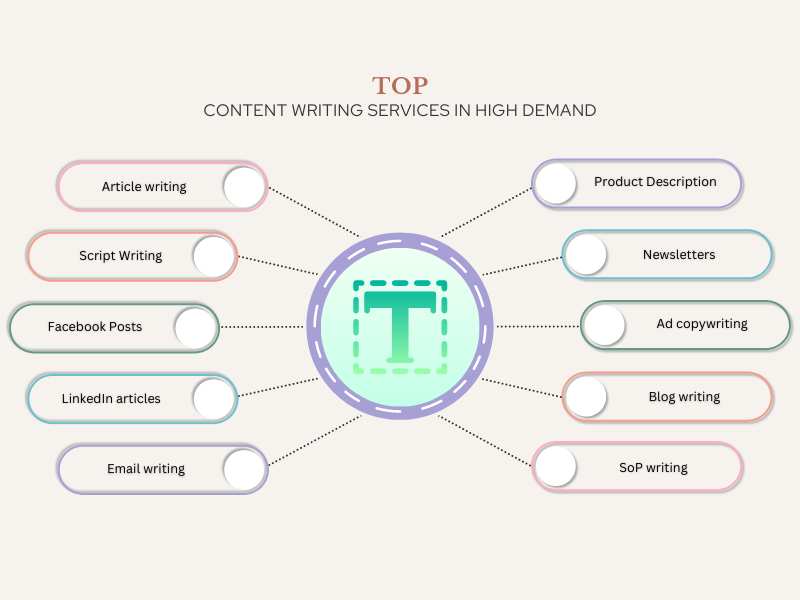
Top content writing services in high demand

Product Description

The product description highlights the feature, specifications, and benefits of the product to persuade customers to buy the product. The purpose of the product description is to capture people’s interest by emphasizing its features, attributes, and advantages. A great product description helps you pitch your product to potential customers and help influence sales.

Newsletters

Newsletters are the most cost-effective method of taking your brand advertisement to the next level. They help you paint a broader picture of your business and facilitate you to maintain regular contact with your clients and customers. A well-written newsletter can be a powerful asset for your brand in strengthening its market presence. 

Proofreading

Proofreading is another invaluable content writing service that ensures your documents are flawlessly written and error-free. When executed with precision and attention to detail, it enables you to deliver a polished and crafted piece of work. Proofreading ensures language consistency and writing improvement. It can help you polish your material by fixing flaws such as grammatical errors, punctuation, and the overall readability of your material.

Blog writing

Through blog posts, businesses can build credibility and engage with their target audience at the same time. A professionally written blog acts as a platform to increase search engine visibility and enhances the overall online presence of the brand. 

SoP writing

A beautifully presented Statement of Purpose (SoP) is important for students to embark on their academic journey. Hence, it is very crucial to compose an impactful SoP to open doors to valuable educational opportunities and professional journeys. And who could be more suitable than a professional content writer to help you whip up the perfect SoP?!

Email writing

According to Hubspot, 86% of consumers like to receive promotional emails from companies they do business with. The marketing world is changing dynamically. Email marketing is the best way to keep up with the latest trends and connect with your target audience and content writers can help your brand by skillfully composing your emails. Professionals can help you optimize your email, maximize your click-through rates and spark conversations. 

LinkedIn articles 

LinkedIn articles are a powerful medium for establishing professional authority, expanding your network, and enhancing your personal brand. Linkedin has become a dominant force, serving as an influential platform for establishing valuable connections and showcasing one’s expertise. With the help of content writing services, you can make a lasting impression that can help you unlock advancement and growth in your career.

Facebook Posts

Facebook posts serve as a direct platform of communication between your brand and its followers. Engaging in Facebook posts requires research, creativity, and an understanding of the target audience. Content writers can help you incorporate relevant hashtags and keywords to attract new followers and potential customers. By having a professional craft your posts you can use their creative prowess to post impactful content. 

Script Writing

Scriptwriting is applicable to multiple platforms such as films, television, and now online web series. The essence of exceptional screenwriting lies in the ability to externalize the internal; you have to transform your emotions and feelings into words to tell a story visually. Scriptwriting is immensely important in the world of storytelling and entertainment. It is a strong foundation that helps bring stories to life.

Article writing

Articles are a powerful tool for Search Engine Optimization (SEO). High-quality articles filled with relevant keywords improve your website’s ranking in search results. Articles drive organic traffic expanding your reach to potential customers. By sharing valuable insights with your article you can set your brand apart from your competitors. In summary, articles inspire, engage and inform readers to boost your online presence. 

Ad copywriting 

Ad copywriting plays a pivotal role in shaping a brand’s image. A well-crafted ad captures attention and effectively connects with customers. Ad copy delivers a concise yet grabbing message that motivates action. The copy should be persuasive and tap into consumers’ emotions evoking a desire to buy the product or service. Witty ad copy can effectively communicate with the audience and leave a lasting impact.

Business proposals

When it comes to business proposals, persuasive and captivating words are all you need. The foundation of a great business proposal depends on how well can you present your ideas in a visually compelling and impactful way. The perfect blend of creativity and knowledge can boost your chances of winning the deal. Professional writers can help you customize your proposal, making it resonate with the readers. 

Case Study 

In the fast-paced world of business, finding ways to streamline operations and maximize efficiency is paramount. Content creation is one such area where outsourcing can be very efficient and make a significant impact on your business.  Writing a case study requires a unique set of skills, and professionals can help you whip up a case study that can hook readers from beginning to end. By carefully building your case study you can showcase your success stories and drive growth. 

To paint a vivid summary

In the highly competitive business landscape, professional writers are like your ace in the hole, your winning edge, and your strategic advancement. They can help you with their dynamic narratives to win over potential partners and customers.  From articles, and ad copies to business proposals content writing services help you boost business growth, deliver high-quality content, and always ensure that your documents are flawless. In a nutshell, these wordsmiths will have your academic and business front covered. So embrace their expertise, harness the power of words, and see your business sail to lofty altitudes. 

Categories
Blogs

5 Content Marketing Goals You Must Track.

Introduction

According to the Content Marketing Institute, 70% of B2C marketers and 73% of B2B marketers use content marketing as part of their overall marketing strategy. When it comes to marketing, the first thing you think of is how you will publish your content to your audience, but that does not mean you will now keep your complete focus on that matter.

Marketing is not all about showcasing your content, it’s a strategy focused on creating and displaying your matter based on how interesting your work is to gain the public’s attention.

Although not every marketing firm knows how to handle this matter, which results in them losing their audience. To bring an end to this, content marketing brings you different types of goals on which you could finally figure out where your team lacks consistency.

What Is Content Marketing?

Now, the main question is, what actually is content marketing and how will it help expand your business? It is all about producing matter on specific topics which does not include any brand awareness or stuff like advertising. 

For example – When you create a content calendar, you set goals on how you will achieve success. That is because you want to make sure what you’re presently working on will help your future set goals to succeed.

There are specialized tools to help you set goals in marketing strategy but before that, you should know your main focus and reason why you want to put those goals. 

Why Do You Need To Set Goals?

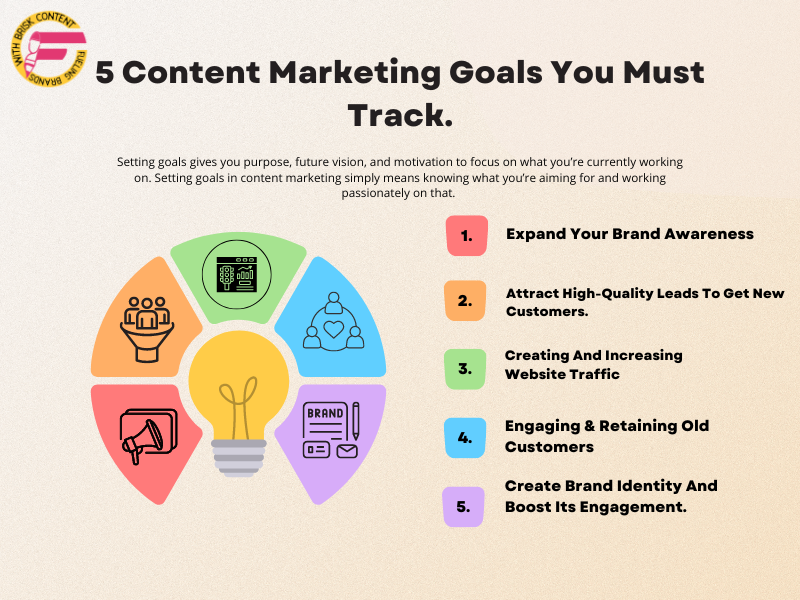
Setting goals gives you purpose, future vision, and motivation to focus on what you’re currently working on. Setting goals in content marketing simply means knowing what you’re aiming for and working passionately on that. 

You should understand and realize the value of money and hard work before using either of those in any situation. 

Creating and tracking your goals is a way of achievement, this article will show you the exact goals to track in content marketing and the primary purpose behind those.

Marketing Goals to Track:

1. Expand Your Brand Awareness:

Brand awareness is a key way to attract customers. Prioritizing your audience is very important. Creating a targeted customer and working for their happiness and satisfaction is what you should set your goal on. If a customer is happy with a product you’re selling, they will introduce it to their family, friends, and colleagues which will increase the brand awareness.

Now the question is how to attract new customers. Firstly, focus on where your targeted audience is and what you’re actually trying to impress them with. Then all you have to do is start with your conversation skills and try to convince them of the benefits of your brand. Make them realize how your brand will help them in different situations. 

2. Attract High-Quality Leads To Get New Customers.

 Attracting qualified leads is itself a main goal for a business and then turning them into brand new customers is again a big task. Creating a lead customer is key to business growth and revenue generation. Generating a lead and nurturing a lead are two different things. Generating a lead has specific tactics such as targeted campaigns, content personalization, etc. On the other hand, nurturing a lead is converting a generated lead into a loyal customer. 

Generating leads is not an easy task, this is counted as a main set plan in content marketing. It consumes its time and our work, conversations in a convincing tone, showing them benefits, and creating campaigns overall results in generating a lead. 

Transforming a lead into a customer is again a big goal to achieve in content strategy. Once you have generated a lead for your business, converting them into customers is just a piece of cake. 

3. Creating And Increasing Website Traffic.

We live in a digital era, and congestion on our websites describes we’re achieving success in our marketing strategy. People are reading our content, they’re enjoying it, and satisfying them is what our motive is. This traffic on our websites is our 3rd most important goal in content marketing. This can increase, and our content can reach more and more audiences just by a few other steps.

  • Writing and publishing blogs
  • More efforts on SEO to increase optimization ranking
  • Creating campaigns for paid ads
  • Social Media is the best way to create traffic for your business

The goal is to reach more people with our content, this will not only increase content ranking but the demand for our business will keep on increasing. 

It is important to showcase your work to as many people as possible, and if it is reaching the targeted audience why not give them the high-quality content they always seek of?

4. Engaging & Retaining Old Customers.

Generating new customers is a tough task but satisfying the old ones isn’t. Make your old customers happy, reach back to them for reviews of your product and content. Keep engaging and retaining them. If a customer is delighted by the products or services you’re offering, they will not only buy from you again and again but also recommend you to their relatives, family, friends, colleagues, etc. 

There are plenty of ways to retain your customers, including:

  • Seek reviews and thoughts about your product/services.
  • Listen to the complaints properly and work on them.
  • Offer them discounts and early access to the products.
  • Respect their thoughts about your content whether they are in your favor or not.
  • Pursue carefully what content you offer to the public that influenced the most deals.

 5. Create Brand Identity And Boost Its Engagement.

Last but not least, the 5th most important goal you must track in content marketing is to create a brand identity and boost its engagement. 

What does one mean by creating an identity and boosting its engagement? Social Media such as Instagram, Facebook, and many others work on the basis of their algorithm. Increasing your reach to more and more people will have a positive impact on your sales. 

Now how does one work on the basis of an algorithm in content marketing? 

  • Social Media shows people what they specifically search for which means you cannot give people what they’re not even interested about. 
  • Second, distribute people the content in one form and one way. Showcasing different types of work in a single moment will make people confused about what you’re trying to convey. 
  • Provide them with different types of stuff at different times so that the engagement of the content is increasing in a particular way.
  • Make people aware of what you’re offering them and how it can benefit them. Make sure that all the 4 Ps of marketing i.e. Price, Place, Product, and People are being considered while making the strategy. 

Last Thoughts:

In order to achieve success setting goals are very important, and timely fulfillment of these goals will only help you grow more and more. 

The Internet is the best place to expand your reach. Generate leads and convert them into loyal customers through tactics such as content personalization and targeted campaigns. 

Try to increase as much traffic on your website as possible, heavier the traffic easier the sales. Gain positive impacts from old customers by listening to their complaints, reviews, and compliments. Boost your engagement by working through the algorithm of social media.

Setting Goals is important in every aspect of life, marketing is just another reason to consume it and grow towards success. 

Contact us now at Content Fayah to set up your personalized goals.

Categories
Uncategorized

Is Ai Generated Content Good for SEO?

Are you tired of spending countless hours creating content for your website or business, only to see little improvement in your search engine rankings? If so, you may have heard about the potential benefits of using AI-generated content to boost your SEO.

But before you jump on the bandwagon, it’s important to consider the potential drawbacks and limitations of relying solely on automated content creation tools. While AI-generated content can certainly help streamline the content creation process, it may not always produce the same level of quality and authenticity as human-written content.

In this article, we’ll explore the pros and cons of using AI-generated content for SEO, and provide insights into how to strike the right balance between automated content creation and the human touch. So, whether you’re a small business owner or a seasoned SEO professional, read on to discover the truth about AI-generated content and its impact on your search engine rankings.

The world of SEO is constantly evolving, and with the rise of AI-powered technologies, automated content creation has become a popular trend. Here, we’ll explore the benefits and drawbacks of AI-generated content for SEO and provide tips on how to incorporate it into your content strategy.

AI content SEO

Benefits of AI-generated content for SEO

One of the primary benefits of AI-generated content is its ability to produce large quantities of content quickly. This can be particularly useful for websites or businesses with a high volume of content needs, such as e-commerce sites or news outlets. Additionally, AI-generated content can help reduce costs and improve efficiency, freeing up time and resources for other important tasks.

Another advantage of AI-generated content is its potential to increase search engine rankings. By using target keywords and optimizing content for SEO, AI-generated content can help boost website traffic and visibility. However, it’s important to note that search engines prioritize quality and relevance over quantity, so it’s essential to strike the right balance between quantity and quality.

Limitations of AI-generated content for SEO

Despite the potential benefits of AI-generated content, there are also limitations to consider. One major drawback is the potential lack of authenticity and personality in the content. While AI algorithms can produce grammatically correct and coherent content, they may not be able to convey the same level of emotion or connection as human-written content. This can lead to a lack of engagement from readers and ultimately harm your SEO efforts.

Avoiding plagiarism and duplicate content

Another limitation of AI-generated content is the risk of plagiarism or duplicate content. AI algorithms may scrape content from other sources and repackage it, which can lead to penalties from search engines and damage your website’s credibility. To avoid this, it’s important to use AI-generated content as a starting point and then edit and refine it with a human touch to ensure its uniqueness.

Incorporating AI-generated content into your content strategy

To reap the benefits of AI-generated content without sacrificing authenticity and engagement, it’s important to incorporate human touch into your content strategy. One way to do this is by using AI-generated content as a starting point and then editing and refining it with a human touch. This allows you to take advantage of the efficiency and convenience of AI-generated content while still ensuring that your content is unique and engaging.

Using AI-generated content for repetitive tasks

Another way to incorporate AI-generated content into your strategy is by using it for repetitive or low-value content, such as product descriptions or social media posts. This frees up time for human writers to focus on higher-value content, such as blog posts or thought leadership pieces.

Does AI-generated Content rank on Search Engines?

Yes, but it’s crucial to optimize the content for SEO and user experience. Search engines prioritize relevance and quality, so striking the right balance between AI-generated content and human touch is important.

To ensure that AI-generated content ranks on search engines, use target keywords, make the content informative and unique, optimize for user experience, and engage with your target audience. However, it’s important to avoid plagiarism and ensure authenticity to maintain credibility.

AI-generated content can rank on search engines if optimized properly. By using AI-generated content and human touch together, you can improve search engine rankings and drive traffic to your website.

Here are some tips for using AI content tools to produce high-quality and engaging content:

  • Choose the right tool for your needs. Some of the best AI content tools in the market include GPT-3, ContentBot, Copy.ai, and Wordsmith.
  • Understand the capabilities and limitations of each tool. While they can generate content quickly and efficiently, it’s important to ensure that the content is authentic, relevant, and engaging.
  • Use the tool to generate ideas and inspiration. AI-generated content can help generate new ideas and perspectives that you may not have considered before.
  • Incorporate human touch and editing. Editing the content generated by AI tools can help ensure that it’s unique, relevant, and resonates with your audience.
  • Use the tool to enhance, not replace, human creativity. While AI-generated content can be useful, it’s important to remember that human creativity and expertise are still essential for producing high-quality content.

AI content tools can be powerful resources for content creation, but it’s important to use them wisely and incorporate the human touch. By understanding their capabilities and limitations, and using them alongside human creativity and editing, you can produce high-quality and engaging content that resonates with your audience.

In Conclusion

AI-generated content can be a powerful tool for improving SEO, but it’s important to understand its limitations and find ways to incorporate the human touch into your content strategy. By striking the right balance between efficiency and authenticity, you can harness the power of AI-generated content to boost your search engine rankings and drive traffic to your website.

Categories
Blogs

7 Lead Generation Strategies for Start-ups

Are you tired of feeling like your startup is stuck in neutral? You know you have a fantastic product or service, but you just can’t seem to reach the right people. Well, don’t throw in the towel just yet because, with the right lead generation strategies in place, you can quickly and effectively attract new customers and take your business to new heights.

In this article, let us reveal seven proven tactics that can help you generate leads, from leveraging the power of social media to harnessing the potential of referral marketing. So, buckle up, and get ready to learn how to take your startup from struggling to thriving!

  1. Content Marketing:

As a startup, you’re inclined to spread the message about your product or service. But how do you reach your target audience and show them what your brand offers?

This is where content marketing comes in. By creating valuable and relevant content, such as blog posts, videos, infographics, or e-books, you can establish yourself as an industry expert and attract potential customers.

For example, if you sell workout clothes for women, creating a blog that provides workout tips, nutrition advice, and healthy living inspiration can be an excellent way to engage with your target audience and generate leads.

By offering them helpful content, you’re not only showcasing your knowledge and expertise but also providing them with something of value, making them more likely to remember your brand and return for future purchases. So, start brainstorming some topics that would be of interest to your target audience, and let your content do the work of attracting and engaging potential customers.

  1. Social Media Marketing:

As a startup, you have a unique opportunity to harness the power of social media to reach a wider audience and build brand awareness. By creating and sharing content, you can engage with potential customers and show them what your brand has to offer.

Social media platforms also offer advertising options that can help you target specific audiences. For instance, if you sell handmade jewelry, creating a Facebook page and running a social media campaign that targets women interested in fashion and accessories can be an effective way to get your brand in front of the right people.

By showcasing your products in a visually appealing and engaging way, you can entice potential customers to visit your website and make a purchase. So, start by identifying which social media platforms your target audience uses most and create a plan for regularly posting engaging content that showcases your brand and products. With a little time and effort, social media can be a powerful tool for growing your startup.

  1. Email Marketing:

Email marketing can be a powerful tool for reaching your potential customers. And as a startup, it’s a cost-effective way to promote your products or services and build relationships with potential customers.

By sending relevant and personalized emails, you can capture the attention of potential customers and encourage them to take action. Email campaigns can nurture leads, keep subscribers informed of new developments in your startup, and promote your products or services.

For example, if you offer monthly subscription boxes, sending email campaigns to promote your latest box and encourage subscribers to refer friends and family can be an effective way to generate more leads and grow your customer base. By providing subscribers with a sneak peek of what’s inside the box and offering them incentives to refer others, you’re not only promoting your product but also building relationships with your subscribers.
So, start by building a list of email subscribers and creating campaigns that provide value and encourage action. With a little bit of creativity, email marketing can be a powerful tool for growing your startup.

  1. Search Engine Optimization (SEO):

It is vital for a startup to appear at the top of search engine results. And with search engine optimization (SEO), startups can improve their website’s visibility and attract potential customers who are searching for their products or services.

By using relevant keywords, high-quality content, and link-building, you can improve your search engine ranking and increase your chances of being found by potential customers.

For example, if you offer online interior design services, using relevant keywords and high-quality content on your website can improve your search engine ranking for terms such as “online interior design services”.

By creating blog posts or articles that offer helpful tips and advice, you’re not only improving your search engine ranking but also showcasing your expertise and building trust with potential customers.

So, start by identifying which keywords are relevant to your startup and create high-quality content that incorporates those keywords. With a little bit of effort, SEO can be a powerful tool for growing your startup and reaching a wider audience.

  1. Paid Advertising:

Paid advertising can be an effective mode for reaching a wider audience. And for startups, it can be a quick and convincing way to generate leads and promote their products or services.

With options such as pay-per-click (PPC) advertising, display advertising, or social media advertising, startups can choose the type of advertising that best fits their target audience and budget.

For example, a startup that sells eco-friendly cleaning products can use Google Ads to target customers searching for eco-friendly household cleaning products.

By using relevant keywords and ad copy, the startup can ensure that their ads are being seen by potential customers who are actively searching for their products.

Social media advertising is also a great option for startups looking to promote their products or services on platforms such as Facebook or Instagram. By targeting specific demographics and interests, startups can reach a wider audience and generate leads quickly.

So, if you’re looking to grow your startup quickly and efficiently, paid advertising is definitely something to consider.

  1. Referral Marketing:

Have you ever recommended a product or service to a friend or family member? Referral marketing is based on that same concept of word-of-mouth recommendations.

It can be a powerful way for startups to generate leads and build customer loyalty. By offering incentives such as discounts, free products, or exclusive access, startups can encourage existing customers to refer their friends and family to the business.

And let’s be real, who doesn’t love a good discount or freebie? As a consumer, I know I’m more likely to try a new product or service if it’s been recommended by someone I know and trust.

For example, a startup that sells plant-based meal delivery services can offer a discount to existing customers who refer to a friend.

By doing so, the startup generates new leads and builds customer loyalty by rewarding existing customers for their support.

  1. Networking:

As the saying goes, “it’s not what you know, it’s who you know.” And when it comes to startups, networking can be a game-changer. By attending industry events and conferences, startups have the opportunity to meet other entrepreneurs and industry leaders.

Not only can networking help startups build valuable relationships, but it can also lead to potential partnerships and referrals. As a business owner, you will soon realize that some of your best opportunities will come from networking events.

For example, a startup that offers social media management services can attend a social media marketing conference to connect with potential customers and industry leaders.

By doing so, they can not only generate leads but also learn from other experts in their field and stay up-to-date on the latest industry trends.

To wrap it up
Lead generation is like planting seeds for the future success of a startup. By using a mix of the above-mentioned methods, startups can cultivate a thriving customer base. It’s important to know your audience, set clear goals, and use a combination of strategies that fit your budget and resources. Just like a farmer tends to their crops, startups need to continuously monitor and optimize their lead generation efforts to ensure growth and success. With the right approach, and good quality human-generated content your startup can attract and convert more potential customers, leading to a brighter future for your company.

Connect with Content Fayah to know how our content marketing ideas can give a boost to your startup.

Categories
Blogs Content Marketing Content Writing

How Content Marketing can Grow Your Business

Brisk, high‑quality content is no longer just a “supporting act” for your brand; it has become the engine of growth in today’s hyper‑competitive digital marketing landscape. 

According to Demand Metrics, “Content marketing costs 62% less than traditional advertising and generates approximately 3x more leads,” therefore making content marketing one of the smartest investments a business can make.

And, with 70% of consumers preferring to learn about a brand through its digital content, it is a critical touchpoint that no brand can ignore if it wants to grow. Learn how content marketing can fuel your business growth and help you reach more audience at a fraction of the cost.

What is Content Marketing?

Content marketing is the strategic process of creating and publishing digital content that informs and engages a specific audience with the goal of converting them into customers.

Good-quality content doesn’t directly pitch its product; instead, it provides useful information that helps users answer their questions or solve a problem. It helps the business to establish credibility and trust over time, thus driving profit and growth.

While traditional marketing is all about promotional messaging, content marketing contests for attention by providing value first, with selling happening indirectly, and costs are comparatively very low.

Why is Content Important for the Brand?

Content is the backbone of modern marketing strategy. The global content marketing industry is projected to reach nearly $1.95 trillion by 2032, showing how deeply brands now rely on content to build trust and loyalty.

Millennials and Gen Z don’t just buy a brand because it is endorsed by a famous personality or because of its logo or slogan. Instead, they will buy your brand if they like what it says, how it says it, and how consistently it delivers.

A simple example could be a washing powder brand that publishes information on ‘Best way to remove curry stains’ or ‘ Common laundry mistakes that harm our clothes.’ If Parents and homemakers find the content useful, they begin to trust the particular washing powder brand.

Apart from helping the audience make smarter buying decisions, content also serves as an important ranking factor for search engines. It will help your websites rank with AI tools, which, in turn, will grow new leads and conversions. 

Types of content format that are popular today include:

  • Social media content (carousels, threads, UGC‑style posts)
  • SEO/GEO Blog posts, articles and long‑form guides
  • Video scripts (YouTube, Reels, Shorts, TikTok)
  • Podcast episodes and audio scripts
  • eBooks, white papers, and case studies
  • Press releases and product descriptions
  • Landing pages and email sequences

Content Format that Dominates 2026

According to recent research by HubSpot, today’s most effective content formats are short‑form, interactive, and multi‑platform.

Content typeWhy it works nowExample use case
Short‑form videoHighest ROI on social media Product demos, quick tips, behind‑the‑scenes.
Long‑form videoStrong for retention and trust Webinars, tutorials, case study walkthroughs.
Blog postsValued for depth and SEO. How‑to guides, product comparisons, explainers.
Infographics30x more likely to be read than text; boost traffic by 12%. Data summaries, mind maps, process breakdowns.
Case studiesTop‑performing format for driving traffic in AI‑first search. ​B2B industrial, SaaS, and service‑based brands.
UGC‑style contentBuilds trust and performs strongly on social media.Customer testimonials, reposts, reviews.
AI‑ready snippetsStructured Q&A sections, FAQs, and tables optimized for AI citations. Feature pages, pricing, and support content.

How AI has Changed the Content Creation Landscape

The introduction of generative AI has transformed content creation beyond recognition. Tools like ChatGPT, Gemini, and Claude can draft blog posts, generate headlines, and even suggest SEO structures in seconds. 

What once took a writer hours can now be conceived in minutes. AI handles time-consuming tasks such as research, formatting, and ideation, so teams can focus on strategy rather than execution.

Yet, for all its power, AI remains a tool, not a creator. It needs humans to feed it context, direction, and purpose. More importantly, only a human can bring genuine emotion, experience, and an authentic voice to content that truly connects with an audience. AI can assist content creators beautifully, but it will never replace them.

How Content Fayah can Fuel your business growth with its Brisk Content

Whether you’re a startup finding your voice or an established brand scaling your reach, Content Fayah builds content that works harder and lasts longer. We are professional content‑writing and growth marketing service providers, and will help your brand reach new highs by creating:

  • Digital marketing strategy for growth 
  • Consistent and impactful brand voice 
  • SEO/GEO optimized and human-centric platform-specific content

A skilfully crafted content piece can be a long‑term asset for your brand, continuously driving engagement and lead generation for many years.

Conclusion: Make Content the Heartbeat of Your Brand

Robert Rose, who is renowned for his expertise in content marketing, once famously said,

 “Traditional marketing and advertising is telling the world you’re a rock star. Content marketing is showing the world that you are.”

That line is even more relevant today, when proving your expertise through content is what separates commodity brands from leaders.

Businesses that invest in original and human‑centric content marketing are more likely to be cited directly by AI tools and search engines. Which is directly proportional to lead generation and hence conversion.

When done right, brisk, high‑quality content becomes the primary driver of discovery and growth. Because your content is what differentiates you from other brands and gives you a competitive edge in the digital marketplace.

Q1. How long does it take for content marketing to show results?

Content marketing is a long-term investment. SEO-driven blog content typically takes 3–6 months to gain meaningful search traction, while social and short-form content can drive faster engagement. Brands that publish regularly compound their visibility over time.

Q2. Can small businesses benefit from content marketing, or is it only for large brands?

 Content marketing is arguably more powerful for small businesses. It levels the playing field by allowing smaller brands to build authority, trust, and visibility without the massive budgets required by traditional advertising. A well-written blog or a consistent social presence can put a small brand in front of the right audience just as effectively as a large-scale campaign.

Q3. What is the difference between content writing and content marketing?

Content writing refers to the actual creation of written material — blogs, scripts, captions, and more. Content marketing is the strategy of using content purposefully to attract, engage, and convert a target audience. Think of content writing as the craft, and content marketing as the plan.

Ready to make content the heartbeat of your brand?
Contact us now https://fayahdigitals.com/contact-us/