Categories
Blogs Content Marketing Content Writing NEW

10 B2B Content Marketing Examples That Will Inspire You

Most B2B buyers are no longer convinced by sales pitches alone. They want useful content that helps them make smarter decisions. According to 6sense’s Buyer Experience Report, B2B buyers complete nearly 70–80% of their purchase journey before ever speaking to a salesperson, and 81% have already chosen a preferred vendor by the time they first contact a salesperson. Your content isn’t just marketing. It’s your actual sales pitch

In this blog, we’ll look at real B2B content marketing examples from leading brands and break down what you can learn from them to improve your own strategy and results.

What is B2B Content Marketing?

B2B content marketing entails creating and distributing relevant content to engage business buyers. Unlike B2C content marketing, which focuses on individual consumers, B2C content marketing targets educating and building relationships with other businesses. 

This approach leverages content types such as blogs, ebooks, case studies, and webinars to address the unique needs and challenges of a B2B audience.

Examples of B2B Content Marketing!
Example 1: Hubspot

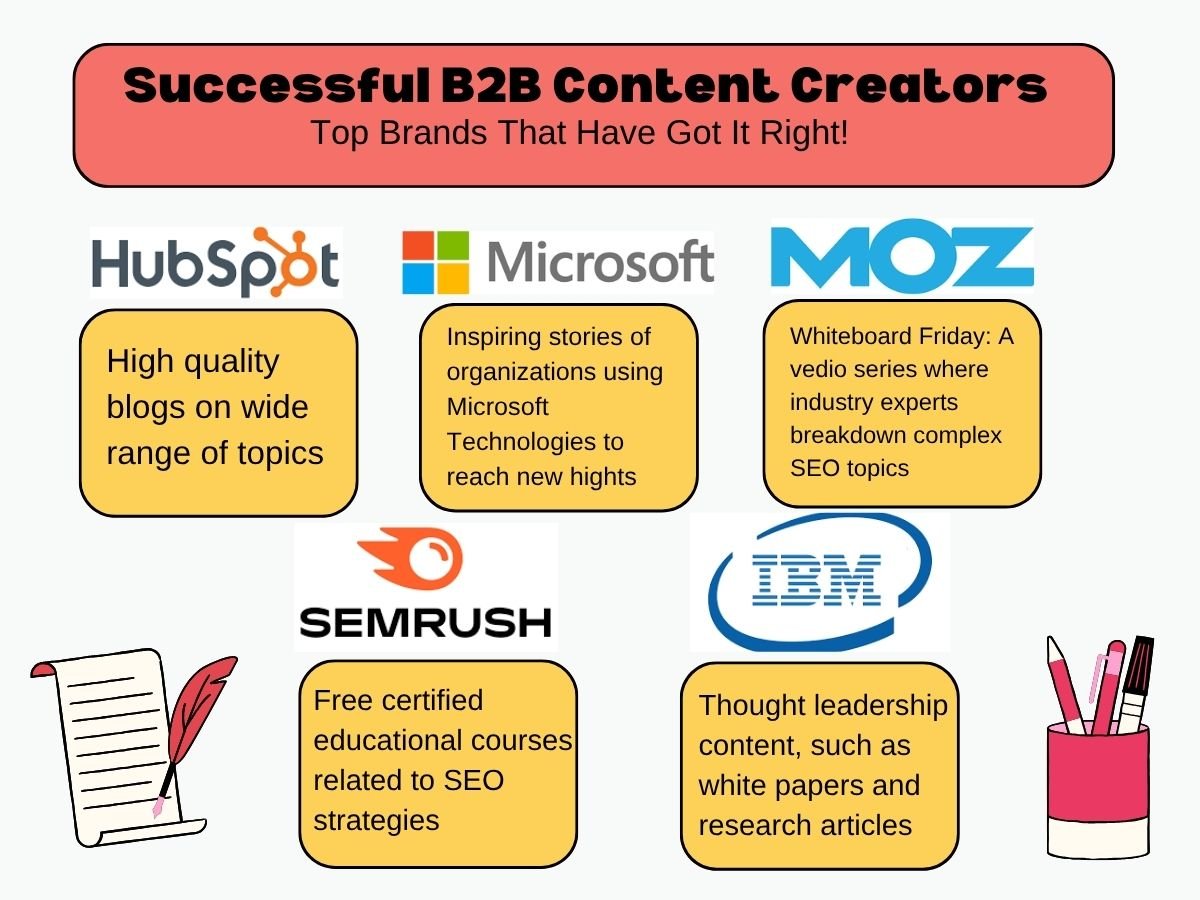
HubSpot has established itself as a reliable resource for marketers by consistently publishing high-quality blog content on a wide range of topics, from SEO techniques to sales strategies. Its educational articles empower businesses to enhance their marketing performance, attract more website visitors, and convert leads effectively. 

Example 2: Semrush

The visibility management SaaS platform Semrush offers free educational courses to help users learn and apply effective SEO strategies. This B2B content marketing approach demonstrates how customers can use its tools while showcasing the value it provides to potential clients. To make the experience more engaging, Semrush rewards learners with certificates upon passing an exam.

Example 3: Shopify

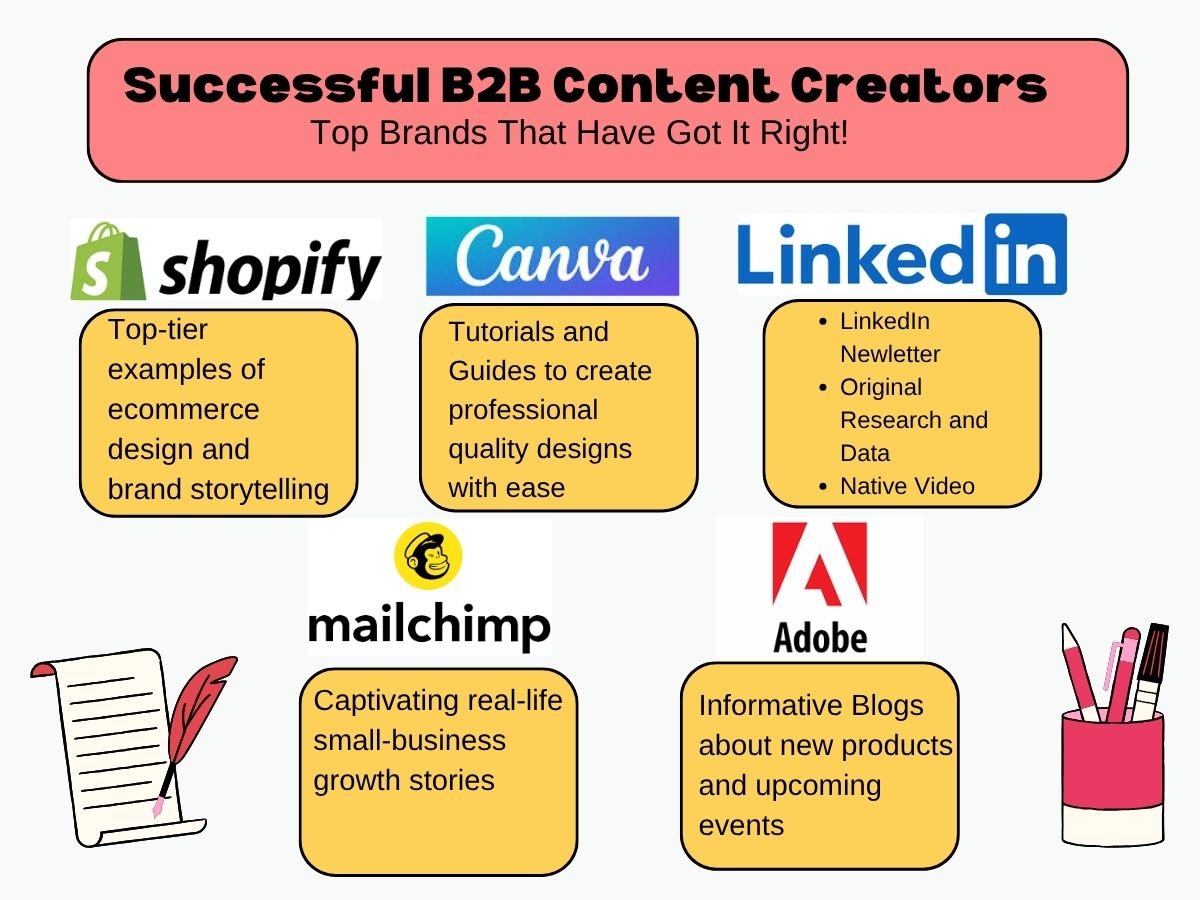
Shopify, a leading Canadian e-commerce platform, provides a large range of services that enable online retailers to create stores, manage sales, process payments, handle shipping, and market to customers. The company benefits from diverse content formats such as blogs, videos, podcasts, online courses, how-to guides, and a user forum to support every stage of its marketing funnel. By improving this content for relevant keywords, Shopify improves its search rankings and generates more traffic to its website.

Example 4: Mailchimp

Mailchimp connects with its audience through captivating and informative content. Sharing insightful stories about marketing and small-business growth helps the brand grab attention and strengthen its reputation as an expert resource in the industry. To learn how to write impactful case studies, read our blog on How to create B2B case studies.

Example 5: Canva

Canva, a popular graphic design platform, helps users create visually compelling social media posts, presentations, and marketing materials. The brand exemplifies effective B2B content marketing by applying the same principles it teaches using appealing visuals, clear messaging, and clean design to engage its audience.

Through blogs, tutorials, guides, and events, Canva focuses on conveying a seamless user experience while showcasing its core value. This consistent, customer-centered approach has made Canva a trusted resource and a strong voice in the design industry.
Example 6: Adobe

Adobe is a strong example of effective B2B content marketing, especially for brands aiming to engage a diverse, creative, and global audience. The company shares a wide variety of content, from inspiring customer stories, such as an artist using creativity to process grief, to filmmakers producing a movie with Adobe Creative Cloud.

It also publishes informative blogs about new products and upcoming events. Adobe’s content consistently educates, motivates, and empowers both its prospects and existing users.

Example 7: Microsoft

Microsoft’s Stories series stands out as a powerful example of B2B content marketing. It throws light on the people and organizations using Microsoft technologies to achieve goals. From students designing robots for social good to innovators using AI to tackle global problems, each story reveals how Microsoft solutions help drive meaningful change. 

By showing how its technology helps people in real life, Microsoft makes it a tool for progress instead of just another product.

Example 8: IBM’s Thought Leadership Strategy

IBM uses thought-leadership content, such as white papers, research reports, and expert articles, to spotlight its technology innovations and expertise. This strategy helps the company earn trust, build credibility, and strengthen its reputation as a leader in the industry.

Example 9: Moz

Moz is an SEO platform and digital marketing toolset designed to help businesses increase their online visibility. The company connects with its audience through its popular educational video series, Whiteboard Friday. Presented in a friendly and approachable style, these videos feature industry experts who share insights on SEO trends, strategies, and best practices. 

Covering topics from new search trends to effective content planning, the series positions Moz as a trusted thought leader while promoting its range of services.

Example 10: LinkedIn B2B Institute

The LinkedIn B2B Institute is a research center that explores new ways to drive B2B growth. It regularly shares content on marketing trends and best practices to help businesses enhance their marketing, attract more valuable website traffic, and generate quality leads. In doing so, it also strengthens LinkedIn’s brand as a go-to platform for B2B marketers looking to stay ahead of the competition.

The B2B Video Shift

If you think video is only for B2C brands, the numbers say otherwise. 58% of B2B marketers consider video marketing as an effective content type, and 37% are actively increasing their video budgets in 2026.

Today’s B2B buyer uses video at every stage of the purchase journey. From short-form LinkedIn videos for discovery, to in-depth explainer videos and webinars before making a final decision. In fact, video has become one of the most effective formats for reducing buyer hesitation and building trust.

Moz has understood this for years. Their Whiteboard Friday series consistently turns complex SEO topics into accessible, engaging videos that educate their audience. Shopify leverages a full mix of video formats, including tutorials, how-to guides, and founder stories, to support every stage of its marketing funnel.

The message is clear: video is the format your buyers are actively seeking out. Whether it’s a 60-second LinkedIn clip or a 20-minute deep-dive webinar, showing up on video instantly builds trust.

Combine AI Speed with Human Depth to Rise Above the Noise

The rise of AI has completely changed how B2B brands create and distribute content. According to recent data, 85% of B2B marketers now rely on AI tools for content creation. Using AI tools to brainstorm ideas, summarize research, and draft content at scale.

But as AI makes content creation faster, the internet is flooded with generic posts that all sound the same. This is why the top brands bet on what AI cannot replicate: original research, first-hand expertise, and real customer stories.

Brands like IBM are already ahead of this curve. Their white papers, research reports, and expert-driven articles are built on genuine insight and credibility. Adobe takes a similar approach by sharing real customer stories that inspire and educate, giving their content a human depth.

So, the final takeaway for your B2B content is to use AI to work smarter, but invest in experience-led content to stand out. Buyers can tell the difference, and so can Google

To learn more about effective B2B marketing stratergies read our blog on 7 content hacks for successful B2B marketing.

Conclusion

The best B2B content marketing examples prove that real success comes from consistently delivering useful, engaging content. When brands share educational resources, real stories, and practical insights, they build trust and long-term relationships. By taking inspiration from these leading companies, you can shape a content strategy that strengthens your brand, attracts quality leads, and supports sustainable business growth. Visit Content Fayah to start building a powerful content marketing strategy customized to your business goals today.

 If you’re ready to create B2B content that not only ranks but also resonates with your audience, let Content Fayah help you.
Contact us
What is B2B content marketing?

B2B content marketing involves creating and sharing valuable content to attract and engage other businesses, build trust, and drive sales or partnerships.

Why is B2B content marketing important?

It helps companies establish authority, nurture leads, and create significant relationships with their target businesses, leading to long-term growth.

What types of content are best for B2B marketing?

Blogs, white papers, case studies, videos, webinars, and podcasts are some of the most effective formats for B2B content marketing.

How can a business start a B2B content marketing strategy?

Start by understanding your audience, setting clear goals, choosing the right content formats, and focusing on consistency and value. Learn from examples set by top B2B content marketing brands such as HubSpot and LinkedIn.
Categories
Content Marketing Content Writing

Seamless Cross-Media Marketing Guide for Manufacturing Brands

Your competitor just got a lead because their blog showed up on Google search results. Here’s why cross-media marketing is no longer optional for manufacturers. 

It is high time that the manufacturing industry realizes that the days are gone when there were only a few manufacturers from whom a distributor or wholesaler could choose. With manufacturing industries mushrooming across the country under the Made in India initiative, competition in the sector has increased. 

Traditional marketing and maintaining just a website is no longer enough for manufacturers. They have to learn to leverage more than a few marketing channels and content formats to build authority and reach as many customers as possible. Research shows that companies that leverage cross-media marketing see up to a 89% higher customer retention and 14% more sales

This blog explores how a manufacturing brand can create successful cross-media marketing and stay ahead of the competition. It dives into the sea of multiple media available to manufacturers to create awareness, generate leads, and drive conversions. It also provides a framework for building an efficient and effective cross-media marketing strategy for manufacturers. 

Why do Manufacturers need a Specialized Marketing Strategy?

Let’s first understand why manufacturers need a special marketing strategy. Marketing strategy for manufacturers differs from that of other businesses because they often deal in complex technical products that require specialized knowledge. This makes them liable to publish content that highlights their specialization and expertise in the field.

Also, the market size is comparatively small as they serve a specific segment with unique needs. So mass advertising will not help them as much as targeted marketing.

Furthermore, the manufacturing industry has a longer decision-making cycle because multiple stakeholders are involved in decision-making, given the high value of the goods. Therefore, their buying journey varies from other businesses and must be catered to accordingly.

These features of the manufacturing business demand specialized marketing content and strategy

Why do Manufacturers need Cross-Media Marketing?

With increasing competition, buyers want to choose the brand that best meets their specifications. Therefore, before approaching the brand directly, they conduct thorough research into what each brand offers. For instance, after watching your brand’s advertisement on LinkedIn or Instagram, they might search for your website online. They will review your online content, such as blogs, case studies, or white papers, if any, to assess your expertise. They will then read the customer reviews on Google before finally contacting you. 

Thus, Cross-Media marketing ensures: 

  • Your presence is felt across all major platforms, thus improving visibility and credibility
  • You reach more buyers  
  • Brand awareness is reinforced with repeated touchpoints
  • Every stage of the buyer’s journey, from awareness to consideration, is catered to through different channels
  • Higher ROI 

Tata Steel is a leading example of a manufacturing brand successfully leveraging cross-media marketing. From publishing blogs and case studies on websites and LinkedIn to posting product demonstrations and behind-the-scenes on YouTube. And from maintaining strong presences at trade expos to advertising their sustainability initiative on TV, they have made their presence felt on all major media platforms and have established themselves as a trusted authority in the steel industry.

Key Platform that Works for Manufacturing Brands

Even though manufacturers have a comparatively small market size and don’t need to be everywhere, they must make their presence felt on all major media platforms where buyers can be. Let’s have a look at platforms that no manufacturer should ignore to get a competitive advantage.

  • LinkedIn
    LinkedIn is the top B2B platform for lead generation, with around 77% of B2B marketers using it as a primary channel.
  • Google & paid search
    Buyers type product and problem keywords into Google daily. When done right, Google Ads can turn a near‑zero‑lead website into a steady pipeline of qualified leads.
  • Email marketing
    Email remains a direct line to your existing contacts and prospects. It is perfect for nurturing long‑cycle manufacturing sales with technical content, case studies, and personalized offers.
  • Social media (Facebook, Instagram, industry portals)
    While whitepapers and technical blogs build trust, social content (especially short videos and reels) makes your brand more approachable.
  • Podcasts are a powerful medium for establishing thought leadership, especially in industrial niches.
  • Trade shows and OOH: In addition to digital media, manufacturers also need to make their presence felt in physical space. Trade shows and business expos provide a great opportunity to meet and interact with buyers who are genuinely interested in your products. Your presence in these events will build credibility and allow you to meet customers and make an impression by explaining your complete scope of business and how you can help them grow. And collect their business card to nurture them with proper content through email further.

Out-of-home (OOH) advertising, such as billboards, will provide constant exposure to a large local population. 

Effective Content for Manufacturers for Lead Generation Across Media

About 76% of businesses, including those in the industrial and manufacturing sectors, report that content marketing boosts lead generation and demand. Manufacturing brands that keep their websites updated with useful content see an average visitor-to-lead conversion of about 5 to 8 percent and an overall conversion rate of 4.6 percent.

A U.S industrial plating company partnered with a marketing agency to rebuild its website, optimize SEO and launch Google Ads. Within one year, it generated $1 million in additional revenue and grew its inbound pipeline from 0 to 100s of qualified leads. This is the power of good quality content. 

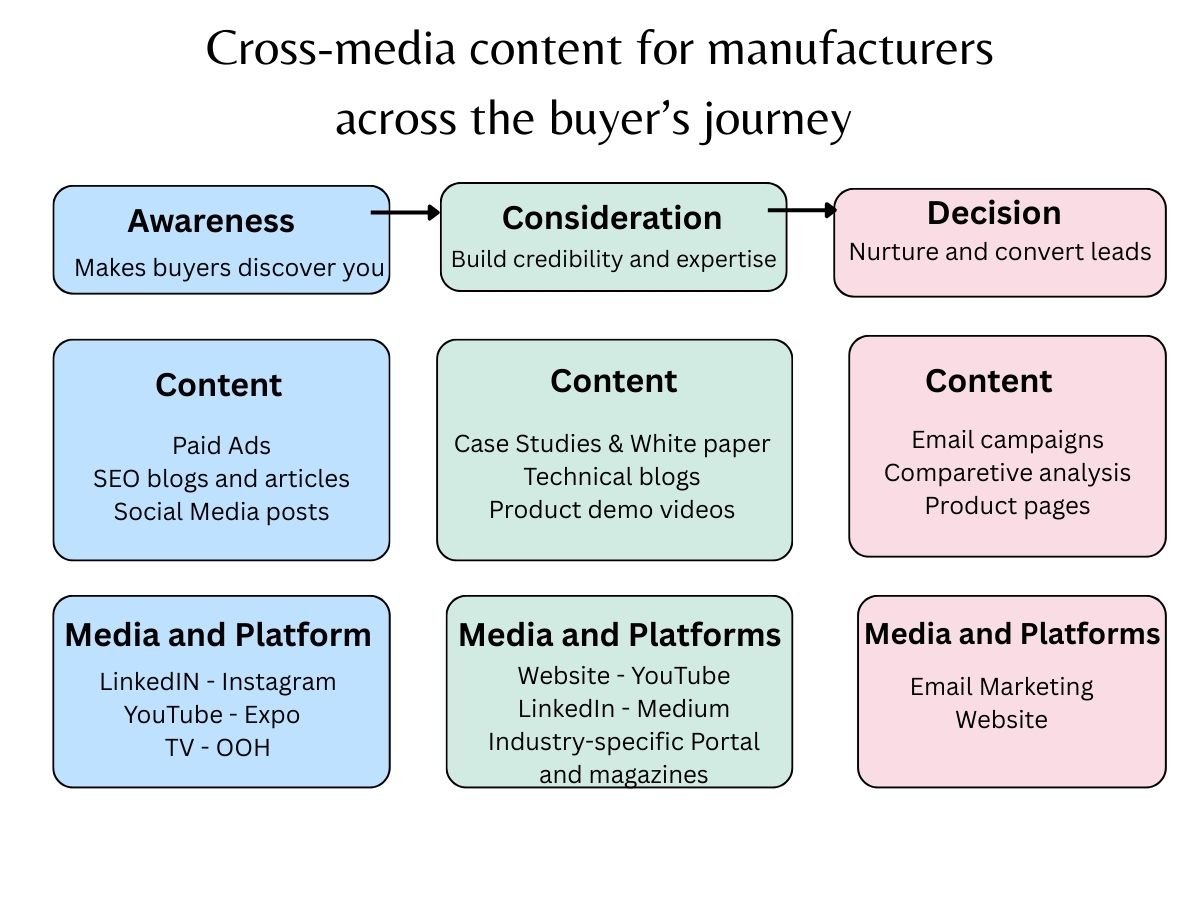
Effective cross-media content for the manufacturer across the buyer’s journey:

Awareness Stage

This type of content will help the prospective buyers to find your brand and create awareness of the products and services you have to offer

  • Paid advertisements on Google search, LinkedIn, Instagram and YouTube
  • SEO content like blogs, posts and articles on websites and LinkedIn

Consideration Stage

Through this content, you aim to establish your credibility in the market. The content at this stage should reflect your authority and expertise in your field. This is the lead generation stage.

  • Case studies, whitepapers and technical blogs on websites and other platforms like Reddit, LinkedIn and Medium
  • Presence on industry-specific portals and Magazines
  • Video of product demonstration on YouTube

Decision Stage

Leads generated in the early stages should be further nurtured so they are sure they are making the right decision by choosing you over your competitors. To learn more about this stage, read our blog on ‘What is BOFU?’

  • Email Nurturing 
  • Comparative Analysis with other available brands
  • High Quality Product Pages 

A Framework to build a seamless cross-media campaign

  1. Map your buyers: Identify who you want to target, on which platforms you will find them, and what content format will help them through the buyer’s journey.
  2. Set clear goals for each platform: Define what you want to achieve by leveraging each platform. For instance: LinkedIn for thought leadership and brand building, Google Ads to capture high-interest buyers searching for the same or similar products and Email to nurture leads through a long sales cycle.
  3. Keep your brand voice consistent: While adapting formats to the platforms, keep your tone, values, and key message consistent.
  4. Track and Improve: Define performance indicators for each platform and track the key metric using analytical tools. Understand the reports and improvise accordingly.
  5. Interlink the platforms: Provide links to your blogs in emails, or offer trade show visitors a code to unlock a white paper for free. This will create a loop to help your content reach buyers in multiple ways.

FAQ’s

Q1. How is cross-media marketing different from multichannel marketing?

Multichannel marketing simply means being present on multiple platforms. Cross-media marketing goes a step further — it ensures all those platforms are connected and working together as one seamless experience. For example, a buyer sees your LinkedIn post, visits your website blog, receives a follow-up email, and finally converts — that entire journey is planned and interlinked. That is cross-media marketing.

Q2. As a small or mid-size manufacturer, do I need to be present on all platforms?

Not necessarily. You don’t need to be everywhere — you need to be where your buyers are. Start with 2-3 platforms that are most relevant to your industry. For most manufacturers, LinkedIn + Google + Email is the strongest starting combination. Once you build consistency there, you can gradually expand to other platforms like YouTube or industry portals.

Q3. How long does it take for cross-media marketing to show results for a manufacturing brand?

Cross-media marketing is a long-term strategy, not a quick fix. Given the longer decision-making cycle in manufacturing, you can typically expect:
1-3 months — improved visibility and brand awareness
3-6 months — increase in website traffic and lead inquiries
6-12 months — measurable growth in qualified leads and conversions
Paid ads on Google and LinkedIn can show faster results, while SEO and content marketing build momentum over time.

Conclusion

Manufacturers can create an unfaltering strategy to reach as many buyers as possible by developing a multi-platform content marketing plan. Start by mapping the buyer’s journey and creating specific content for multiple platforms according to the buyer’s needs.

The next step is to interlink the cross‑media campaign, connecting search, social, email, and offline events into a seamless experience that repeatedly guides buyers into your sales funnel.

Want a cross‑media marketing strategy that actually converts for your manufacturing brand?
Let Content Fayah craft high‑impact, SEO‑friendly content across LinkedIn, Google, email, and your website.
Call Content Fayah today and turn your manufacturing brand’s expertise into a steady flow of qualified leads.
Contact us

Categories
Blogs Content Marketing Content Writing Post

Updating Online Content for Better Performance

Introduction

Nothing makes a content creator happier than knowing their content ranks on Google’s SERPs and generates leads.

Every Content masterpiece needs time and effort to rule the charts.  But reaching peak performance is hardly the end of the story. Over time, content performance changes, and when it does, we know it is time to take action: update the old blog or refresh the website content. 

A HubSpot study found that refreshing online content led to an average 106% increase in organic traffic.

Online content must be managed in accordance with the company’s content maintenance strategy. Its performance must be reviewed regularly, and, if necessary, refreshed and updated to extend its lifespan. 

This blog explores why, when, and how online content must be updated to improve performance. It also provides a practical, easy-to-follow framework for the update process, so your content stays fresh and relevant for longer.

Why is the content update necessary?

Every piece of content contains data and information that the audience is searching for. The data can become outdated, information can become obsolete, and search intent can change over time. It is natural, then, that high-performing content can decline in rankings and conversions because Google prefers fresh, authentic content that precisely matches its customers’ search intent. According to 90% of marketers, updated older content outperforms new content.

When is the best time to update the content?

There is no one best time to update a particular piece of content. Rather, there are signs to watch out for and events that may necessitate a content update. 

Events that require content updates.

  • Changing your web address: If you have changed your web address, please notify Google. Make all necessary changes to your internal and external links, and create proper redirect pages where needed so that visitors can find your pages easily.
  • Updates to products and services: If the company has made any changes to products or services, including additions or updates, they should be updated online immediately.
  • Updates in general or marketing site copy: If there are any changes made in the branding, then it should immediately reflect not only the new content but also all the content that is already present online. 

As we have already discussed, the primary sign to look for is a failure in the content’s performance. Watch for red flags, such as a decline in rankings, lead generation, or conversion rates. If you notice any of these signs over the next few weeks, it is time to update and refresh your content.

Signs that require content updates

  • Inspect SEO scores: Use content optimization tools such as Clearscope and SurferSEO to review your content’s SEO performance and suggest fixes to improve content rankings, if needed. Read our blog on ‘Best Keyword Optimization Techniques to try’, if you are interested in learning more about SEO.
  • Check for a mismatch in Search Intent: If your page is no longer ranking for its intended queries, run a competitor content analysis to identify what your content lacks relative to competitor content, and make updates accordingly.
  • Review information accuracy: Google ranks accurate, properly referenced content on facts and figures. Always keep your data-driven content up to date. Content with obsolete data leads to reduced traffic, lower CTR’s and higher bounce rates.
  • Scan for Technical Glitches: If your SEO score, search intent, and information accuracy are in check but your pages still aren’t ranking or driving conversions, the issue could be a technical glitch, such as a broken link, indexing issues, or multi-device adaptability. 

How often Should You Check for Update Signals?

Now, let’s answer the big question: how often should you check for the signs that indicate the need for an update? Or how often do you do content performance tracking?The answer is simple: Content audit effectively identifies the signs indicating updates, such as traffic decline, ranking drop and increasing bounce rates. Content audit frequency is typically once or twice a year. Therefore, align your content updates with content audits for non- critical pages.

However, review and update critical business pages, such as product and landing pages, every few weeks. Frequent monitoring of business-critical pages enables early detection of problems and prevents escalation. Free analytical tools, such as Google Analytics, can help you track performance with ease and suggest the required updates. 

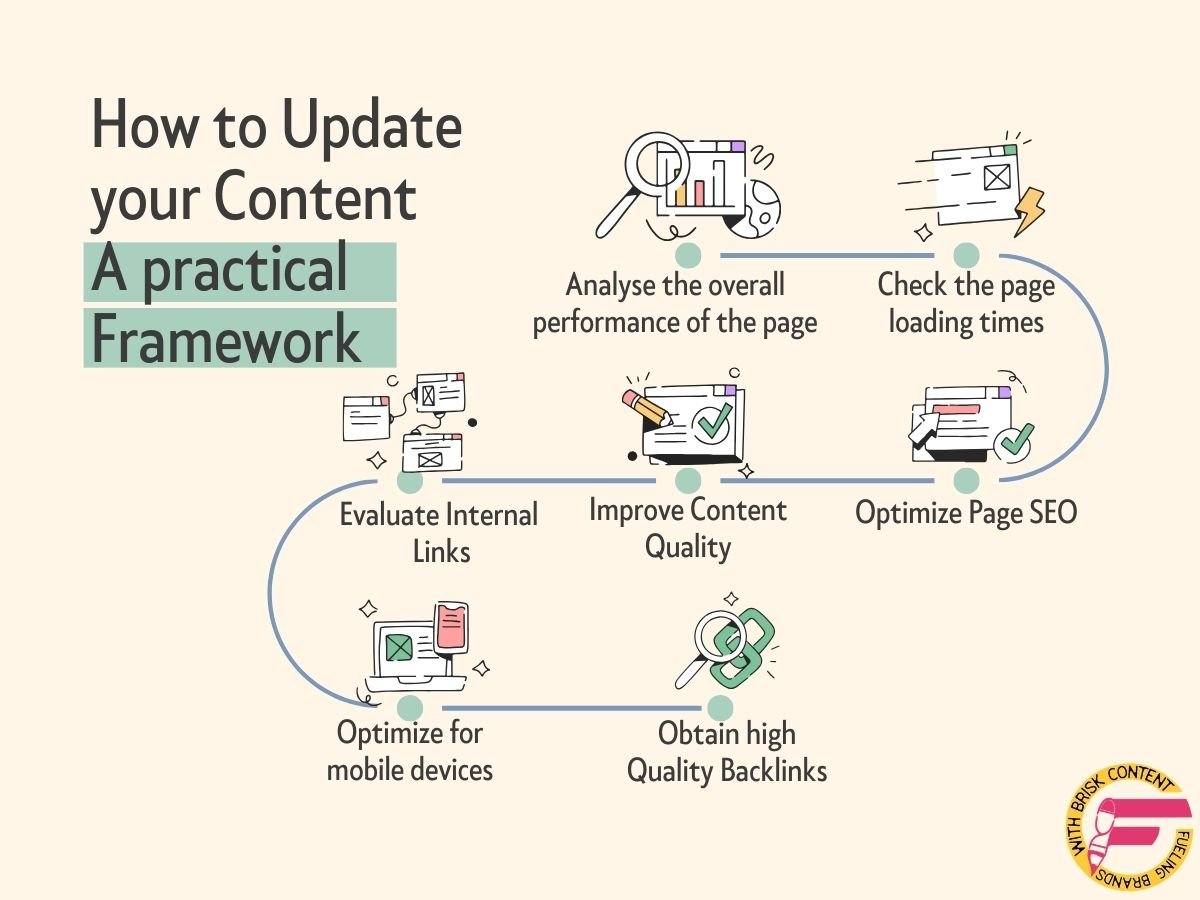
How to update your content: A practical Framework 

Follow these steps while updating and refreshig old online content and you will have a better performing content as the end result.

Once you have identified content that needs updating, use this simple framework to guide you through.

  • Crawl your pages using analytical tools to assess overall page performance and note down the problem areas.
  • Check page loading times. If slow, optimize videos, images, and scripts.
  • Optimise the headers, meta-descriptions and URL slug in accordance with the latest SEO keywords
  • Improve content quality by updating facts, figures, and publication dates, and by enhancing multimedia content in accordance with the pages that are ranking high. 
  • Evaluate and fix internal links
  • Work on improving the user experience(UX) over multiple devices
  • Focus on obtaining high-quality backlinks to improve visibility

Conclusion

Your online content can drive significant business growth. It is essential to keep it fresh and relevant to leverage its full potential. By conducting regular content audits, monitoring performance red flags, and following a systematic update framework, you can extend your content’s lifespan and maximize its performance. 

Online content experts at ContentFayah can help your business grow by creating and managing your online content. Let us help you fuel your brands’ online presence with our brisk content strategy. 

FAQ’s

How often should I update my website content?

The frequency of content updates depends on the type of content. Review critical business pages, such as product and landing pages, every few weeks. However, update general content during your annual or bi-annual content audits.

How will updating my old content improve my SEO rankings?

When you update old content, the SEO rankings improve because Google favors fresh, accurate, and relevant content. Update the content strategically by refreshing outdated information, adding new keywords, and improving E-E-A-T.

What’s the difference between refreshing and rewriting content?

When content is refreshed, data, statistics, keywords, and formatting are updated while the core message remains intact. Whereas rewriting means creating the content from scratch with a new angle or approach to a certain topic. 

How do I know which content to update first?

Start by running an analytical tool to identify the underperforming pages. Once the tool identifies the pages with issues, focus on those that historically drove significant traffic or conversions and have the best potential for recovery.

Categories
Blogs Content Writing

17 Types of Written Content to Boost your Marketing Strategy

Content! It’s everywhere, and everyone is talking about it. In recent years, online content has emerged as the undisputed ‘King of Marketing’. Even though there are three major types of content: written content, video content, and audio content. But writers are not only responsible for written content; they are also responsible for producing video and audio content.

If people find your written work interesting, you can create a range of content and turn your gift into a source of income. This blog explores different types of content that companies create. So, read along to understand the purpose behind each type of content and its features and find out which type of content is best for you.

  1. SEO – GEO Writing

SEO (Search Engine Optimization) is a domain of content writing in which primary goal of content is to rank higher on Google search engine result pages (SERPs). The written copy integrates user-friendly information with well-researched keywords and phrases to help it rank on Google.

But more recently, the attention has shifted from SEO to GEO. What is GEO? Well! The introduction of AI into search engines has given rise to Generative Engine Optimization (GEO), where intent to rank higher in AI search engines such as Perplexity and Grok. To rank in AI search engines, content needs more than just high-ranking keywords. AI search engines check for authenticity, relevance, and up-to-date data when ranking pages. Pages that have properly referenced, unique, and recent data often rank higher. Since AI also powers Google search engines, content writers are now working on both SEO and GEO, aiming not only to rank but also to secure a spot in Google Overview.

Want to know more about GEO, our blog of ‘GEO in 2026’ is a comprehensive guide on this subject you wouldn’t want to miss.

  1. Blog Post

Blogs, derived from Weblogs, are creative, regularly updated content on various topics posted on websites. They written to share personal experiences, thoughts, views or expertise on multiple subjects. The two main types of blogs are:

Personal Blogs – Posted on a personal website to share travel experiences, personal views, or specific expertise. There are various types of bloggers, including food, fitness, and lifestyle bloggers. Those who believe they have a unique idea worth sharing. Furthermore, they can turn their blogs into a source of income by earning affiliate commissions from affiliate links. Examples of famous blogs include Labnol.org by Amit Agarwal, a tech blogger; YouStory by Shardha Sharma, which covers real-life startup stories; and TheShootingStar by Shivya Nath, which covers diverse travel experiences, to name just a few.

Corporate Blogs – Companies publish them to boost brand identity. A well-informed blog post can drive more visitors to the company website. Commercial bloggers optimize their blogs to improve their rankings in Google search results. Examples of corporations with strong blogs include Aster for health-related content, IBM for tech and data, and Airbnb for travel-related content, among others.  

  1. Articles

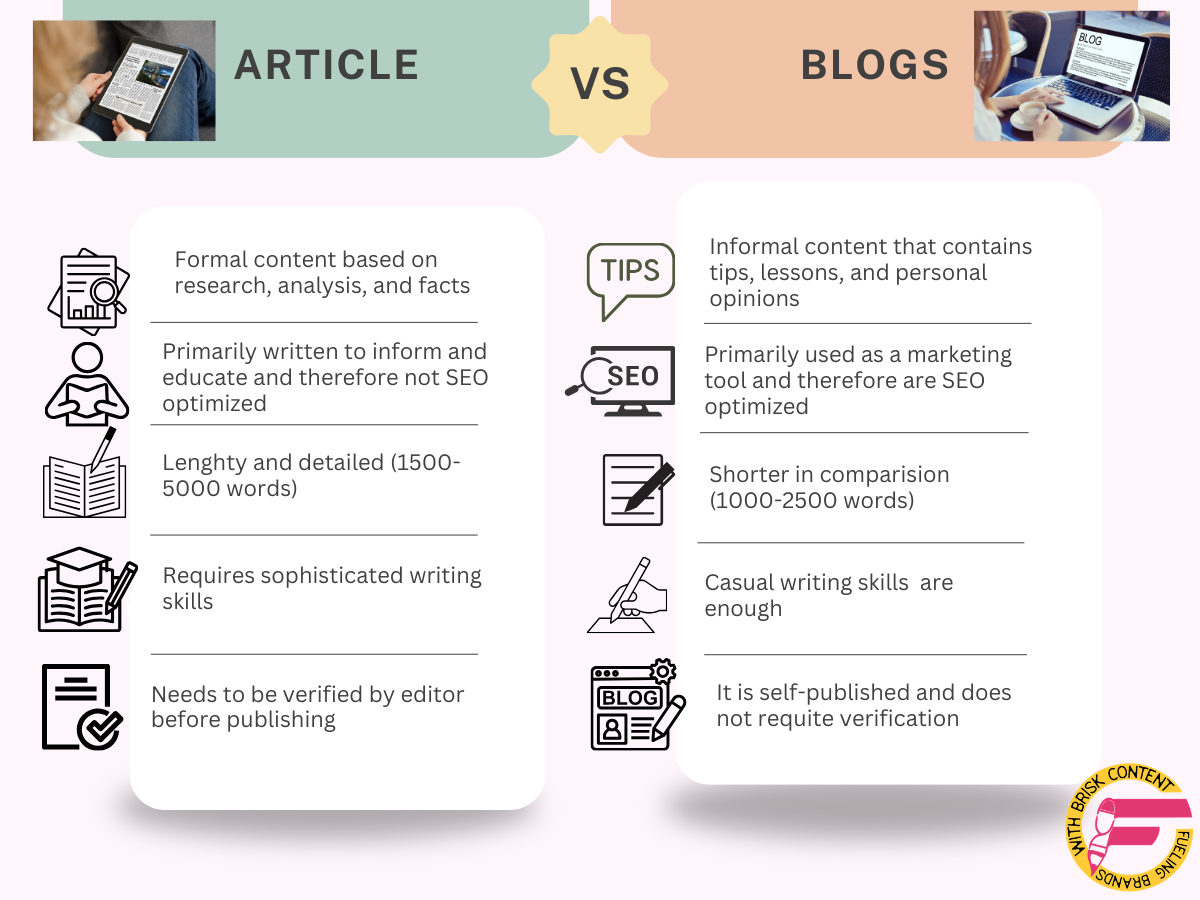
Articles are widely used written content formats in digital and print media. They inform and educate a target audience on a specific topic. Unlike blogs, articles tend to follow a more formal structure and are long, in-depth pieces of written content, making them a more credible source of information. 

They are published to establish authority in magazines, newspapers, online publications, and industry platforms. In content writing, articles are a powerful tool for building brand credibility and delivering value to readers.

Difference between a blog post and an Article
  1. Copywriting

Copywriting is a purely commercial form of writing. The copywriters create persuasive content with sales in mind. The aim is to win customers with their clever writing. Copywriters write content for advertising campaigns, sales pitches, and tag lines. The objective is to capture the audience’s attention and convince them that your product will provide the solution they are looking for. The writing should be attention-grabbing, clear, and concise. In a few impactful words, it should convince the audience to take the intended action, such as buying, investing, subscribing, or visiting your store or website. Examples of some impactful copywriting are: ‘Because you’re worth it ’- L’Oréal, ‘Just Do It ’-Nike, ‘Daag Acche Hai ’-Surf Excel, ‘Kuch Meetha Ho Jaye ’-Dairy Milk, etc.

Click here to read more about tapping into the power of Copywriting.

  1. Social Media Post

The popularity of social media has pushed brands to leverage it as a marketing medium. Corporate businesses maintain accounts on social media platforms such as LinkedIn, Instagram, and X to influence their target audience online.

Content creators craft content tailored to the audience in form of trending reels, articles, posts, polls, etc. Through these platforms, companies aim to engage their audience, understand their views on products and services, and identify any unmet requirements. The audience primarily uses these platforms for entertainment; therefore, the content should be engaging enough to capture their attention while remaining meaningful and effective. Zomato, Airbnb, Dove, and Amul are examples of successful marketing campaigns.

  1. Branding Copy

To put it simply, branding copy gives the company its personality. It builds a distinct voice for your brand in consumers’ minds, one they will always associate with your company. Unlike copywriting that drives immediate sales, branding copy establishes what your brand stands for. Concurrently, it remains consistent across all platforms. Excellent branding copy doesn’t just describe what you do; it communicates why you exist and what makes you different. When done right, it turns customers into loyal advocates who choose your brand not just for the product, but for what it represents. Examples of a few impressive brand copies are

  • Apple’s “Think Different” -The brand became synonymous with innovation and creativity.
  • Amul’s “The Taste of India” – Established Amul as a homegrown, trustworthy brand deeply rooted in culture and values, which each indian can connect to.
  • Tata’s “Leadership with Trust” – Communicates integrity and reliability, shaping how consumers perceive every Tata product.
  1. Technical Writing

The technical writers make complex technical information simple enough to be understood by a layman. They are employed by firms, such as engineering, medical, and law, to explain complex concepts to the public. Majorly, technical writers write product descriptions and how-to manuals that accompany the product. They help consumers navigate the technical details with ease. For instance, if you buy a new laptop with many features, the ‘how to set up’ or ‘steps to setup’ manual that comes with it is written by a technical writer who step-by-step guides the user, who could be anyone from a grandfather to a housewife, in a way that is easy to understand. 

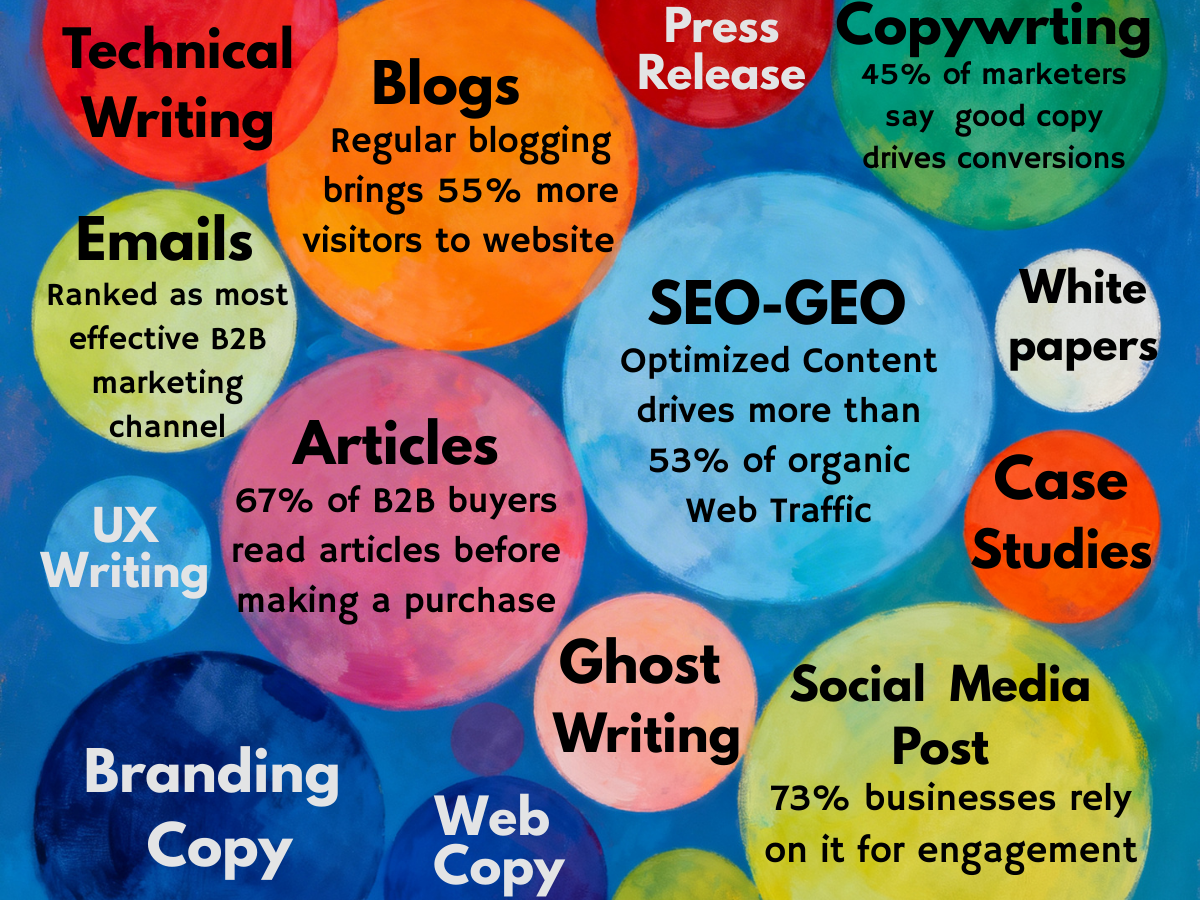
Types of Content
Explore why written content is important
  1. Web Copy

Web copy is the writing of engaging content for web pages. Neat, clean, and formal webpages convey a sense of trustworthiness. A user-friendly and attractive web copy engages visitors, keeps them on the website, and encourages them to explore its features. The copy should also include a clear Call to Action (CTA) to boost conversions. The copy creator should keep in mind that the users can access the website on other smart devices. Engaging, easy-to-understand web page content enhances the user experience, boosts sales, and builds customer loyalty. To learn more about how to write a successful web copy, read our blog ‘Web Content Writing for Business’. Examples of well-constructed web copy include the ZARA online store, which features a clean design and high-resolution images.

  1. Email 

Email is a trusted and efficient channel for communicating with consumers. They can be used to deliver advertisments and send newsletters. Email writers should include a hook in the subject line, make the message as personalized as possible, and include a clear call to action. A professional should sign off on them to confirm the sender’s identity (rather than just adding the company name; include the name of the marketing or HR manager). Content writers must also craft an email newsletter, a powerful tool for fostering customer loyalty and positioning the brand as an industry leader.

  1. Academic Content Writing

As the name suggest academic content writing is related to education. Academic content shares knowledge through carefully researched material backed by formal evidence and appropriate citations. It is detailed and is created only for a specific audience. Research papers, textbooks, and theses are all examples of academic content.

  1. Case studies 

Case studies strengthens customer loyalty and trust. They are in‑depth reports that describe how a business succeeded or failed in serving a particular client. It often highlights how their product, service, or solution addressed their customers’ requirements or failed to do so and what they learned in the process.

  1. Whitepapers

White papers are detailed and influential reports on a company’s products, services, or topics related to its field of expertise. The goal is to subtly persuade consumers by addressing a need and proposing a viable solution. It is supported by original research and analysis done by the author. White papers were initially issued only by government bodies, but more recently, they have been used as a B2B marketing strategy. 

Companies build credibility by demonstrating deep industry expertise through whitepapers. This, in turn, leads to customer trust and a competitive edge in the market.

  1. Press Release

When a corporation wants to make an important announcement to the public, they do so through the media. These announcment are known as a Press Releases. The company issues a press release to announce a product launch, an event, a milestone, financial results, new partnerships, awards, or recognition, etc. Companies promote brand awareness and enhance the company’s public image through it. The press release features a catchy, concise yet informative headline: “Tata Motos Unveils New Electric SUV targeting Mid-Range Segment.” or “ITC Earns Highest Global Recognition for Water Stewardship”. When we read these headlines, it becomes very clear what the press release is about.

  1. Ghost Writing

When famous personalities want to write a book on a topic but lack the time or skill to do so, they hire a ghostwriter. A ghostwriter writes a book for someone else but does not take credit for it. The book could be about the writer themselves, like an autobiography or something they want to share with the world. The writer must clearly understand the writer’s thought process and context. Famous sports, business, or political personalities hire them to enhance their public image and establish themselves as leaders in their fields.

  1. Video Script Writing

Short-form videos are the most popular format for sharing content online, especially on platforms like TikTok and Instagram. Script is the soul of the video. A good script is entertaining and engaging, with a strong call to action. Video scriptwriters not only write dialogue but also include details about on-screen actions and visual cues to accompany it, making the content attention-grabbing and engaging. 

  1. Presentations

Writing content for presentation slides is also a form of content writing. Content writers must clearly understand the presentation’s topic and purpose. The slides should highlight only the key points and be concise. Visually appealing elements, such as images, infographics, and videos, are added to slides to make them engaging and help maintain audience attention through to the end.  

  1. UX Writer

User Experience (UX) refers to a product’s usability. It primarily describes how well-designed the digital products, such as websites and apps, are in terms of ease of use. UX writers create content for these digital products to help users operate them with ease, including titles, labels, image labels, and error messages.  The UX team is responsible for making the digital products user-friendly and easy to navigate.

Conclusion

The content writing industry offers multiple prospects for skilled writers. Whether you’re drawn to expressive blogging or persuasive copywriting, there’s a niche for every writer.

Although AI has made content creation faster and easier, demand for skilled content writers is growing because AI-generated content lacks the essential emotional touch only a human can provide.

You can start by exploring the types of content that resonate with you and build your portfolio.  Many successful writers combine multiple content types to create diverse income streams. 

FAQ’s

What’s the difference between SEO and GEO writing? 

SEO (Search Engine Optimization) focuses on improving rankings in traditional search engines only through keyword optimization. Whereas, GEO (Generative Engine Optimization) is used for AI-powered search engines such as Perplexity and Grok, and, along with keyword optimization, it requires that the content be authentic, well-referenced, and up-to-date. Modern content writers now work on both to maximize visibility across all search platforms.

Which type of content writing offers better pay? 

Typically, copywriting and technical writing roles command higher pay because of their direct impact on sales and user experience. However, ghostwriters for high-profile clients and white paper creators can also command premium rates for their services. How much you will earn depends on your expertise and client base.

Can I specialize in multiple types of content writing? 

Absolutely! Many successful content writers combine multiple content types to diversify their income streams. For example, you might write blog posts and social media content for one client while creating email newsletters for another. 

Do I need different skills for each type of content writing? 

Yes, a few specialised types of content writing require specific skills. For example, copywriting requires persuasive skills, and technical writing demands the ability to simplify complex data, etc.

How do I choose which type of content writing is right for me? 

Consider your interests, strengths, and career goals. If you enjoy research and education, academic or technical writing might suit you. If you’re creative and persuasive, try copywriting or branding. Start by experimenting with different types, and analyze what you enjoy and are interested in. Monitor evolving market needs and upskill accordingly to stay competitive.

At ContentFayah, we provide a range of professional writing services. From SEO/GEO-optimized blogs and persuasivecopywriting to technical documentation and engaging social media content. Contact us today if you are interested in and passionate about creating content like ours, or if you are looking for a quality content writer to boost your business growth.
Boost your growth