

Categories
Blogs Content Marketing

Top 5 Tips To Create Effective SEO Content Strategy

“SEO is not about optimizing for search engines; it’s about optimizing for people.”-Rand Fishkin, founder of Moz

When it comes to increasing your website’s visibility in search engine results, it’s best to aim high. An effective SEO content strategy helps your site rank higher on search engine result pages (SERP), the higher your click-through rate and the more organic traffic you’ll receive.

Yet reaching those treasured top slots requires some effort. You’ll need a complete SEO content strategy based on audience, keywords, and user intent, as well as a finger on the pulse of the ever-changing search landscape.

We’ll look at how SEO-driven content fits into your overall search visibility efforts in this post and the important aspects you’ll need to construct an effective campaign.

Components of a Successful SEO Strategy

Before we get started, let’s take a step back and look at the larger picture. According to reports, more than 200 Google ranking factors influence where sites appear in SERPs. SEO content authoring is vital, but it is only one of several.

A thorough SEO strategy consists of four components:

  • On-page SEO helps search engines understand a page’s content, enabling it to be matched to relevant search queries. Writing meta titles and descriptions, using headers, optimizing images, creating informative URLs, and adding internal links are all examples of these tasks.
  • Off-page SEO involves earning backlinks from other websites to demonstrate your content’s credibility and value. A link-building approach may include guest articles, influencer collaborations, or outreach to reference pages.
  • Technical SEO makes it easier for search bots to crawl your site by addressing issues such as site speed, loading times, mobile compatibility, security, and other technical factors.
  • Content SEO is the creation of information that users want to consume. The information should be simple to read, informative, and provide a considered response to the search query.

Implementing a successful Content Strategy

Implementingan effective SEO content strategy makes your website more attractive to search engines, enabling their crawlers to quickly explore, categorize, and rank your content. If you are looking for tips to make your content stand out and rank on SERP, then read our blog on 12 tips to take your content to the next level.

This involves search bots collecting and organizing data based on essential SEO features like metadata and keywords. Ultimately, search engines evaluate a page’s relevance, quality, and user-friendliness to determine its usefulness and placement in search results.

Crafting a Winning SEO Content Strategy

To succeed in the competitive world of SEO, your content must be top-notch and match the needs of your target audience. Google’s aim is to deliver the most appropriate and useful results for users’ searches. As a result, your content must be high-quality and relevant to rank well. To achieve this, you should create a comprehensive SEO content strategy centered on the following key components: understanding your audience, identifying their needs, setting clear business goals, and crafting content that aligns with both your audience’s needs and your business objectives. Building your strategy around these components allows you to create content that engages your audience and improves your search engine rankings.

Target Audience

To start with SEO content writing, it is crucial to identify your target audience. You should understand their needs, concerns, preferred information sources, and content format preferences, such as videos or comprehensive articles. Adjust your content to cater to your audience and use a tone that connects with them effectively.

Industry Niche

SEO content strategies are not one-size-fits-all and depend on the industry niche. Researching customer search terms and competitor keyword targeting is essential. For industries such as landscaping, event planning, plumbing, real estate, and automobile repair, local SEO is crucial. Health and finance businesses that publish on “your money, your life” topics must prioritize quality and subject-matter expertise. In summary, effective SEO content strategies vary by industry, and businesses must tailor their approach accordingly.

Search Intent 

A successful SEO content strategy goes beyond simply targeting keywords and considers the search intent behind them. By understanding the user’s intent, you can create content that directly addresses their questions and needs. For instance, a cosmetics company targeting the keyword “moisturizer with retinol” should determine whether the user is seeking general information about the product or is already aware of the benefits and is comparing different brands. By tailoring content to match user intent, you increase the likelihood of ranking higher in search results and delivering value to your target audience.

Top 5 Tips for SEO Content Strategy 

  1. Conduct thorough keyword research

Use keyword research tools to identify relevant and high-traffic keywords that your target audience is searching for. This will help you create optimized content for these keywords, making it easier for your target audience to find your website.

  1. Optimize your website structure

Ensure your website structure is optimized for search engines, with a clear page hierarchy, easy navigation, and well-structured URLs. This will help search engines better understand the content of your website and make it easier for users to find what they’re looking for.

  1. Create high-quality, engaging content

Publish high-quality content that is engaging and informative for your target audience. This will not only help you rank higher in search engine results but will also help you establish yourself as an authority in your industry.

  1. Promote your content: 

Share your content on social media platforms, email newsletters, and other channels to increase visibility and reach a wider audience. This will help you attract more traffic to your website and improve your search engine rankings.

  1. Analyze and optimize: 

Monitor your website’s performance using analytics tools and adjust as needed to improve your SEO strategy. This includes optimizing your content for new keywords, improving your website structure, and changing your content promotion strategy. By constantly analyzing and optimizing your SEO strategy, you can stay ahead of the competition and continue to improve your search engine rankings.

Final Thoughts 

If you want your content to reach your target audience successfully, start by understanding their needs and preferences. Create content that resonates with them and delivers your message in a way that connects. By doing so, you can improve your SEO rankings and build a loyal following of readers. For the best SEO content, contact Content Fayah.

Categories
Blogs Content Marketing

9 Powerful Content Marketing Strategies to Hold Your Audience’s Attention

Content is everywhere today, but only the smartest brands know how to hold attention in a world full of noise. Your audience scrolls fast, skips faster, and forgets even faster. That’s why you need more than random posts. You need a content plan that grabs attention in seconds, delivers value without delay, and keeps people coming back because they genuinely enjoy what you create. An effective content marketing strategy helps you cut through the clutter, speak directly to your ideal audience, and build trust that lasts. 

When your content is clear, helpful, and memorable, you don’t have to chase customers; they follow you because they feel connected to your brand. This blog walks you through nine powerful strategies that help you do exactly that: capture attention, keep it, and turn it into long-term growth.

What is a Content Marketing Strategy?

A content marketing strategy is a basic plan for making and sharing useful information that your audience cares about. The goal is to attract people, keep them interested, build trust over time, and encourage them to take actions that help your business, such as signing up, booking a call, or making a purchase.

Instead of pushing sales through traditional ads, this approach focuses on delivering real value through blogs, videos, podcasts, emails, and social media posts. It feels helpful, not salesy.

A good strategy connects your content with your business goals, your audience’s needs, and the right platforms, such as your website, email, and social channels. When done well, it helps improve brand awareness, search rankings, and customer loyalty.

Why You Need a Content Marketing Strategy

For a firm to succeed, a clear content marketing plan is essential. It extends audience engagement, increases social media traction, builds trust, and delivers higher-quality, more valuable leads.

Engage audiences longer:

When your content is interesting and valuable, people enjoy it so much they stick around and come back for more, spending more time with your brand.

Produce more traction on social media: 

Sharing content that’s easy to like, comment on, and share helps more people see your brand and talk about it, boosting your presence on social channels.

Build trust with your audience: 

Regularly providing helpful, relevant content demonstrates that you understand your audience’s needs and care about them, which builds trust and fosters loyalty to your brand.

Generate more and higher-quality leads: 

Good content attracts the right people by addressing their needs, guiding them through their buying decision, and encouraging them to take action, such as signing up or making a purchase.

9 Content Marketing Secrets 

  1. Build a Good Website

Imagine a website that’s easy to navigate and looks great. It makes a strong first impression and encourages visitors to stay by enabling them to find what they want quickly and enjoy browsing.

  1. Actual Magic is in the Heading

Your title is the gateway to your content; if it is clear and compelling, it will immediately draw readers in and pique their interest.

  1. Add Some Curiosity Marketing Lines

Tease your audience with questions or hints that don’t give everything away, so they feel motivated to keep reading to learn the details.

  1. Throw a Powerful Emotions Trap

When your content makes people feel something, whether it’s happiness, surprise, or empathy, they’re much more likely to connect with it and share it with others.

  1. Use Fear of Missing Out

If you create a sense of urgency or exclusivity, such as “limited time offer” or “only a few spots left,” it encourages people to act now rather than wait.

  1. Tell a Story via Content 

People love hearing good stories, so share relatable experiences or journeys to make your content resonate and evoke emotion in your audience.

  1. Surprise Hook for Your Audience

Unexpected twists or facts throughout your content keep readers interested and make your message stand out from the usual.

  1. Follow a Trend

When you jump on current trends or popular topics, your content feels fresh and relevant, which naturally draws more attention and engagement.

  1. Add Value to Your Customer’s Experience

Focus on giving your audience something useful, whether it’s tips, insights, or helpful information that makes their life easier or better.

Conclusion & CTA

In the end, holding your audience’s attention isn’t about posting more; it’s about creating content that feels real, valuable, and worth their time. When you focus on clarity, emotion, curiosity, and genuine usefulness, people stay with your brand because they want to, not because you force them to. These tips will help you stand out in a crowded market and turn those who just stop by into loyal followers who trust what you say.

If you’re ready to build deeper connections and grow your brand the right way, start applying these ideas to your next piece of content. Small improvements add up fast, so take the first step today and create something your audience will remember.

1. How can I tell if my content marketing strategy is actually working?

Essential indicators, including website traffic, lead generation, social media engagement, and conversion rate, can be monitored. You can identify which information resonates with your audience and adjust your approach by regularly analyzing these metrics.

2. What type of content should I focus on to connect better with my audience?

Focus on content that provides real value, whether it’s solving a problem, answering questions, or entertaining your audience. Mixing formats like blogs, videos, and social posts tailored to your audience’s preferences works best.

3. How often should I update my content to keep my audience interested without overwhelming them?

Make an effort to stick to a regular publishing schedule that satisfies the demands of your team and your audience, such as once a week or every two weeks. Update outdated content regularly to keep your readers engaged and avoid overwhelming them.

FAQs

1. How can I tell if my content marketing strategy is actually working?

Essential indicators, including website traffic, lead generation, social media engagement, and conversion rate, can be monitored. You can identify which information resonates with your audience and adjust your approach by regularly analyzing these metrics.

2. What type of content should I focus on to connect better with my audience?

Focus on content that provides real value, whether it’s solving a problem, answering questions, or entertaining your audience. Mixing formats like blogs, videos, and social posts tailored to your audience’s preferences works best.

3. How often should I update my content to keep my audience interested without overwhelming them?

Make an effort to stick to a regular publishing schedule that satisfies the demands of your team and your audience, such as once a week or every two weeks. Update outdated content regularly to keep your readers engaged and avoid overwhelming them.

Categories
Content Marketing

Crafting Content Briefs: How to Customize for Every Format

Did you know that content marketing generates over 3 times as many leads as outbound marketing tactics, and guess what: it’s 62% less expensive. Only 89% of marketers with strategic planning (like detailed content briefs) actively use it to drive demand. Imagine you are spinning your wheels on blogs, videos, and emails that collapse because they are not dialed in to each format, wasting time and resulting in zero conversions. Sound familiar? That’s where the content brief, your behind-the-scenes hero, turns chaos into content gold. 

In this blog, we will unpack what a content brief is, reveal a content brief template, and walk through how to write a content brief, from content brief primary keyword research and competing URLs content analysis to crafting a flawless content brief structure. Learn to customize content brief formats, grab content brief examples, and amp up your content brief SEO. Time to craft content that converts.

What Is a Content Brief?

A content brief is your roadmap for creating content that beats the mark every time. You can think of it as a fraud sheet that aligns your team’s vision with audience needs and SEO goals. Unlike an uncertain outline, it details everything from content briefs and primary keywords to tone, structure, and calls to action, ensuring consistency across formats such as blogs, videos, and infographics.

 It saves hours of revision time by front-loading research, making it easy to customize content brief formats for any channel. Whether you’re a solo creator or leading a team, a strong foundation in content briefs turns chaotic ideas into polished, high-performing pieces that rank and convert.

What to Include in a Content Brief?

A solid content brief template includes essential pieces that steer writers while leaving room for their creative spark. Start with your content brief primary keyword and secondary keywords for SEO focus as detailed in The Ultimate Guide to Content Marketing in 2025. Add a reader profile (pain points, demographics), content brief structure outline (H2s, bullet points), estimated word count, and tone guidelines. 

Include competing URLs’ content analysis perceptions, unique angles from original research or expert interviews, and CTAs. Visuals, such as suggested images or data charts, round it out. This checklist makes sure your brief is comprehensive, adaptable, and ready to create content brief magic across formats.

How to Write a Content Brief?

A content brief follows a simple step-by-step process. Start with primary keyword research (Ahrefs/SEMrush for volume/intent). Add secondary keywords. Analyze top-competing URLs for gaps. Set word count by format (2,000+ blogs). Build a reader profile, add original research or expert interviews, then craft a suggested structure with headings/FAQs. Follow this how-to write a content brief path for SEO wins and reader love.

  1. Research the Primary Keyword

Start with your main keyword, the star of your brief. Use tools to check search volume, difficulty, and intent (like informational or buying-focused). Select terms with strong traffic but low competition, such as “content brief template.” This sets up your content brief SEO from the start.

  1. Identify Relevant Secondary Keywords

Support your star with 5-10 secondary keywords, such as “content brief example” or “customize content brief formats.” These expand coverage, boost topical authority, and capture related searches without keyword stuffing.

  1. Analyze the Top-Competing URLs

Check the top 10 ranking pages: their length, layout, and links. Spot gaps like missing data or weak visuals, then plan to beat them. This gives you a clear advantage.

  1. Calculate the Estimated Word Count

Fit the length to your format and competitors: 1,500-3,000 words for blog posts, shorter for social posts. Add more depth for guides. It keeps content full while remaining easy to read.

  1. Add a Reader Profile

Paint a vivid picture: Age, job, challenges (e.g., “Busy marketer struggling with SEO”). Tailor tone and examples to them for deeper resonance and higher engagement.

  1. Perform Original Research

Just don’t go through Google survey readers, crunch fresh stats, or test tools. This adds credibility and shareability, setting your content apart in content brief SEO.

  1. Interview In-House Experts

Talk to your team for real insights. Quotes and stats from SMEs make your brief authoritative and authentic.

  1. Create a Suggested Structure

Outline H1-H3s, intros, lists, and CTAs. Suggest transitions and FAQs for the flow. A sound content brief structure makes writing effortless.

3 Effective Content Brief Examples (+ Why They Work)

Have you ever wondered how top brands create content that ranks well and keeps readers hooked? Real examples show the way. Backlinko adds solid data and smart keywords to drive significant traffic. Relato creates short-story-style email briefs that achieve very high open rates. Beam makes video briefs with clear timings and attractive visuals for short, fast clips. They do well because they combine SEO skills, audience understanding, and the right content format, much like the B2B hacks in 7 Content Hacks for a Successful B2B Marketing. Use their approach to strengthen your content.

Example 1: Backlinko

Backlinko’s briefs are SEO stars. They check top pages, add charts, and break things into steps. This lands them #1 by filling gaps others skip.

Example 2: Relato

Relato does great story briefs for emails and social posts. They hook readers with simple flows. Result? Lots of likes and shares, without pushy sales.

Example 3: Beam

Beam’s video briefs outline hooks within the first 5 seconds, additional clips, and next steps. Built for YouTube, they grow watch time and fans fast.

Conclusion

Content briefs are your shortcut to blogs, videos, and emails that hit home every time. They line up the best keywords, map out reader needs, and sketch a clear path so nothing falls through the cracks. Simple steps like identifying top pages and fresh ideas help everyone move faster with fewer changes. Top brands like Backlinko prove that strong briefs mean more visitors and real impact. Pick up a basic template today, adjust it for your style, and see your content climb charts while pulling in loyal fans. No more wasted effort; just smart, steady wins. Ready to try? Contact Content Fayah now to build your first brief and share your results in the comments. We love to hear how it goes.

FAQs

1. What is a content brief?

A content brief is a short guide with keywords, reader information, and structure to make content easier and more effective.

2. How to write a content brief?

To write a content brief, you need to research keywords, check rivals, add a reader profile, and outline the structure step by step.

3. Why use a content brief template?

It keeps teams aligned, boosts SEO, and cuts revisions to deliver better results faster.

Categories
Content Marketing

Guide to Effective Content Ideation Techniques

In simple terms, content ideation is the process of generating, selecting and developing engaging content ideas in line with your content strategy. As content creation gets competitive, maintaining a steady flow of original ideas is a challenge content creators frequently face. So, how do we stay ahead of the competition? How do we ensure we never run out of creative content ideas?
Following Effective Content Ideation Techniques can help you overcome creative blocks by stimulating your imagination. These research-backed techniques will cover every avenue for idea discovery, every method of idea generation, and every source of inspiration or collaboration that can spark fresh content ideas.

In this blog, we will first examine why content ideation is so essential for content creators. Then we will explore techniques for generating fresh content ideas and discuss tools to streamline and enhance the process. As a bonus, we will further examine why human factors should never be underestimated in the ideation process for creating content that is relevant and grounded in reality.

Why is content ideation essential?

Let’s have a look at some stats by the Content Marketing Institute to understand the importance of Content Marketing today:

  • 91% of  B2B marketer use content marketing to reach their customers 
  • 72% of content marketers say that regularly updated, relevant content helps improve their lead generation.
  • Email campaigns and academic content are the top content marketing methods.

These statistics make it clear that content marketing is the backbone of the marketing strategy and cannot be underestimated. 

Effective content marketing requires a steady stream of engaging content posted on time. The first step to creating content is to come up with an idea for the content. This is where the role of content ideation comes into play. The ideation process helps streamline the generation and development of ideas needed to create fresh content and, therefore, is an indispensable part of a content marketing strategy. 

The first step in the ideation process is generating ideas. Let’s explore some of the most effective content ideation techniques that will ensure you always have enough fresh ideas at your disposal.

Top 7 Effective Content Ideation Techniques

1) Brainstorming

    A group exercise that can generate an extensive volume of ideas quickly. It encourages free thinking and allows team members to build upon each other’s ideas. The goal is to explore a wide range of options before narrowing down to the best options. Brainstorming sessions facilitate wild and quirky ideas, where no final decisions have to be made instantly. Fresh ideas should be jotted down, even if they feel ‘weird,’ as they could spark innovative solutions later. Including people from other departments ensures diverse perspectives and fosters collaboration that drives creative and practical outcomes.

    Miro AI, Claude, HyperWrite, and IdeaMap are some AI tools for brainstorming and idea generation.

    2) Competitor Analysis

      You can generate new ideas for your content by monitoring your rivals to detect gaps where your content can shine more brightly. Survey their topics, keywords, and rankings to uncover what pushes their traffic and where they fall short. Repurpose their high-performing content by adding missed angles and deeper insights to capture more search visibility. 

      AI tools for competitor analysis, such as those from Ahrefs or SEMrush, will help you easily uncover competitors’ top-ranking pages, organic keywords, and total traffic.

      3) Social Listening

        New ideas can also be generated by tracking what your users and potential customers discuss on social media platforms related to your products and services. Monitoring online forums and communities will make you aware of the conversation around your industry. This technique will help you better understand your customers’ preferences and their current concerns. When you create content around these trends and concerns, it will automatically resonate with your audience and help your content rank higher.

        AI tools like Heygen AI and Surfer SEO can help you analyse the data collected to generate optimized organic keywords for your content. 

             4) Customer Surveys and Feedback

        Another way to generate ideas from your customers is to examine product reviews and gather feedback. These often reveal unmet needs and areas that require guidance. These insights can be converted into targeted content, such as FAQs or how-to guides, that address specific concerns and build trust. 

        Alternatively, you can conduct a quick survey or poll via email and social media to gauge preferences and uncover fresh ideas directly. Use open-ended questions such as “What’s your biggest challenge with [product]?” to spark rich, detailed responses across multiple topics. Share survey results as standalone content pieces, such as infographics, to boost engagement and generate even more ideas. This will also help you keep your content calendar audience-focused.

        5) Search Behaviors

        New content ideas can also be generated using keyword tools like Google Keyword Planner or Semrush to uncover what people actually search for. Check auto-suggests and trends to align topics with high-intent queries your audience types daily. This valuable information will reveal relevant topics and popular keywords to inspire you to create SEO content that drives organic traffic. 

        6) Leverage Seasonal Events

        Festivals and holiday seasons can also provide ideas for new content. Keep track of national and international events and festivals. You can boost engagement by aligning content with these seasonal events and tapping into audience excitement.

        Plan ahead with a calendar of key dates, prioritizing high-impact ones for your niches, such as travel and finance. This keeps your content timely and shareable, and boosts conversions year-round.

        7) Keep an Idea Journal

        You can jot down every spark, random notes, overheard chats, or late-night thoughts into a simple app or notebook for later. Review weekly to connect dots across entries and spot patterns for content series. Tag by theme or urgency to build a personal idea bank that never runs dry. Share snippets in team huddles to develop solo ideas into something solid. 

        Adding the Human Touch

        There are a number of AI tools that will help you generate ideas without using any techniques, but these ideas overlook the Human factor. Adding the human touch to content ideation means valuing all the human stakeholders who make that content and for whom the content is made. 

        Genuine ideas emerge from collaboration, avoiding disconnected themes. For example, Airbnb’s cross-team sessions turned host stories into “Experiences” content, growing bookings 25%. We make content for our audience, so it is imperative that we never ignore audience feedback. HubSpot analyzes support tickets to create “How-to” guides that promote engagement by 30%. Trending topics are important, but never undervalue evergreen topics like “SEO Basics” that drive steady traffic. Focus on empathetic storytelling, addressing real challenges, and use customer testimonials to spark global conversations and sales uplift. 

        Conclusion

        Content ideation techniques form the foundation of successful marketing strategies that deliver consistent results. Teams that master brainstorming, social listening, competitor analysis, and customer feedback maintain a year-round pipeline of fresh, audience-focused ideas. These methods, backed by tools like Ahrefs, SEMrush, and Miro AI, eliminate creative blocks while ensuring content aligns with search trends and real user needs. Statistics from Content Marketing Institute confirm 91% of B2B marketers rely on content marketing, with 72% seeing improved lead generation from regular, relevant posts. The human touch remains irreplaceable, blending AI efficiency with empathetic storytelling for authentic connections.

        Ready to build an unstoppable content pipeline? ContentFayah specializes in turning ideation into high-ROI campaigns. Schedule your free strategy session today and get a custom content calendar plus 3 ready-to-publish ideas tailored to your brand. Transform scattered thoughts into steady growth. Start now.

        FAQs

        1. What are the most effective content ideation techniques for 2026?

        Brainstorming, competitor analysis, social listening, and customer surveys top the list. Tools like Ahrefs, SEMrush, and Miro AI streamline the process while human collaboration ensures ideas stay authentic and audience-focused.

        2. How can AI tools enhance content ideation without losing the human touch?

        AI excels at competitor analysis (Ahrefs), keyword research (SEMrush), and brainstorming (Miro AI), but human insight adds empathy. Combine AI-generated data with customer feedback and team brainstorming to create content that ranks high and resonates deeply.

        3. How often should content creators practice ideation techniques?

        Weekly brainstorming sessions plus daily social listening keep ideas flowing. Review your idea journal every Friday and align monthly with seasonal events. Consistency across techniques prevents creative blocks and maintains fresh, SEO-optimized content.

        Categories
        Content Marketing

        What Is Thought Leadership Content?

        Did you know that nearly 75% of executives have explored products or services they weren’t initially considering after engaging with quality thought leadership content? Thought leadership is now one of the most trusted ways to learn about a company’s expertise and value, far beyond traditional ads. It helps brands and experts share real knowledge and fresh ideas through posts, blogs, podcasts, or even books. This builds trust, opens new opportunities, and connects you with the right audience. 

        This blog will guide you through everything you need to know to successfully create and use thought leadership content to boost your brand and influence.

        What Is Thought Leadership Content Marketing?

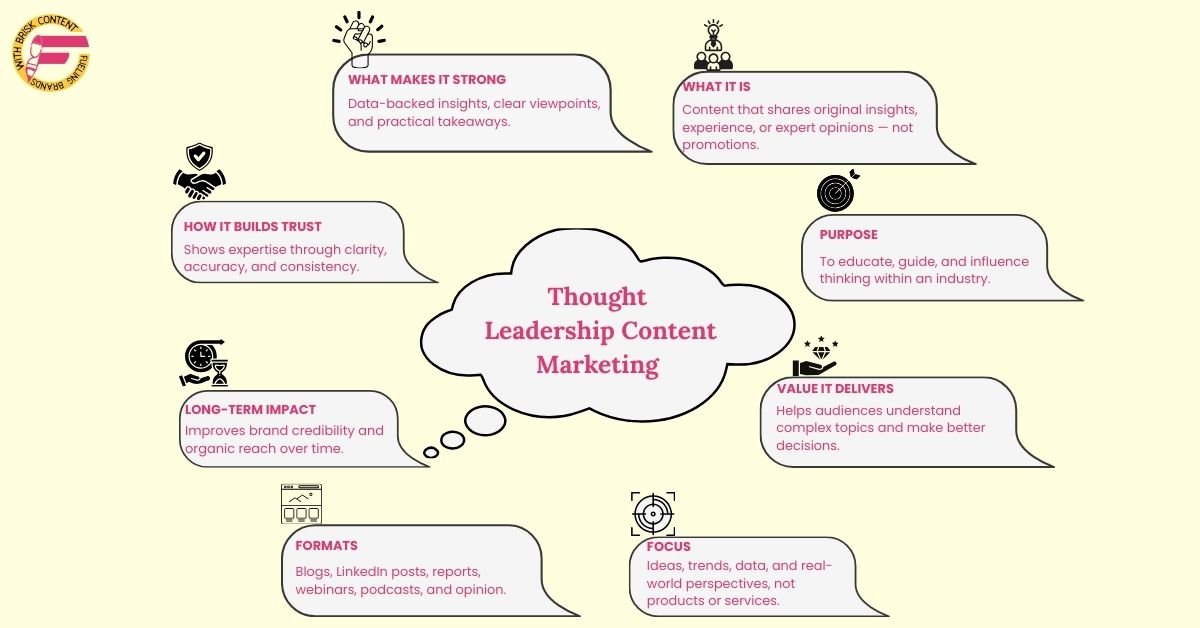
        Thought leadership content marketing is when a brand shares useful, high-quality information from experts who really know their field. These experts, known as thought leaders, use formats like articles, infographics, videos, or social media posts to share their knowledge and help others learn something valuable. For brands, this type of content helps build trust, grow credibility, and strengthen their reputation in the industry.

        7 types of thought leadership content

        Sharing thought leadership content is one of the best ways to show your expertise and connect with your audience. Here are seven popular formats that top leaders use to share their ideas and make a real impact.

        1. LinkedIn/Twitter 

        LinkedIn is great for building your professional reputation and connecting with key decision-makers, like CEOs and business leaders. You can share useful industry info, post regularly, join conversations, and mix your own ideas with interesting articles. Twitter is faster and more casual, lets you share quick thoughts, join trending chats, and reach a wider group, including journalists and influencers. Using both together helps you get noticed, build trust, and grab more opportunities in different ways.

             2. Newsletters and blogs

        If you have more to say, start a blog or newsletter. These platforms let you share deeper insights and talk directly to your audience without dealing with social media algorithms. Email marketing also offers strong returns, so it’s worth the effort. The challenge is keeping your content engaging and growing your audience over time. This is where a content agency can help maintain quality and consistency.

            3. Op-eds and bylines

        If you publish your ideas in respected outlets like Forbes and The Wall Street Journal, it can greatly boost your visibility. A byline lets you speak directly to large audiences while strengthening your personal brand. The more people see your name next to well-known media brands, the more credible your expertise becomes. Partnering with professionals who know how to pitch to editors can help you get your ideas published.

            4. Podcasts

        Podcasts are booming, with hundreds of millions of listeners. Starting your own show or appearing as a guest helps share your expertise in an informal, conversation-style setting. It’s perfect for connecting with niche or engaged audiences. If you host your own, be patient and consistent; it takes a while to grow an audience. Joining existing podcasts, however, can quickly expand your reach.

            5. Media interviews and profiles

        Being featured in news articles or industry interviews can expose your ideas to much wider audiences , and it boosts trust, since earned media is often seen as more credible than ads. The trick is to stay on message and build good relationships with journalists. If you team up with an agency that already has media contacts, it’s much easier to get noticed and ensure your point of view comes through clearly.

            6. Speeches and presentations

        Speaking at events, webinars, or panels positions you as an expert to a ready audience. These opportunities help you create credibility and grow your professional network. Also, data reveals that the speaking gigs can bring a strong return on investment. People will want to hear more from you as you speak, creating a positive cycle of influence and recognition. 

            7. Books

        Book publishing shows deep knowledge of your field and offers you an everlasting way to share your ideas. It’s more substantial than a post or an article, and it can even generate passive income. Books help build authority and connect you with decision-makers who respect well-thought-out, long-form ideas. Whether self-published or traditionally released, a book can be a powerful piece of your thought leadership strategy.

        Thought Leadership Strategy!

        A thought leadership strategy is about building your reputation as an expert, not just pushing sales. It focuses on creating content that answers your audience’s important questions and shows your deep knowledge.

        Step 1: Set SMART goals.
        Break your big goal into smaller parts using SMART criteria, make your goals Specific, Measurable, Attainable, Relevant, and Timely. For example, aim to attract five new leads in three months. Then list the actions to reach that goal, like starting a blog or growing LinkedIn followers, prioritising what your audience prefers.

        Step 2: Brainstorm content ideas.
        Think about your audience personas and what they want to read or watch. Look for questions they ask on social media or forums like Reddit. Focus on creating content that meets their real needs.

        Step 3: Analyze competitors.
        Find out who your audience turns to now and what content they consume. Identify gaps where their needs aren’t met, and check which competitor posts get lots of likes or shares to inspire your ideas.

        Step 4: Create and distribute content.
        Make your content stand out by sharing your unique view and personality. Keep it easy to understand and share. Avoid copying popular content; instead, bring fresh insights so social media algorithms and readers notice you.

        Step 5: Measure results.
        Track how your content is doing based on the goals you set. Use relevant metrics to see if your strategy is bringing the impact you want and adjust as needed.

        Why You Need Thought Leadership in Your Content Strategy

        Thought leadership is important and a must-have in your content strategy because it helps your brand stand out by showing real expertise and building trust with your targeted audience. Instead of just selling, thought leadership focuses on providing valuable insights and answers that your audience is searching for, which forms deeper connections. Such type of content boosts your credibility, attracts new opportunities, and makes you stand out from competitors by positioning you as a go-to expert in your field. Using thought leadership can also help your brand’s image and, over time, make people more interested and loyal to it.

        Final Thoughts

        Think of thought leadership content like your trusted guide in a crowded marketplace. In 2025, 73% of decision-makers trust this kind of content more than traditional ads or brochures. They spend significant time digging into thoughtful articles and insights because they want real value, not sales talk.​

        But here’s the catch: 85% say a lot of content out there misses the mark by lacking fresh ideas or depth. So, it’s not about just pumping out posts; it’s about sharing smart, original ideas that answer real questions. When you nail this, you don’t just build credibility; you open doors to new opportunities and become a go-to expert that people want to engage with and do business with.ContentFayah helps brands master this exact balance through expert content writing that turns insights into influence. Schedule your free strategy call today and elevate your thought leadership game.

        FAQs

        1. How can I make my thought leadership stand out?

        Focus on sharing fresh ideas or new angles that others aren’t talking about. Original research or stories from real experiences really catch attention.

        2. Who should be involved in creating thought leadership content?

        It’s best to involve experts or leaders in your company who truly understand the topics. Their insights make the content more reliable.

        3. How often should I publish thought leadership content?

        Consistency matters more than quantity. By posting regularly, even if small, you keep your audience engaged and help build your reputation over time.

        Categories
        Content Marketing

        What Is a Content Calendar? How To Plan Your Content

        In 2025, more than 60% of marketers create new content every day, helping businesses grow their audiences and leads. Email marketing paired with smart scheduling tools can generate $44 for every $1 spent, showing how important planning is for success. The marketing calendar software market will grow from $15 billion this year to over $28 billion by 2034, proving that more companies rely on smart content calendars every day. 

        With billions of users using social media, planning posts with a content calendar saves time, avoids mistakes, and lets brands post consistently to keep their audience engaged and growing. In this blog, we will cover what a content calendar is, why it matters, and how you can plan content step by step for better results.

        What Is a Content Calendar?

        A content calendar is a simple plan that shows when and where you will share your content. It helps you organize everything: blogs, social posts, videos, and emails in one place. With a content calendar, you will not have to rush at the last moment or miss important dates. It keeps your schedule clear and helps you know what to work on next.

        Why Every Brand Needs a Content Calendar?

        Every brand, big or small, can benefit from a content calendar. It helps you stay organized and make sure you don’t forget important posts. When you post regularly, your audience begins to trust and expect your content. A calendar also helps your team work well together because everyone knows what to do and when. Plus, you can see which posts work best and improve your planning over time.

        Components of an Effective Content Calendar

        A good content calendar has a few main parts. This shows the sort of content, like a blog, social media post, email, or video. It also has the date and time to post. It also shows who will create or post the content. The calendar notes the channel where the content will occur. It shows the status, like writing, ready, or published. You can add notes about your goals, keywords, or your target audience. Use simple tools like Google Sheets or other software to keep everything clear and easy to find.

        How To Plan Your Content Step-by-Step

        Planning your content calendar is easy if you follow these steps:

        1. Set your goals: Know what you want, more website visitors, sales, or followers.
        2. Know your audience: Understand who you want to reach and what they like.
        3. Brainstorm topics: Write ideas that match your goals and the audience’s interests.
        4. Choose channels: Decide where you will post: blogs, Instagram, Facebook, and emails.
        5. Make a schedule: Spread your content over days or weeks with different types of posts.
        6. Assign tasks: Give each post to a person or do it yourself.
        7. Fill your calendar: Enter all details in a planner or tool.
        8. Use schedule features: Automate posts to save time.
        9. Review and adapt: Check your calendar often and make changes when needed.

        Choosing the Right Content Calendar Tools

        Using the right tools will make your content planning simple. Here are good options for 2025:

        • Google Sheets or Calendar: Easy and good for beginners.
        • Trello or Asana: Great for teams to share and manage tasks.
        • WordPress: Best if blogging is your main focus.
        • CoSchedule or Monday.com: Strong apps for scheduling, reminders, and teamwork.

        Tips for Keeping Your Calendar Consistent & Flexible

        Here are tips to keep your calendar working well:

        • Make content in groups to stay ahead.
        • Leave days open for trending or urgent posts.
        • Check your calendar every week to stay on track.
        • Use reminders for deadlines.
        • Have backup team members in case someone is busy.
        • Mark special days like holidays and product launches.

        Common Mistakes To Avoid When Planning Content

        When you plan content, try to avoid some common mistakes. Always keep your calendar updated and don’t miss your deadlines. Make sure your content matches your goals so your work stays focused. Ask your team for ideas to get better topics. Check how your posts are doing to know what works best. Use a calendar tool to stay organised. Avoiding these mistakes will make your plan smooth, successful and on time.

        Example of a Content Calendar

        Here is a simple example of a monthly calendar:

        DatePlatformContent TypeTopicStatusOwner
        Nov 4BlogArticleStep-by-step guideDraftAlex
        Nov 6InstagramSocial PostBehind-the-scenesReadyJamie
        Nov 8FacebookVideoProduct launchEditingPriya
        Nov 12NewsletterEmailMonthly highlightsScheduledTeam Lead

        One Last Thing

        A content calendar helps you work with more control and less stress. It gives you time to create better content instead of rushing at the last minute. When your team uses a calendar, everyone knows what to do and when to do it, which makes teamwork easier. 

        A clear plan like this keeps your messages steady, so your audience trusts you more. It also helps you spot what works well and where you can improve. Using a content calendar isn’t just about planning; it’s about making your work smarter and your marketing stronger each and every day. If you want help building a clear, results-driven content calendar, Content Fayah can help you plan, create, and manage content that stays consistent and delivers real impact.

        1. How often should I update my content calendar?

         You should review your calendar weekly and update it whenever priorities, trends, or goals change.

        2. Can a content calendar work for small businesses?

        Yes. Even small businesses benefit from content calendars because they save time, reduce stress, and improve consistency.

        3. Do I need paid tools to manage a content calendar?

        No. Free tools like Google Sheets or Calendar work well. Paid tools are helpful for larger teams or frequent posting.

        .

        Categories
        Blogs Content Marketing

        7 Content Hacks for a Successful B2B Marketing

        As we enter 2025, effective content marketing remains the foundation for B2B success. However, things are changing; AI is here to aid us and be a partner in our marketing strategies. The B2B marketing team needs to move with this change and get ahead of others. But what AI lacks is the human touch; hence, teams. It is the best tool for B2B success as it brings awareness about your products, and gives trust, leads generation, and traffic generation. 

        We shall discuss seven hacks to improve your content marketing strategy.

        7 Important Content Marketing Hacks for B2B Success

        1. Craft a Well-Organized Content Calendar

        The right planning tool for a B2B marketing team is a content calendar. As a strategic road map, it enables planning and scheduling content ahead of time. Organizing your topics, deadlines, and distribution channels helps align your message with the key events or product launches tied to the seasonal trend.

         This proactive approach streamlines the content creation and makes collaboration easier for team members. A content calendar offers a visual of weeks or even months for your content strategy, helping you catch gaps and messaging overlaps more easily.

         It allows consistent posting frequencies – contributing to trust, engagement, and audience-building from your followers’ side. Last but not least, effective content calendars make your team’s work possible by delivering good, engaging, and meaningful content to the audience.

        2. Understand and Classify Your Audience Segments

        The core of successful content marketing is understanding the audience for content. Audience segmentation splits your broader audience into smaller, more defined subgroups based on specific characteristics, such as demographics, interests, or behaviors. This approach enables you to create the right kinds of content to meet each subgroup’s special needs and preferences.

         A technology company might have different content for IT managers than for other end-users. Using data analytics tools and customer feedback, you can create detailed buyer personas that guide your content creation process. This way, your messages are relevant and engaging, increasing the likelihood of conversion.

         In addition, segmented campaigns often have higher engagement rates because they speak directly to the audience’s pain points and interests. Knowing your audience deeply in a competitive B2B landscape can be the difference between you and competitors who take a more general approach.

        3. Produce Content That Remains Relevant Over Time

        Evergreen content is a rich element of any B2B content marketing. Unlike news content or article-driven pieces, which quickly lose relevance over time, it remains useful far into the future. 

        The basis of such writing usually concerns central industry subjects for which people could use guidance that would last forever and a day. Such content saves time in the long term and guarantees consistent website traffic by attracting visitors over months or years. 

        To search engine-optimize by using relevant keywords. Update the content periodically to keep it fresh and aligned with your niche’s current trends or developments. Investing in evergreen content builds a robust library of resources that can establish your authority in the field and nurture leads over time.

        4. Expand Your Reach Across Multiple Channels

        In today’s digital world, depending on a single platform for distribution can limit your reach and engagement potential. Expanding your reach across multiple channels is key to capturing a wider audience and maximizing the impact of your content marketing efforts.

        Consider using blogs, videos, infographics, podcasts, and social media posts to effectively engage with different segments of your audience. Each platform has its own strength; for instance, video content may be best suited for social media, but in-depth articles are better for LinkedIn or industry blogs. This will increase the chances of engagement and sharing, depending on the platform’s specific style and audience preferences.

        Furthermore, diversifying your reach allows you to experiment with different types of content and discover what resonates best with your audience. Ultimately, this multi-channel approach broadens your visibility and fosters deeper connections with potential clients.

         5. Maintain Consistency in Your Content Strategy

        Consistency is also a key to successful content marketing. Top-tier content published from time to time helps you achieve the audience’s trust and thereby positions your business as an expert in that sector. Whether it’s weekly blog updates or monthly webinars, maintaining such a schedule builds anticipation among viewers and provides them with fresh information regularly.

        Maintaining consistency helps you stay at the forefront of consumers’ minds and boosts your website’s search engine results because search engines prefer sites that consistently add new content.

        Maintaining a consistent voice and style for all channels helps strengthen brand identification and facilitates audience recognition and connection. Establishing rules for frequency, tone, and style that all team members can follow can help you achieve this level of consistency.

        6. Implement SEO Strategies to Boost Online Presence

        SEO is important for increasing the visibility of your B2B content online. By optimizing your content with relevant keywords and phrases your potential customers search for, you increase the likelihood of appearing higher in search engine results pages (SERPs). Begin by researching keywords to identify terms that align with your business goals and customer queries. Incorporate these keywords naturally into all content elements, including titles, headings, meta descriptions, and throughout the body text to improve its relevance to search engines without sacrificing user readability. 

        Technical aspects of SEO – including site speed and mobile-friendliness – can improve the user experience while making a ripple effect on rankings. Moreover, blogging older posts with new information or even different keywords can be relevant. If SEO is part of your content strategy, you can drive more organic traffic and position yourself as an authority within your niche.

        7. Evaluate and Enhance Your Content Performance

        Continuously evaluating and optimizing your content marketing efforts is the last hack to B2B success in 2025. Analytics tools let you track KPIs such as website traffic, engagement, conversions, and social shares. It helps you see which types of content resonate best with your audience and which need adjustment or improvement.

        For instance, if certain topics generate higher engagement than others, consider creating more related content or exploring those themes further. Additionally, pay attention to user feedback through comments or surveys; this qualitative data can provide valuable insights into what audiences find most valuable or engaging about your offerings.

        Optimization should be an ongoing process. Using analytics, you’ll experiment with distribution formats or channels to improve results. By committing to analysis and optimization, you ensure your B2B marketing strategy remains agile and responsive to changing market dynamics.

        Conclusion

        These seven hacks help you build a strong foundation for B2B content marketing in 2025. Tie strategies to business goals, understand audience pain points, and create evergreen content for lasting value. Diversify channels while staying consistent to boost reach and brand identity.

        Regularly review metrics to refine what works, keeping you ahead in the digital landscape through planning, insights, longevity, and optimization.

        If you’re ready to supercharge your B2B content with proven hacks that drive leads and growth, Content Fayah can help. Our experts deliver data-driven strategies tailored for success. Get started today for scalable results.

        What is a content calendar in B2B marketing?

        A content calendar is a planning tool that schedules topics, deadlines, and channels ahead of time. It aligns content with business goals, ensures consistency, and spots gaps for better engagement.

        Why is evergreen content important for B2B?

        Evergreen content stays relevant long-term, driving ongoing traffic and leads. Optimize it with SEO keywords and update periodically to maintain authority and value.

        How do I measure B2B content performance?

        Track KPIs like traffic, engagement, conversions, and shares using analytics tools. Use insights to optimize high-performers and refine underperformers for better ROI.

        Categories
        Uncategorized

        Is Ai Generated Content Good for SEO?

        Are you tired of spending countless hours creating content for your website or business, only to see little improvement in your search engine rankings? If so, you may have heard about the potential benefits of using AI-generated content to boost your SEO.

        But before you jump on the bandwagon, it’s important to consider the potential drawbacks and limitations of relying solely on automated content creation tools. While AI-generated content can certainly help streamline the content creation process, it may not always produce the same level of quality and authenticity as human-written content.

        In this article, we’ll explore the pros and cons of using AI-generated content for SEO, and provide insights into how to strike the right balance between automated content creation and the human touch. So, whether you’re a small business owner or a seasoned SEO professional, read on to discover the truth about AI-generated content and its impact on your search engine rankings.

        The world of SEO is constantly evolving, and with the rise of AI-powered technologies, automated content creation has become a popular trend. Here, we’ll explore the benefits and drawbacks of AI-generated content for SEO and provide tips on how to incorporate it into your content strategy.

        AI content SEO

        Benefits of AI-generated content for SEO

        One of the primary benefits of AI-generated content is its ability to produce large quantities of content quickly. This can be particularly useful for websites or businesses with a high volume of content needs, such as e-commerce sites or news outlets. Additionally, AI-generated content can help reduce costs and improve efficiency, freeing up time and resources for other important tasks.

        Another advantage of AI-generated content is its potential to increase search engine rankings. By using target keywords and optimizing content for SEO, AI-generated content can help boost website traffic and visibility. However, it’s important to note that search engines prioritize quality and relevance over quantity, so it’s essential to strike the right balance between quantity and quality.

        Limitations of AI-generated content for SEO

        Despite the potential benefits of AI-generated content, there are also limitations to consider. One major drawback is the potential lack of authenticity and personality in the content. While AI algorithms can produce grammatically correct and coherent content, they may not be able to convey the same level of emotion or connection as human-written content. This can lead to a lack of engagement from readers and ultimately harm your SEO efforts.

        Avoiding plagiarism and duplicate content

        Another limitation of AI-generated content is the risk of plagiarism or duplicate content. AI algorithms may scrape content from other sources and repackage it, which can lead to penalties from search engines and damage your website’s credibility. To avoid this, it’s important to use AI-generated content as a starting point and then edit and refine it with a human touch to ensure its uniqueness.

        Incorporating AI-generated content into your content strategy

        To reap the benefits of AI-generated content without sacrificing authenticity and engagement, it’s important to incorporate human touch into your content strategy. One way to do this is by using AI-generated content as a starting point and then editing and refining it with a human touch. This allows you to take advantage of the efficiency and convenience of AI-generated content while still ensuring that your content is unique and engaging.

        Using AI-generated content for repetitive tasks

        Another way to incorporate AI-generated content into your strategy is by using it for repetitive or low-value content, such as product descriptions or social media posts. This frees up time for human writers to focus on higher-value content, such as blog posts or thought leadership pieces.

        Does AI-generated Content rank on Search Engines?

        Yes, but it’s crucial to optimize the content for SEO and user experience. Search engines prioritize relevance and quality, so striking the right balance between AI-generated content and human touch is important.

        To ensure that AI-generated content ranks on search engines, use target keywords, make the content informative and unique, optimize for user experience, and engage with your target audience. However, it’s important to avoid plagiarism and ensure authenticity to maintain credibility.

        AI-generated content can rank on search engines if optimized properly. By using AI-generated content and human touch together, you can improve search engine rankings and drive traffic to your website.

        Here are some tips for using AI content tools to produce high-quality and engaging content:

        • Choose the right tool for your needs. Some of the best AI content tools in the market include GPT-3, ContentBot, Copy.ai, and Wordsmith.
        • Understand the capabilities and limitations of each tool. While they can generate content quickly and efficiently, it’s important to ensure that the content is authentic, relevant, and engaging.
        • Use the tool to generate ideas and inspiration. AI-generated content can help generate new ideas and perspectives that you may not have considered before.
        • Incorporate human touch and editing. Editing the content generated by AI tools can help ensure that it’s unique, relevant, and resonates with your audience.
        • Use the tool to enhance, not replace, human creativity. While AI-generated content can be useful, it’s important to remember that human creativity and expertise are still essential for producing high-quality content.

        AI content tools can be powerful resources for content creation, but it’s important to use them wisely and incorporate the human touch. By understanding their capabilities and limitations, and using them alongside human creativity and editing, you can produce high-quality and engaging content that resonates with your audience.

        In Conclusion

        AI-generated content can be a powerful tool for improving SEO, but it’s important to understand its limitations and find ways to incorporate the human touch into your content strategy. By striking the right balance between efficiency and authenticity, you can harness the power of AI-generated content to boost your search engine rankings and drive traffic to your website.