Categories
Content Marketing

What Is Thought Leadership Content?

Did you know that nearly 75% of executives have explored products or services they weren’t initially considering after engaging with quality thought leadership content? Thought leadership is now one of the most trusted ways to learn about a company’s expertise and value, far beyond traditional ads. It helps brands and experts share real knowledge and fresh ideas through posts, blogs, podcasts, or even books. This builds trust, opens new opportunities, and connects you with the right audience. 

This blog will guide you through everything you need to know to successfully create and use thought leadership content to boost your brand and influence.

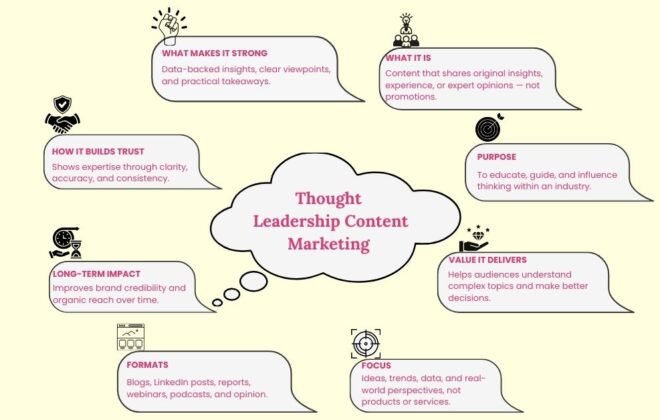
What Is Thought Leadership Content Marketing?

Thought leadership content marketing is when a brand shares useful, high-quality information from experts who really know their field. These experts, known as thought leaders, use formats like articles, infographics, videos, or social media posts to share their knowledge and help others learn something valuable. For brands, this type of content helps build trust, grow credibility, and strengthen their reputation in the industry.

7 types of thought leadership content

Sharing thought leadership content is one of the best ways to show your expertise and connect with your audience. Here are seven popular formats that top leaders use to share their ideas and make a real impact.

  1. LinkedIn/Twitter 

LinkedIn is great for building your professional reputation and connecting with key decision-makers, like CEOs and business leaders. You can share useful industry info, post regularly, join conversations, and mix your own ideas with interesting articles. Twitter is faster and more casual, lets you share quick thoughts, join trending chats, and reach a wider group, including journalists and influencers. Using both together helps you get noticed, build trust, and grab more opportunities in different ways.

     2. Newsletters and blogs

If you have more to say, start a blog or newsletter. These platforms let you share deeper insights and talk directly to your audience without dealing with social media algorithms. Email marketing also offers strong returns, so it’s worth the effort. The challenge is keeping your content engaging and growing your audience over time. This is where a content agency can help maintain quality and consistency.

    3. Op-eds and bylines

If you publish your ideas in respected outlets like Forbes and The Wall Street Journal, it can greatly boost your visibility. A byline lets you speak directly to large audiences while strengthening your personal brand. The more people see your name next to well-known media brands, the more credible your expertise becomes. Partnering with professionals who know how to pitch to editors can help you get your ideas published.

    4. Podcasts

Podcasts are booming, with hundreds of millions of listeners. Starting your own show or appearing as a guest helps share your expertise in an informal, conversation-style setting. It’s perfect for connecting with niche or engaged audiences. If you host your own, be patient and consistent; it takes a while to grow an audience. Joining existing podcasts, however, can quickly expand your reach.

    5. Media interviews and profiles

Being featured in news articles or industry interviews can expose your ideas to much wider audiences , and it boosts trust, since earned media is often seen as more credible than ads. The trick is to stay on message and build good relationships with journalists. If you team up with an agency that already has media contacts, it’s much easier to get noticed and ensure your point of view comes through clearly.

    6. Speeches and presentations

Speaking at events, webinars, or panels positions you as an expert to a ready audience. These opportunities help you create credibility and grow your professional network. Also, data reveals that the speaking gigs can bring a strong return on investment. People will want to hear more from you as you speak, creating a positive cycle of influence and recognition. 

    7. Books

Book publishing shows deep knowledge of your field and offers you an everlasting way to share your ideas. It’s more substantial than a post or an article, and it can even generate passive income. Books help build authority and connect you with decision-makers who respect well-thought-out, long-form ideas. Whether self-published or traditionally released, a book can be a powerful piece of your thought leadership strategy.
Thought Leadership Strategy!

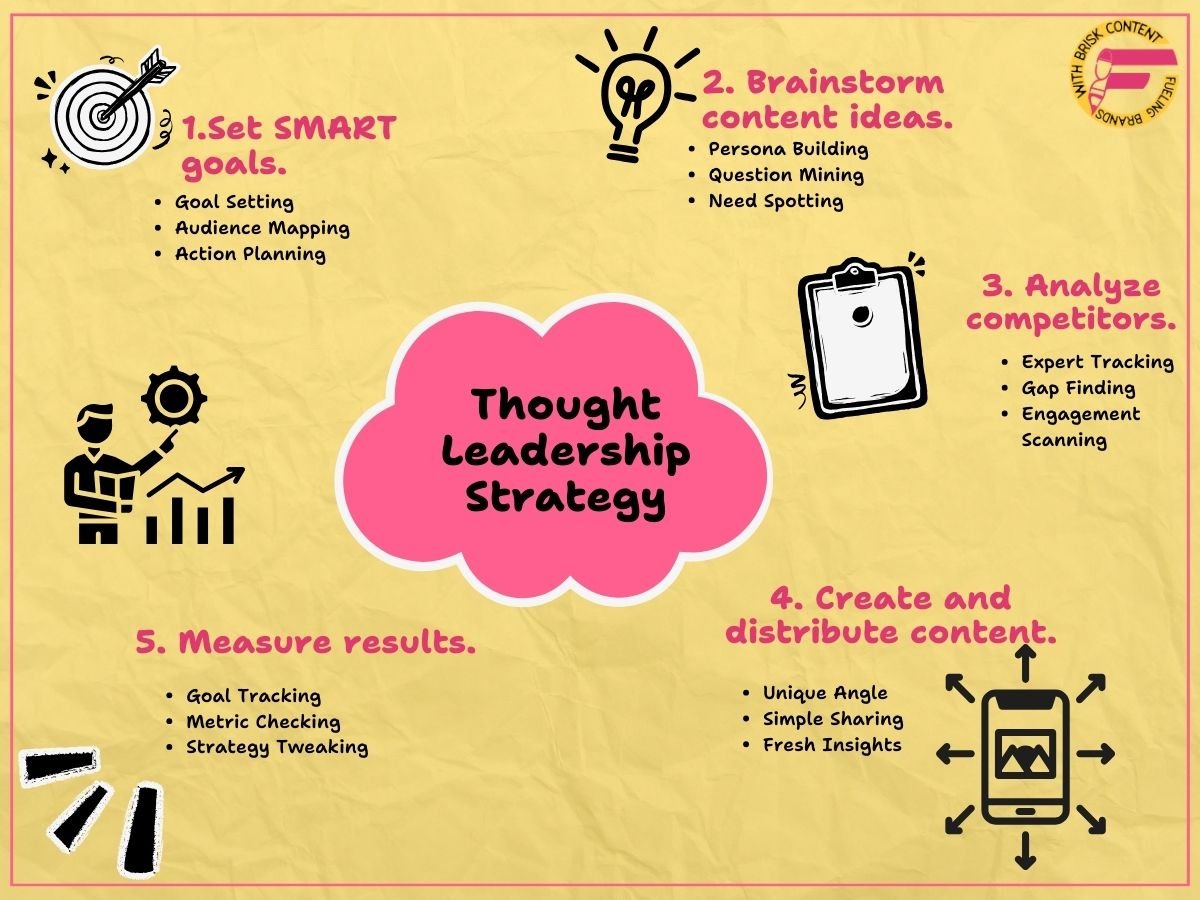
A thought leadership strategy is about building your reputation as an expert, not just pushing sales. It focuses on creating content that answers your audience’s important questions and shows your deep knowledge.

Step 1: Set SMART goals.
Break your big goal into smaller parts using SMART criteria, make your goals Specific, Measurable, Attainable, Relevant, and Timely. For example, aim to attract five new leads in three months. Then list the actions to reach that goal, like starting a blog or growing LinkedIn followers, prioritising what your audience prefers.

Step 2: Brainstorm content ideas.
Think about your audience personas and what they want to read or watch. Look for questions they ask on social media or forums like Reddit. Focus on creating content that meets their real needs.

Step 3: Analyze competitors.
Find out who your audience turns to now and what content they consume. Identify gaps where their needs aren’t met, and check which competitor posts get lots of likes or shares to inspire your ideas.

Step 4: Create and distribute content.
Make your content stand out by sharing your unique view and personality. Keep it easy to understand and share. Avoid copying popular content; instead, bring fresh insights so social media algorithms and readers notice you.

Step 5: Measure results.
Track how your content is doing based on the goals you set. Use relevant metrics to see if your strategy is bringing the impact you want and adjust as needed.

Why You Need Thought Leadership in Your Content Strategy

Thought leadership is important and a must-have in your content strategy because it helps your brand stand out by showing real expertise and building trust with your targeted audience. Instead of just selling, thought leadership focuses on providing valuable insights and answers that your audience is searching for, which forms deeper connections. Such type of content boosts your credibility, attracts new opportunities, and makes you stand out from competitors by positioning you as a go-to expert in your field. Using thought leadership can also help your brand’s image and, over time, make people more interested and loyal to it.

Final Thoughts

Think of thought leadership content like your trusted guide in a crowded marketplace. In 2025, 73% of decision-makers trust this kind of content more than traditional ads or brochures. They spend significant time digging into thoughtful articles and insights because they want real value, not sales talk.​

But here’s the catch: 85% say a lot of content out there misses the mark by lacking fresh ideas or depth. So, it’s not about just pumping out posts; it’s about sharing smart, original ideas that answer real questions. When you nail this, you don’t just build credibility; you open doors to new opportunities and become a go-to expert that people want to engage with and do business with.ContentFayah helps brands master this exact balance through expert content writing that turns insights into influence. Schedule your free strategy call today and elevate your thought leadership game.

FAQs

1. How can I make my thought leadership stand out?

Focus on sharing fresh ideas or new angles that others aren’t talking about. Original research or stories from real experiences really catch attention.

2. Who should be involved in creating thought leadership content?

It’s best to involve experts or leaders in your company who truly understand the topics. Their insights make the content more reliable.

3. How often should I publish thought leadership content?

Consistency matters more than quantity. By posting regularly, even if small, you keep your audience engaged and help build your reputation over time.

Categories
Content Marketing

10 Game-Changing Tips for Crafting Email Subject Lines That Work

Do you know the average email open rate across industries was about 35.63% in 2025? Which means one in three emails are opened, it is pretty much clear that your subject line is your main hero, on which it is decided whether your message gets noticed or not. Your subject line is the gateway to your message, so it is very important to craft it properly to boost engagement and help you improve email marketing success.

But what makes a subject line irresistible enough to click? Is it personalization, urgency, curiosity, or something else? In this blog, you are gonna discover 10 practical tips to write better subject lines. Whether you’re a marketer, a business owner, or simply trying to write better emails, these tips can help you get more people to open your messages. Let’s get started and make sure your subject lines truly catch your reader’s eye.

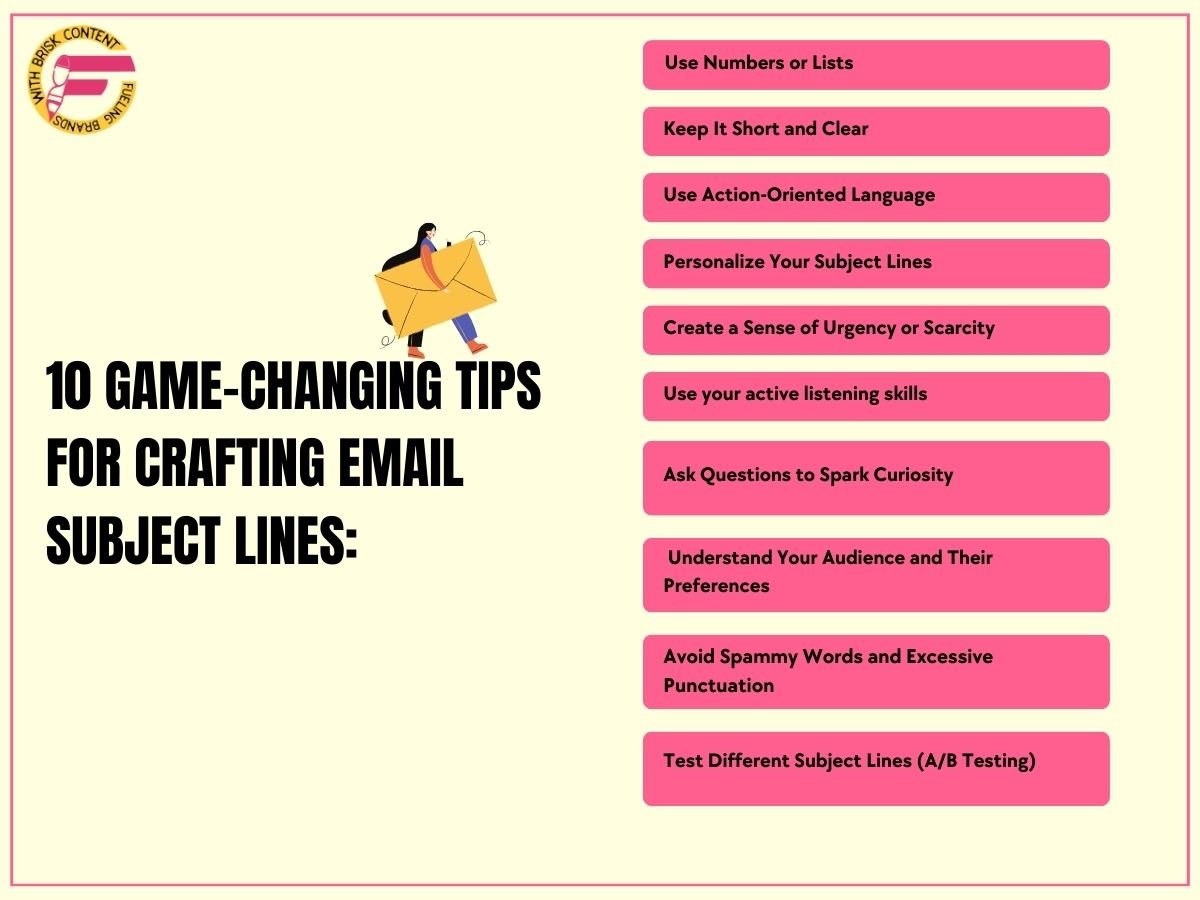
  1. Understand Your Audience and Their Preferences

A good subject line starts with knowing your audience. Ask yourself what their preferred tone is for engaging with them, and what typically captures their interest. Check your existing data, whether it is about browsing habits, past emails, or purchase details, and also use it to shape your message. When your audience sees something that feels personal, they are more likely to click.

  1. Keep It Short and Clear

Most people check their emails on phones where space is limited. Subject lines between 30 and 50 characters tend to perform best. Being direct about the email’s content helps readers decide quickly whether to open it. For example, “Your March Invoice is Ready” is clearer than “Important Invoice Information.”

  1. Use Action-Oriented Language

Your subject line can convince readers to open your email if it has a powerful verb.  “Discover,” “Get,” “Unlock,” and “Join” are examples of words that pique interest and convey a sense of urgency.  These action phrases give your email a sense of importance and let readers know that it contains something worthwhile.  This easy tactic can significantly increase your open rates and increase the number of people who interact with your content.

  1. Personalize Your Subject Lines

A person’s name or other personal details can help increase open rates. People are more likely to open emails that feel directed at them. Just be careful not to overuse personalization, because it can come across as too much.

  1. Create a Sense of Urgency or Scarcity

Short deadlines make your email feel more urgent. A subject line such as “Only 2 Days Left” or “Last Chance to Save” tells readers they need to open it soon. Always be truthful about the offer; you will earn more trust that way. Such tactics boost open rates and conversions but should be used sparingly and honestly to avoid damaging credibility.

  1. Ask Questions to Spark Curiosity

Questions in subject lines spark curiosity and engage readers immediately. If you ask relevant questions like “Want to Save More?” or “Looking for Better Deals?”, ask recipients to answer. When questions clearly relate to the email content, they make the message more personal and compelling, which increases the chances of opens and interactions, especially when combined with a strong CTA inside.

  1. Avoid Spammy Words and Excessive Punctuation

Words like “FREE,” “Guarantee,” or multiple exclamation marks can set off spam filters or give the impression that you are unreliable.  Remain sincere and professional.  Avoid using ALL CAPS, which can come across as yelling, and use basic punctuation.

  1. Test Different Subject Lines (A/B Testing)

What attracts one group may not work for another. A/B testing can help you figure this out. You can try sending different subject lines to small segments of your audience and see which one gets more opens and clicks. Once you know the winner, send that version to the rest of your list. This simple step can make your email campaigns perform better using real, clear data.

  1. Use Numbers or Lists

Numbers grab attention and set clear expectations. Subject lines like “5 Secrets to Better Emails” or “3 Tips for Weekend Planning” show readers how much value they’ll get inside. These list-style examples, inspired by strategies like those in 17 Massive Content Marketing Examples to Boost Your Brand, make content easy to scan and promise actionable insights.

  1. Align Subject Lines With Your Email Content

Make sure your subject line accurately represents the email’s content. Misleading subject lines may get opens, but damage your brand’s trust long-term. Honor the reader’s time by being honest and clear about what’s inside.

Conclusion

Email subject lines can make a major difference in how well your campaign performs. A compelling subject line draws readers in, piques their interest, and demonstrates why your email is worthwhile.  Your message is more likely to stand out in a busy inbox when you include components like personalization, urgency, or insightful inquiries.  Just bear in mind to deliver on your promises; high-quality content fosters trust and maintains viewer engagement.

Testing different subject lines is also key. It helps you to continue developing your strategy by revealing what really resonates with your audience.  Every phrase in the subject line counts because it is your first opportunity to attract attention and convince someone to read your email.  Strong subject lines have the potential to boost open rates and foster enduring relationships when used effectively. Start using these tips today, and you’ll notice more people paying attention to your emails.

If you’re ready to take your subject lines to the next level, teams like Content Fayah specialize in email copywriting that blends these proven strategies with authentic storytelling. Start with their free subject line audit to see instant improvements.

FAQs

1. How long should my email subject line be?

You should aim for 30-50 characters to ensure full visibility on mobile devices. Short, clear subject lines capture attention quickly.

2. Is personalization always effective?

Yes, but it should feel natural. Personalize when you have meaningful data like name or location. Avoid overdoing it to prevent looking spammy.

3. Why is A/B testing essential for subject lines?

A/B testing reveals what resonates with your specific audience using real data. It optimizes campaigns by identifying winners, improving opens and clicks over time.

Categories
Content Marketing

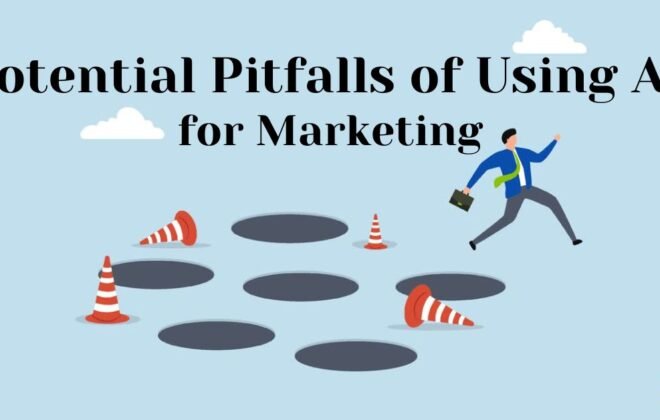
Potential Pitfalls of Using AI for Marketing

Are you wondering how AI is changing marketing? AI is transforming marketing by helping brands work faster, reach the right people, and personalize messages better than ever. But it’s not all smooth sailing. Using AI means dealing with messy data, tough tech setups, privacy rules, and making sure marketing still feels human. Many marketers struggle with these issues, from high costs and a lack of skills to keeping creativity alive. 

Knowing these challenges is key to using AI in a way that helps your brand grow without losing what makes it special. Let’s dive into the real pitfalls marketers face with AI and how to avoid them.

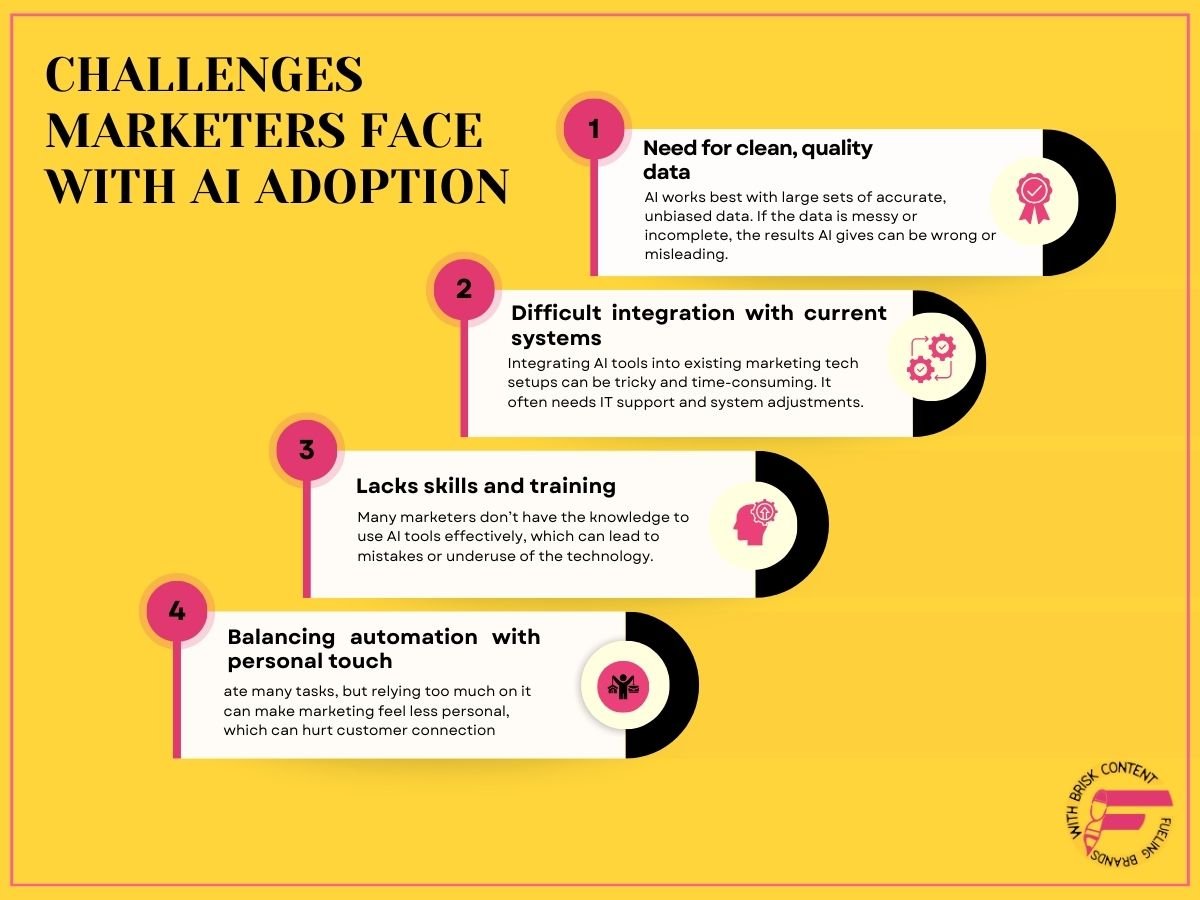
What are the common challenges marketers face when adopting AI?

When marketers start using AI, they often face several key challenges that are important to know:

  • Need for clean, quality data
    AI works best with large sets of accurate, unbiased data. If the data is messy or incomplete, the results AI gives can be wrong or misleading.
  • Difficult integration with current systems
    Putting AI tools into existing marketing tech setups can be tricky and take a lot of time. It often needs IT support and system adjustments.
  • Lack of skills and training
    Many marketers don’t yet have the knowledge to use AI tools effectively, which can cause mistakes or underuse of the technology.
  • Balancing automation with personal touch
    AI can automate many tasks, but relying too much on it can make marketing feel less personal, which can hurt customer connection.
  • Privacy and compliance concerns
    Marketers must follow privacy laws and ethical guidelines when using AI, or they risk legal trouble and loss of customer trust.
  • High costs and ongoing support
    AI tools can be expensive to start using and require continuous maintenance, which can be difficult for smaller businesses to afford.
  • Limited creativity and emotional understanding
    AI lacks human creativity and can’t truly understand emotions, so it may not produce content that connects deeply with audiences.

How can AI lead to the loss of human touch in marketing campaigns?

AI can cause marketing to lose its human touch, mainly because it focuses on automation and data instead of real human feelings and understanding. Here’s why:

  • Automated messages from AI often sound generic and robotic, not warm or personal.
  • AI struggles to get human emotions right, so its content can miss the emotional connection that builds trust.
  • Relying too much on data makes marketing feel impersonal, as it doesn’t always consider individual human stories.
  • AI-driven campaigns can be predictable and lack the creative spark that humans bring.
  • When chatbots and automated emails replace real people, customers miss out on genuine human interactions.

What risks does AI pose to brand voice and authenticity?

Here are the risks AI poses to brand voice and authenticity, broken down simply in subpoints with explanations:

  • Generic content
    AI often creates similar-sounding messages for many brands. This can make your brand’s unique voice fade and feel less special.
  • Flat, emotionless tone
    AI struggles to catch the feelings and subtleties behind words. So, marketing messages might come off as robotic or boring instead of warm and real.
  • Inconsistent style
    Without proper controls, AI can sometimes create content that doesn’t match your brand’s usual tone. This confuses customers about who you are.
  • Too much automation
    Relying heavily on AI can make marketing feel less personal. People want to connect with real, relatable brands—not just machines.
  • Possible mistakes
    AI-generated content can have errors or ideas that don’t fit your brand well. It needs human review to keep the message right.

How does data quality and bias affect AI marketing outcomes?

Data quality and bias have a big effect on how well AI works in marketing. If the data is messy, outdated, or missing important details, AI can give wrong or misleading results. This can make it hard to target the right customers and waste marketing time as well as money. It’s also possible for AI to repeat or even make worse biases in data that already has them. This is unfair and can hurt trust. So, having clean, accurate, and unbiased data is key to getting good results from AI in marketing.

What privacy and ethical concerns arise from using AI in marketing?

Here are the privacy and ethical concerns that come with using AI in marketing:

  1. Collecting personal data
    AI collects a lot of customer info, so businesses must be careful to handle it responsibly and keep it safe.
  2. Following privacy laws
    Marketers need to follow rules like GDPR to make sure they’re using data legally and respecting customer rights.
  3. Avoiding data breaches
    If data isn’t protected well, it can be leaked or hacked, which hurts customer trust and damages brands.
  4. Preventing bias and unfairness
    AI systems can inherit biases from data, leading to unfair treatment of certain groups. This needs to be managed carefully.
  5. Being transparent
    Customers should know when AI is used in marketing and how their data is being handled to build trust.
  6. Using data ethically
    It’s important not to misuse data or manipulate customers in ways that feel invasive or dishonest.

Can over-reliance on AI tools harm marketing creativity?

If you depend too much on AI tools, it can sometimes hold back marketing creativity because AI tends to stick to the same patterns and data, making campaigns feel similar and expected. It lacks the fresh, unique and creative ideas that come from human imagination. But when used well, AI actually helps by taking care of boring tasks and giving marketers more time to get creative. It can even inspire new ideas and help tailor content quickly. So really, AI should team up with humans, letting marketers focus on big creative thinking and storytelling.

What legal issues should marketers consider when using AI content?

Here are some of the legal issues marketers need to be aware of while using AI content:

  1. First, copyright and ownership. It can be tough. AI content might not be legally owned until enough human creativity is involved, so you could lose exclusive rights.
  2. Next, plagiarism is a big risk. AI sometimes produces work too close to existing material, which could lead to lawsuits.
  3. Data privacy laws are another big one. You must follow rules about using personal info for AI training and marketing.
  4. Transparency is important too. Let your audience know when AI creates content so you don’t mislead them.
  5. Avoid false or exaggerated claims in AI-generated content because that can cause legal problems under advertising laws.
  6. You also need to carefully read and follow the terms of use for any AI tool or platform you use.
  7. Watch out for trademark risks—AI might accidentally use logos or branding that belong to others.
  8. Lastly, check for defamation or inaccurate statements in AI content before publishing to protect your reputation.

What strategies can marketers use to overcome the pitfalls of AI adoption?

Marketers can overcome the pitfalls of AI adoption by following some straightforward strategies.

  • First, invest time in learning and training, so your team completely understands how to use AI tools properly. 
  • Always keep human creativity and judgment involved to balance AI’s automation with a personal touch. 
  • Use high-quality, unbiased data to feed AI systems for better results. 
  • Stay fair with customers about AI usage to build trust. 
  • Make sure to follow privacy laws and ethical guidelines carefully. 
  • Also, review AI-generated content before publishing to avoid mistakes. 
  • Finally, choose AI tools that fit your business needs and budget, and be patient as you adapt to the new technology. 
  • This way, you can get the best out of AI without losing what makes your marketing unique.

Conclusion

A.I. is quickly changing marketing by giving us tools that help us work better and connect with more people. All you have to make sure of is that the data is correct, that you protect privacy, that you deal with costs, and that you don’t miss the personal side of marketing. The winners will be the marketers who blend AI’s power with real creativity and fairness.

Smart technology and real ties with customers that keep them coming back are both things that brands can get if they learn new skills, choose the right tools, and use AI carefully. Contact ContentFayah today for expert content writing services that blend AI efficiency with creative storytelling. Get your free strategy consultation and ignite your marketing.

FAQs

1. What are the biggest pitfalls of using AI in marketing?

Common pitfalls include poor data quality leading to bad results, loss of brand authenticity, privacy risks, high costs, and over-automation that feels robotic. Balancing AI with human creativity helps avoid these.

2. How can marketers keep the human touch when using AI?

Always review AI outputs, add emotional storytelling, personalize beyond data, and use AI for routine tasks only. This keeps campaigns relatable and builds stronger customer connections.

3. What steps prevent legal issues with AI-generated marketing content?

Follow privacy laws like GDPR, disclose AI use, check for plagiarism and biases, ensure human edits for ownership, and review for false claims to stay compliant and trustworthy.

Categories
Content Marketing

The Best Keyword Optimization Techniques To Try

Are you aware that Google processes over 16 billion searches every day in 2025? With such massive search volumes, optimizing your keywords is important to make sure your content reaches the right audience. Research shows that long-tail keywords push around 70% of all search traffic, which makes particularity a key part of keyword strategy. 

Also, nearly 95% of keywords receive very low monthly searches, which opens up opportunities to target niche phrases that competitors might overlook. Knowing how to research and apply these keywords effectively can set your content apart and boost your search rankings. This blog examines proven keyword optimization techniques that can help you stay ahead in the developing digital landscape.

What Is Keyword Optimization and Why Does It Matter?

Keyword optimization involves strategically choosing and placing search terms that users insert into search engines to improve a website’s visibility. When done right, it connects your content with people actively looking for what you offer. This increases organic traffic, improves user engagement, and supports higher conversion rates.

Effective keyword optimization means not only choosing popular words but also understanding what users want, current search trends, and your competition. This helps search engines know what your content is about, making it easier to match with the right searches.

Keyword Research: Finding the Correct Phrases to Target

The foundation of strong keyword optimization starts with detailed keyword research. Using instruments like Google Keyword Planner, Ahrefs, and Semrush, marketers identify terms that potential customers are searching for. Learn 17 massive content marketing examples from Content Fayah showing keyword strategies in action.

Some key tips for research are as follows:

  • Focus on long-tail keywords. These specific phrases often reveal higher intent and lower competition.
  • Consider related and semantic keywords to capture broader search intent.
  • Evaluate keyword difficulty to find phrases with a good balance of volume and achievability.
  • Use question-based keywords to target featured snippets and voice search results.
  • Staying updated on trending keywords also ensures your content remains relevant.

Mapping Keywords to the Customer Journey

Keywords differ, which totally depends on where the searcher is in their buying process. Grouping keywords by these stages can make your content more targeted and effective. Mapping in the manner given below helps you to attract the right audience with content that meets their needs at each phase.

  1. Awareness Stage: Broad, informational keywords that help users recognize a need or problem (e.g., “what is content marketing”).
  2. Consideration Stage: Evaluation-related keywords, often with qualifiers like “best,” “vs.,” or “review.
  3. Decision Stage: Keywords with direct buying intent, such as product names or phrases like “buy,” “discount,” or “near me.”..

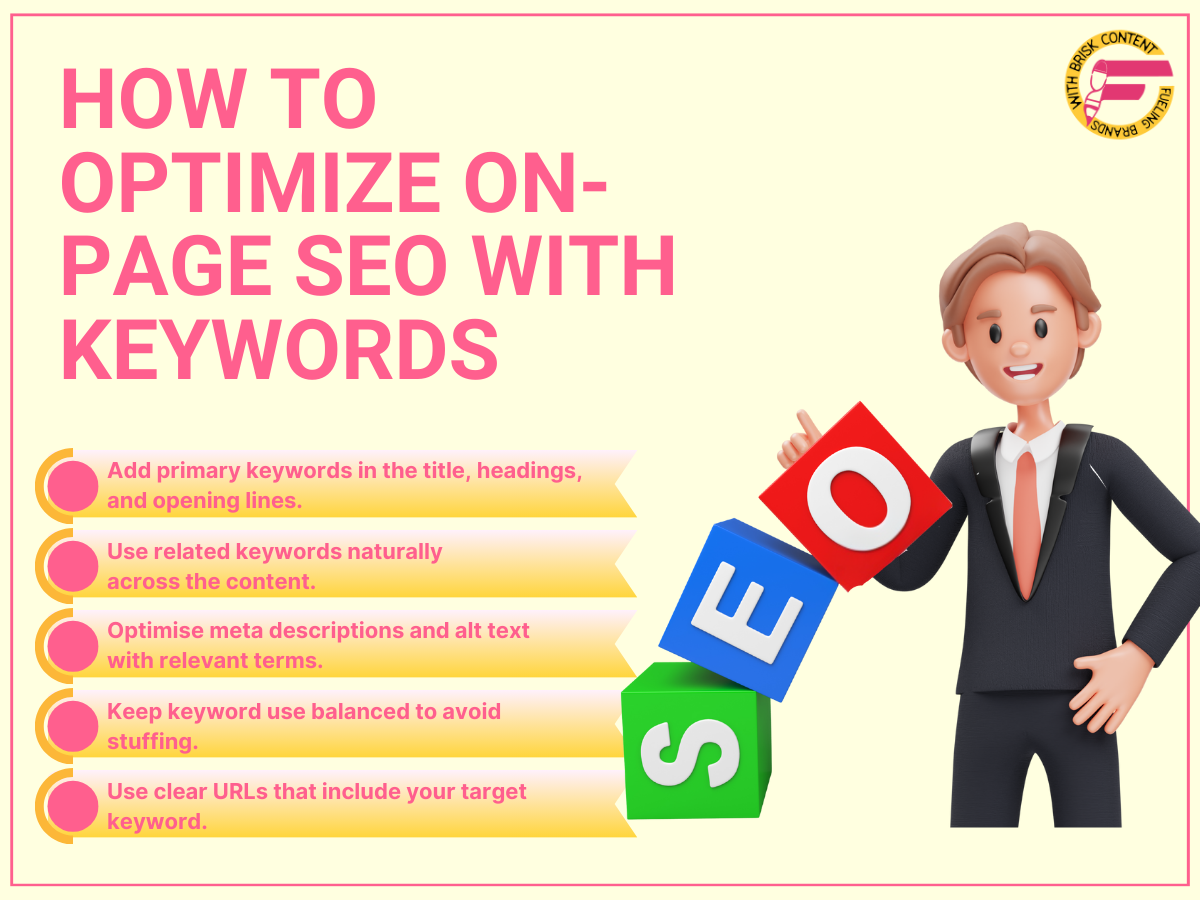
Optimizing On-Page SEO With Keywords

On-page SEO is critical to ensure that search engines and users understand your content. You can follow the best practices that are given below:

  1. Use primary keywords naturally in titles, headings, and the first 100 words.
  2. Incorporate related keywords semantically throughout the content.
  3. Optimize meta descriptions and alt text with relevant terms.
  4. Maintain valid keyword density to avoid keyword stuffing.
  5. Use URL structures that contain target keywords for better readability and SEO value.
  6. On-page keyword placement directly impacts rankings and click-through rates.

Utilizing Keyword Clustering for Topic Authority

Keyword clustering groups related search terms together and forms wide content that covers multiple related queries. Search engines increasingly favor this because it provides depth and context.

For example, instead of writing several small articles on “running shoes,” “trail running shoes,” and “best running shoes,” create a single authoritative guide covering all these terms in detail. This approach helps you build topical relevance, keeps users engaged longer and improves chances to rank for multiple keywords simultaneously. Apply clustering with tactics from Content Fayah’s 7 Content Hacks for B2B Marketing to dominate search clusters.

Using Advanced Keyword Tools for Deeper Insights

To help you choose the most suitable platform, here’s a comparison of some of the leading advanced keyword research tools available in 2025.

Tool NameKey FeaturesStandout AdvantagePricing
SemrushExtensive keyword database, competitor analysis, SERP features, keyword gap analysis, and content templates.Comprehensive all-in-one SEO suite with deep insightsStarts at $129.95/month
AhrefsBacklink analysis, keyword difficulty scoring, click data, SERP explorerAccurate traffic potential estimates and content gap analysisStarts at $99/month
ClearscopeInstant content ranking, keyword suggestions that are based on language understanding, and competitor content reviewAI-powered optimization based on SERP contextPricing varies by usage
Surfer SEOReal-time content editor, keyword difficulty metrics, SERP analysis, NLP suggestionsOn-page SEO optimization with AI-based guidancePlans start around $59/month
KWFinderKeyword difficulty, opportunity insights, search volume, and intent taggingUser-friendly interface and keyword opportunity alertsStarts at $29.90/month
Google Keyword PlannerKeyword suggestions, search trends, and cost forecastingFree tool directly from Google for keyword ideasFree

Refreshing Content with Updated Keyword Strategies

SEO is not a “set and forget” effort. Regularly reviewing and updating your best-performing content to include new keywords and related terms is important. Google rewards fresh, relevant content that aligns with growing search trends.

Adding FAQ sections, expanding on topics with new data, or optimizing for voice search by including conversational phrases can keep your rankings strong.

Optimizing for Voice and Mobile Search

As voice-based technology grows rapidly, especially on smartphones and smart speakers, keywords need to adapt. Voice searches tend to be longer and more conversational. The approaches given below align your content with how people speak and use devices, helping you capture voice search traffic effectively. Techniques to optimize for voice and mobile search include:

  1. Targeting long-tail, conversational keywords that reflect natural speech.
  2. Creating FAQ pages that answer common questions clearly.
  3. Using structured data markup allows search engines to understand your content.
  4. Improving page load speed for a smooth mobile experience.
  5. Ensuring your website is fully mobile-friendly and responsive.
  6. Focusing on local SEO with location-based keywords.
  7. Creating content that matches natural language patterns and voice-related queries.
  8. Optimizing for featured snippets and zero-click searches to capture voice assistant responses.

Measuring Success: Tracking Keyword Performance

Tracking the following key areas allows you to make informed decisions that boost your website’s performance and effectiveness in search results. If you measure your keyword success, it helps you adjust your SEO strategy by focusing on several important metrics, such as:

  • Organic traffic growth
  • Keyword ranking positions
  • Bounce rates and time spent on page
  • Conversion rates from organic search

Conclusion

Good keyword optimization is an ongoing process that needs constant research, changes, and the right tools to succeed. By choosing keyword strategies that match what users want, you can increase your content’s visibility and attract visitors who are genuinely interested. Advanced keyword tools give valuable information to improve your plan and stay ahead of your competitors. 
To keep up, update keywords regularly, optimize for new trends like voice search, and align keywords with the buyer’s journey. Businesses that aim to improve their SEO and content marketing will see better results by working with experienced professionals. Ready to implement winning keyword strategies? Contact Content Fayah today for expert SEO content that ranks and converts.

FAQs

1. How do short-tail and long-tail keywords differ from each other?

Short-tail keywords are broad and high volume, while long-tail keywords are more specific with lower volume but higher conversion potential.

2. How often should I update my keyword strategy?

Review your keywords at least quarterly or when significant algorithm changes happen to stay relevant.

3. Are keywords still important with AI and voice search growing?

Yes, but optimization now includes natural language and conversational phrases suited for voice queries.

4. What’s the best free tool for keyword research?

The best free tools for keyword research are Google Search Console and  Google Keyword Planner, which help you to start keyword research effectively.

Categories
Content Marketing

Law Firm Content Writing: Do You Really Need It?

According to the 2024 Edelman Trust Barometer, 94% of customers are more likely to trust a law firm that provides original, informative content on its website. Effective legal content showcases your expertise and reliability. 89% of law firms consider frequently updating their website with good quality content as a ‘very important’ part of their digital marketing strategy to stay competitive. 

This blog explores why your law firms need to post content regularly and what kind of content would drive more client leads for your firm. It further explores how hiring a professional legal content writer translates into substantial business growth.

Why Do Law Firms Need to Post Content?

Consistently posting high-quality, relevant content helps law firms establish trust with prospective clients. About 96% of potential clients begin their search for legal assistance online, often using Google to find an attorney nearby. When someone searches for a “criminal lawyer near me” or “best personal injury attorney,” the law firms that appear on the first page of search results are those that maintain active and meaningful content.

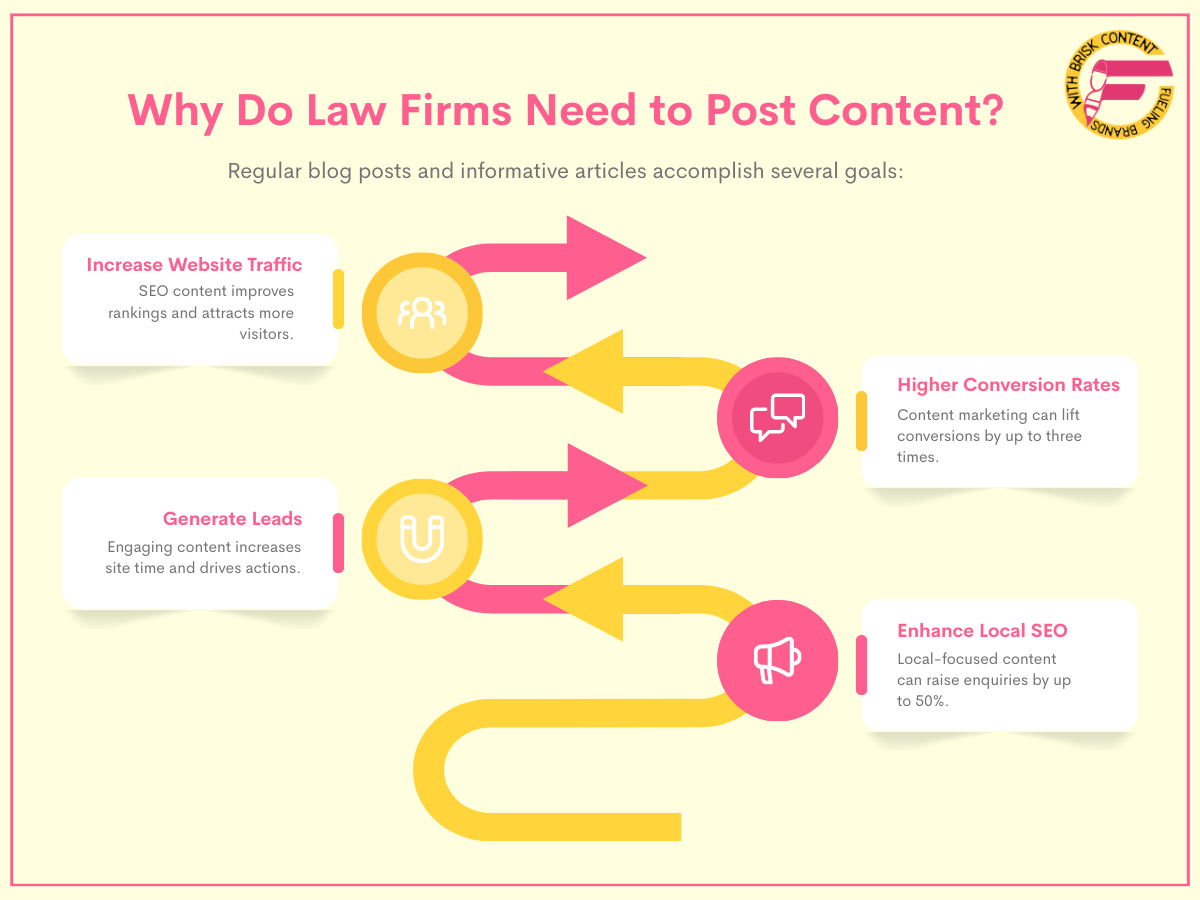
Regular blog posts and informative articles accomplish several goals:

  • Increase Website Traffic: Search Engine Optimised (SEO) content drives organic traffic to your site. It helps your pages rank higher in search results, increasing organic traffic.
  • Higher Conversion Rates: According to the latest Content Marketing Institute stats, firms that invest in content marketing see conversion rates up to 3 times higher.
  • Build Trust and Authority: Content educates potential clients, making complex legal concepts easier to understand. This positions the firm as a knowledgeable partner ready to guide clients through difficult legal matters.
  • Enhance Local SEO: According to the 2024 Local SEO Industry Report by BrightLocal, legal content that integrates local SEO can increase client inquiries by 50%. Creating content relevant to your practice area’s local laws improves your search engine rankings in your area, helping you connect with nearby clients.
  • Generate Leads: Engaging content increases the time visitors spend on your site. Embedding calls to action in your pieces can lead to new customers.

Top 9 Content Formats That Drive Client Leads for Law Firms

To attract potential clients, you can take advantage of a variety of content formats suited to your audience’s needs. Here are the top content formats that drive client leads for law firms:

  1. Blog Posts: 88% of law firms actively update their blog post for client growth. Consistent, informative blog posts that answer common legal questions, explain procedures, and address client concerns improve SEO rankings and position your firm as an expert. 
  2. Practice Area Pages: Dedicated pages for each area of law your firm practices. These pages help clients quickly find relevant services and boost search engine visibility.
  3. Attorney Bios: Well-drafted attorney profiles build trust by highlighting your team’s credentials and experience. Bios with professional achievements help humanize your firm.
  4. FAQs: Sections that address typical client queries in simple language improve SEO performance by targeting relevant keywords.
  5. Case Studies: Stories of successful outcomes demonstrate your firm’s expertise and provide proof that builds reliability and trust.
  6. Short Videos: Videos that explain legal concepts and related procedures that help educate clients can help you become their trusted law firm.
  7. Ebooks and Guides: Offering downloadable resources, such as legal guides or checklists, in exchange for contact information is an effective lead-generation tactic.
  8. Social Media Posts: Regular posts on platforms such as LinkedIn, Facebook, and Twitter extend your reach, share snippets of legal advice, and promote your blog content.
  9. Email Newsletters: Email campaigns nurture leads by delivering valuable legal insights, and the latest news related to Law and Order keeps your firm top-of-mind when clients need help.

Why Hire a Content Writer?

While many attorneys are accomplished writers in legal contexts, writing effective law firm SEO content requires a different skill set. Here’s why hiring a professional content writer will help your firm in the long run:

  • Simplifies Complex Jargon: Professional content creators convert dense legal language into easy-to-understand language that an average reader can understand. This makes legal information accessible to a broader audience and helps clients feel more confident.
  • Employs Strategic SEO: Content creators use SEO best practices to optimize your content and format it for readability. By targeting relevant keywords, they help clients who are actively searching for legal help.
  • Saves Time and Resources: Outsourcing your content creation ensures a steady flow of fresh content. This will allow your firm to concentrate on core legal responsibilities while maintaining a powerful online presence.
  • Maintains Website Health: Content writing companies often conduct continuous audits to update and improve websites. This will help keep your website relevant and aligned with the latest standards.
  • Injects Empathy: Law firm content writers recognize that legal content is not just informational but also emotional. This human-centered approach fosters trust and encourages potential clients to reach out.
  • Measurable ROI Growth: Investing in high-quality legal content leads to tangible business results. Law firms that have invested in online marketing have achieved a 526% ROI in just three years. SEO ensures ongoing, cost-effective visibility compared to paid ads.

Conclusion

Law firm content writing transforms websites into powerful lead-generation engines, building trust and driving sustainable growth in competitive markets. Professional writers from ContentFayah deliver SEO-optimized, empathetic content that simplifies legal jargon and maximizes ROI through proven strategies, including the 526% returns top firms achieve.

Ready to dominate local search and convert more clients? Contact ContentFayah today for a free content audit and start publishing high-impact legal content that positions your firm as the go-to authority.

1. What types of content work best for law firms?

Blog posts, practice area pages, attorney bios, FAQs, case studies, videos, ebooks, social posts, and email newsletters drive the most client leads.

2. How much does law firm content writing cost?

Pricing varies by word count and complexity, but ContentFayah offers packages starting with blog posts at competitive rates. Request a custom quote for your needs.

3. How long until we see ROI from legal content?

Most firms see traffic increases within 3-6 months, with conversion improvements following consistent publishing and SEO optimization.

Categories
Content Marketing

What Is Share of Search? Definition, Best Practices?

Have you ever wondered how many people searching online are actually looking for your brand compared to your competitors? Share of Search answers this exact question by measuring what percentage of searches in your product category are specifically for your brand. In 2025, Google processes around 9.5 million searches every minute, with over 60% 

happening on mobile devices.

Tracking your brand’s Share of Search can provide valuable insights into consumer interest and predict your future market share, with some studies showing it accounts for up to 83% of it. Understanding this metric helps marketers focus their efforts on boosting brand visibility where it truly matters.

How does Share of Voice differ from Share of Search?

When comparing brand metrics, it is important to understand the difference between Share of Voice and Share of Search, as both provide amazing insights into your market presence and consumer behavior.

AspectShare of Voice (SOV)Share of Search (SOS)
DefinitionThis measures brand presence across paid and organic media channels, such as advertising, social mentions, and PR.Measures the percentage of brand-related searches within a product category on search engines.
FocusBrand visibility and media exposure across multiple channels.Consumer search behavior and branded search interest online
Measurement BasisVolume of ads, impressions, social media mentions, and overall media share.Number of searches for the brand versus competitors in a category.
ReflectsMarketing spend and brand awareness efforts (input metric).Actual consumer intent and interest (outcome metric).
Funnel StageTypically, the upper funnel shows brand awareness.Closer to the lower funnel, indicating a stage of purchasing consideration.
UsageTo gauge media dominance and advertising effectiveness.To predict market share and understand real buyer interest.
Data FrequencyOften periodic, based on advertising campaigns and media reports.Continuously updated, real-time search data.

What tools and software can measure Share of Search effectively?

Several tools can help you measure Share of Search consistently and accurately. Best practice is to use these tools regularly to capture seasonal trends and campaign effects. Some of the popular options include:

  • Google Keyword Planner and Google Trends for tracking search volume.​
  • SEO platforms like SEMrush, Ahrefs, and Mangools allow deep keyword analysis, brand search monitoring, and competitive comparisons.​
  • Mangools provides a simple dashboard to compare multiple brands side by side for organic search, ideal for benchmarking.​

How can Share of Search inform your SEO and content marketing strategies?

Share of Search reveals the portion of your digital audience that is looking for your brand versus your competitors, providing marketers with insight for planning effective campaigns. If your Share of Search goes up, your SEO and content efforts are likely paying off.​ By measuring the metrics/ changes below over time, marketing teams can see what works in creating brand presence.

  1. Set content priorities: Focus on terms linked to high search interest for your brand. Check out our blog on the best SEO content writing software to create optimized content that boosts your Share of Search.
  2. Spot gaps and opportunities: If your Share of Search lags, adjust your content topics, backlink strategy, or landing page messaging.
  3. Gauge real impact: Track how new blog posts, PR, or ad campaigns lift Share of Search.

What are the common pitfalls or challenges when analyzing Share of Search?

Fix the following issues by routinely updating keyword lists, cross-verifying data, and segmenting Share of Search reports. Tracking Share of Search sounds simple, but comes with a few common challenges:

  • Not defining category scope: Results are only relevant if category terms are clear and competitors are accurately listed.​
  • Ignoring keyword variations and brand misspellings: These can skew the actual percentage.
  • Overlooking seasonal spikes in interest can give a misleading picture of long-term trends.
  • Relying only on one data source or looking at Share of Search in isolation from other metrics like conversion rates.

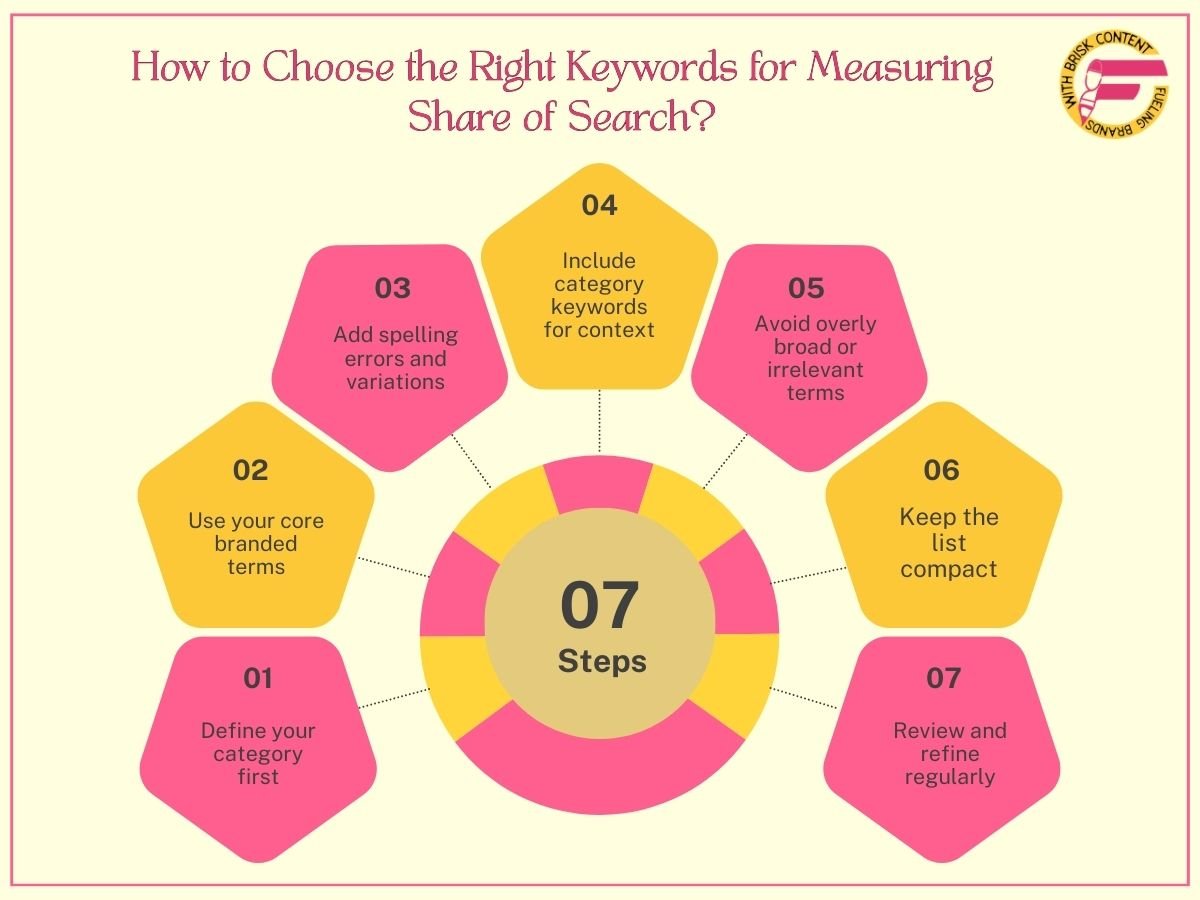
How to Choose the Right Keywords for Measuring Share of Search?

Selecting the right keywords is the foundation of accurate Share of Search analysis. A focused keyword list gives a reliable picture of consumer interest and helps you see how your brand stacks up against competitors. Here is a simple and effective way to build that list.

  1. Define your category first

Start by clarifying the product category you operate in. A clear category scope ensures you compare your brand against the right competitors and avoid noisy data.

  1. Use your core branded terms

Branded keywords should be at the centre of your list. Include your brand name, product names, and any well-known variants. These terms reveal true intent and direct brand interest.

  1. Add spelling errors and variations

Users often misspell brand names. Add the most common variations so you capture full search behaviour and avoid under-reporting your actual share.

  1. Include category keywords for context

Category terms help you understand overall search volume and validate whether interest in your market is rising or falling. Keep these terms specific and relevant.

  1. Avoid overly broad or irrelevant terms

Generic keywords may inflate your numbers and give a false impression of interest. Stick to terms that clearly relate to your brand or category.

  1. Keep the list compact

A concise keyword list reduces noise and gives cleaner trends. A small, well-selected set of terms works better than a long list filled with marginal keywords.

  1. Review and refine regularly

Search behaviour changes with launches, campaigns, and market shifts. Update your keyword list from time to time to keep your Share of Search data accurate. Learn more about content marketing trends shaping search in 2026 to stay ahead of keyword evolution.

How can Share of Search predict future sales or market trends?

Share of Search is often a strong leading indicator. Research suggests that shifts in Share of Search can predict up to 83% of future market share for some industries. When more people search for your brand versus the competition, it signals rising interest and intent.​

This is useful for planning inventory, measuring campaign impact, or anticipating quarterly sales trends. While not guaranteed, an uptick in Share of Search usually means more people are considering your brand, often before sales numbers reflect those changes.

What industries benefit the most from tracking Share of Search?

Categories where purchase consideration starts with an online search will see the largest impact from monitoring Share of Search. Industries with high competition and frequent changes tend to gain the most, including:

  1. Consumer goods (e.g., beverages, snacks, electronics).
  2. Automotive and travel markets.
  3. Technology and software brands.
  4. Health and finance products.

How do offline marketing efforts influence online Share of Search?

Traditional ads, sponsorships, and even PR activities can impact Share of Search. Offline campaigns may generate curiosity or buzz that leads people to look up your brand online. For this reason, align your online and offline campaigns and look for jumps in Share of Search after major TV ads, events, or press coverage.

Can Share of Search be applied to social media or other digital platforms?

Share of Search has traditionally focused on search engines, but similar concepts can extend to social platforms. Tools are available for Facebook, Instagram, and YouTube to measure branded search or hashtag usage.

However, intent differs by platform. Search engines show active interest, while social media may track passive engagement or brand mentions.

How can small businesses leverage Share of Search insights compared to larger brands?

Share of Search is not just for big brands. Small businesses can use simple keyword tracking tools to see how local search interest changes and compare against nearby competitors. Smaller brands can act quickly if data shows a drop, switching up content, ads, or community engagement strategies to regain share.

You just need to focus on:

  1. Location-based tracking.
  2. Seasonal campaigns (e.g., holiday or event-driven spikes for local services).
  3. Niche keyword clusters that reflect your specialties.

Conclusion

Clear insights into how consumers search for your brand versus competitors open a new window of opportunity for marketers. Share of Search provides a fresh perspective on brand awareness by focusing on actual consumer purpose rather than just media presence. This clarity helps in informed decision-making in SEO, content, and marketing plans. Creating your strategy around these insights can help bridge the gap between digital visibility and real engagement. 

For businesses aiming to promote their brand’s online impact and drive meaningful growth, professional content marketing can make a significant difference. Dig out how expert guidance can transform your marketing efforts by visiting Content Fayah. Let data-driven content strategies be the cornerstone of your path to capturing and retaining consumer attention in a competitive landscape.

1. How often should Share of Search be measured?

Monthly is best, with additional checks during or after major campaigns for accuracy.

2. Can Share of Search help in launching new products?

Yes, tracking search trends lets you gauge early audience interest and adjust marketing plans fast.

3. Is a drop in the Share of Search always bad?

Not always, it can be due to seasonality, competitor launches, or temporary trends. Investigate closely before making changes.

4. Are there free tools to monitor Share of Search?

Free options include Google Trends and Mangools’ dashboard. Paid tools offer deeper insights and reporting features.

Categories
Content Marketing

How to Plan Your AI Content Strategy?

Effective content marketing starts with an exceptional content strategy. An efficiently planned content marketing strategy will boost your search traffic and increase the number of valuable actions your audience takes.

As Artificial Intelligence (AI) transforms how we work, think and create, why not use it to supercharge your content strategy, too? In this post, we will discuss how to plan and build your AI content strategy using the latest AI tools, making the complete process smarter, faster and more impactful.

What is a content strategy?

A content strategy outlines how your business develops, publishes and manages its online content to achieve clear objectives. It acts as a roadmap to guide your efforts in delivering targeted, valuable, and consistent digital material across different platforms. 

The essential components of a reliable content strategy include:

  • Ideas for valuable content: Testimonials, video tutorials, Interviews, research, FAQ’s
  • Type of content: Blogpost, videos, podcast, infographics, whitepapers, etc.
  • Distribution Platform: Website, emails, social media, etc.
  • Resources: Workforce, time, and budget.
  • Publishing deadline: A Structured calendar to ensure a consistent publishing

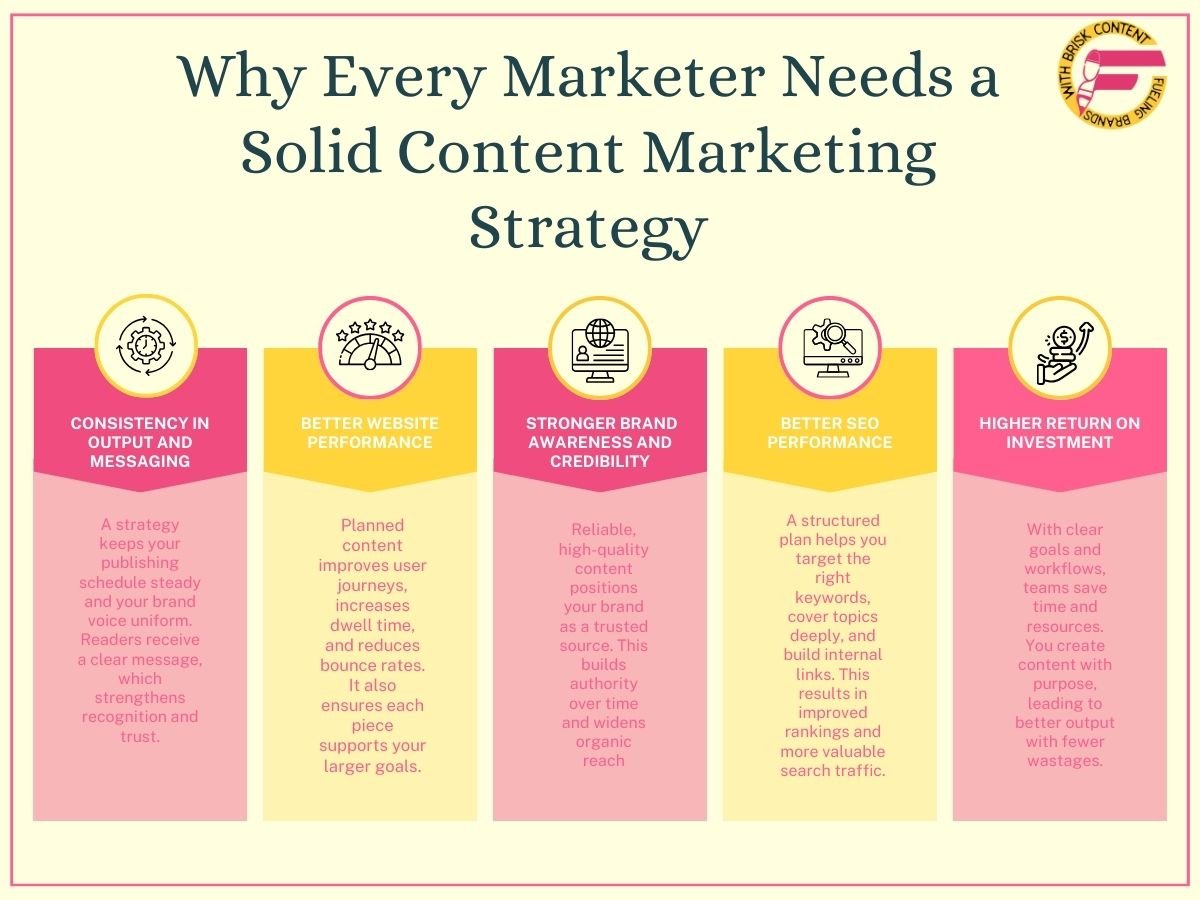
Why is it Necessary for Marketers to create a Content Marketing Strategy?

A strong content strategy will better equip you to create convincing narratives and rich content experiences that inform, engage and inspire. Without a structured approach, your efforts risk being inconsistent and ineffective.

A well-defined content marketing strategy provides several long-term benefits:

  • Consistency in output and brand message.
  • Better website performance
  • Improved brand awareness, credibility, and trust.
  • Enhanced SEO performance and valuable search traffic.
  • A better return on investment through optimized content creation processes.
  • Helps in goal setting and Tracking
  • Lower operational costs by avoiding redundant efforts.

Charging up your Content Marketing Strategy with  AI

AI is reshaping the content marketing landscape at a rapid pace. According to recent AI content marketing statistics

  • 67% of marketers use AI for content marketing or SEO 
  • Marketers who use AI see an average of 70% increase in ROI

Using AI for content marketing leverages machine learning algorithms to automate and optimize your content-related processes. It will improve your audience targeting, discover new content opportunities, and enhance engagement through better personalization. By adopting AI tools, you can focus on high-value creative work while AI handles data-intensive tasks such as research, keyword analysis, and performance tracking.

Content Marketing Strategy Statistics

“At this moment, AI is changing the game for marketers. If you are not adopting AI in your day-to-day process, the risk of falling behind your competitors is greater and greater.” Dan Sheffer, Director, SEO.com

Below is the list highlighting the growth of AI in marketing

  • In 2025, AI in the marketing industry is worth $47.32 billion, up from $12.05 billion in 2020.
  • International AI marketing revenue is estimated to reach 107.5 billion dollars by 2028
  • The AI marketing industry is expected to grow at a compound annual growth rate of 36.6% globally between 2024 and 2030. 

Elements of a Content Strategy Plan Powered by AI

The stages of an AI content marketing strategy include content ideation, creation, distribution, and performance measurement. Let’s see how AI content creation tools support each stage of content planning:

1. Brainstorming: 

The first step to creating a plan is generating ideas. There are powerful AI tools designed to generate new viewpoints and connections, resulting in more diverse and innovative content ideas. Miro AI Assist, Notion AI, and Otter are great brainstorming tools you can use.

2. Research and Data Analysis

Great marketers are also great researchers. Effective content relies on an in-depth understanding of both the audience and competitors. Elicit, Research Rabbit, and Consensus are AI tools that simplify this process by consolidating insights from multiple credible sources, summarizing findings, and identifying key trends. This will help you make quicker, data-backed decisions and identify content gaps. 

4. Text-Based Content Creation

AI’s text generation tools, such as ChatGPT, Google’s Gemini, Claude, and Copy.ai, help you quickly draft blog posts, ad copy, and emails. Want the top SEO content writing tools that work with AI? Check out our blog on the best SEO content writing software for 2026 to discover AI-powered tools that make content creation faster and more effective.

5. Automated Conversational Marketing

AI chatbots have become an integral part of conversational marketing, enabling personalized engagement. Platforms like Drift, Slack integrations, and ManyChat help automate interactions and provide instant support. These systems operate 24/7, ensuring your brand remains approachable at any hour and leading to higher conversion rates. 

6. Multimedia Content Creation

Multimedia generation powered by AI is experiencing rapid growth. Tools like Synthesia, Pictory, and Runway ML enable the quick creation of videos, graphics, and infographics. For instance, you can repurpose a current blog post into a video to enhance engagement on social platforms. 

7. Performance Tracking

AI tools for content marketing performance measurement analyze large amounts of data to provide actionable insights, track key metrics, and optimize future strategies. HubSpot’s Marketing Hub and SEMrush are examples of such platforms that help you track how content impacts the sales pipeline and revenue.

Limitations of AI in Content Planning

While the potential of AI content creation tools is extensive, they still have limitations. One must remain watchful as AI can lack context, creativity, and emotional intelligence.

Some common challenges include:

  • Data Quality: AI-generated content relies on patterns found in existing data, which can sometimes be outdated or inaccurate. Human verification is essential before publishing information online.
  • Data Security: AI is currently unregulated, so there is no guarantee your shared information won’t be stored or shared with others.
  • Over-Automation: Relying entirely on AI can lead to generic and impersonal content that fails to connect emotionally.

Conclusion

AI may be used to conduct various types of research and identify interesting angles, but it can never fully replace writers and thinkers. Humans’ touch in content strategy will always require critical thinking. AI can assist you by producing content in a shorter time, but you will need the services of humans to feed in the right prompt. Combining these tools with Human creativity and careful thinking is the best way to use them.

Content marketers like Content Fayah can help you by adding that essential human touch, ensuring creativity and credibility are maintained. The expertise to seamlessly combine AI with human creativity allows you to connect with your audience on an emotional level and build strong customer relationships, which are paramount to a successful marketing campaign. 

1. What is an AI content strategy?

An AI content strategy uses tools like ChatGPT and Gemini to plan, create, and optimize content faster while preserving human creativity to drive better engagement and ROI.

2. What AI tools help with content ideation?

Miro AI Assist, Notion AI, and Otter generate diverse content ideas quickly, helping you brainstorm innovative topics and angles for blogs, videos, and social posts.

3. What are AI content creation limitations?

AI lacks emotional intelligence and context, so human oversight is needed to ensure authenticity, data accuracy, and brand voice in final content.

Categories
Uncategorized

What is Bottom-of-the-Funnel Content and How to Create it?

Starting your journey to boost sales means focusing on what really works when buyers are ready to commit. Bottom-of-the-Funnel (BoFu) content does exactly that—it gives your prospects the confidence and proof they need to choose your product over others. 

Companies like Reloadly have increased sales by giving buyers clear product demos, interesting case studies, and simple price pages that stick in their minds. Another smart tactic is showing customer testimonials or hosting webinars to address last-minute questions. This kind of content doesn’t just inform; it helps buyers see real value and removes doubts, pushing them to take action confidently.

What Is Bottom-of-the-Funnel Content?

Bottom of the Funnel (BoFu) is the final stage in the buyer’s journey where potential customers are ready to make a purchase decision. At this point, they have already researched their options, compared different brands or products, and are now deciding which one to choose.

BoFu content and marketing concentrate on helping these prospects take the last step to become paying customers by giving information that builds trust and shows clear value, such as demos, consultations, case studies, or customer testimonials. Essentially, it’s about turning interested leads into buyers by answering their final questions and making the buying process easy and convincing.

Why Is Bottom-of-the-Funnel Content Important?

Bottom-of-the-Funnel (BoFu) content is important because it targets people who are ready to buy, helping you turn visits into real sales and grow your business faster.

1. Different Content, Different Buyer Intent

  • BoFu content targets buyers who are ready to make a purchase decision.
  • Unlike general content that attracts curious visitors, BoFu content helps people who are comparing options and are serious about buying.

2. Quality Over Quantity

  • BoFu content may get less traffic, but it attracts high-quality visitors with clear buying intent.
  • It focuses on converting these visitors into customers, which is more valuable than just increasing overall pageviews.

3. Higher Conversion Rates

  • BoFu content converts at much higher rates — up to 10 times more than top-of-the-funnel content.
  • This means more of your website visitors become paying customers.

4. Bigger and More Valuable Deals

  • Sales coming from BoFu content tend to be larger and more profitable.
  • For example, comparison posts (a common BoFu content type) often bring in not just more customers but also bigger deals.

5. Focus on Business Results

  • Investing in BoFu content first helps you get real business results much faster.
  • It ensures you’re creating content that actually drives sales and revenue, rather than just traffic.

6. Boosts Confidence and Removes Doubts

  • BoFu content answers final questions, provides proof like case studies or demos, and helps buyers feel confident in their decision.

Differences Between Top, Middle, and Bottom-of-the-Funnel Content

Let’s understand the difference between the three stages of the content marketing funnel:

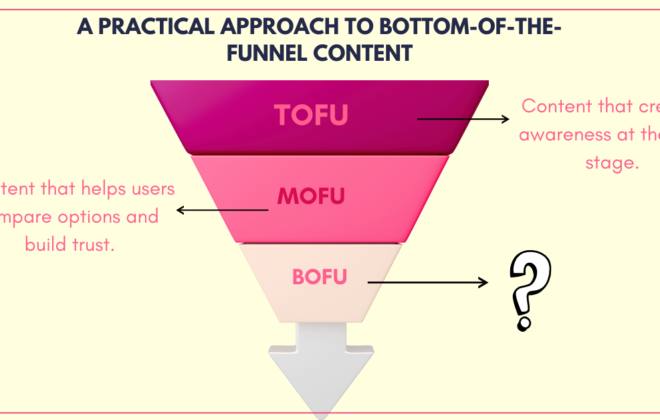
  • At the Top of the Funnel (ToFu), your goal is to grab people’s attention. This is where they first hear about your brand and realize they might have a problem. The content here is simple and broad, designed to educate or entertain, like blog posts or social media updates.
  • Moving to the Middle of the Funnel (MoFu), people know their problem and start looking for solutions. They compare options and want to know how your product or service can help. Content here dives deeper with guides, webinars, and case studies to build trust.
  • Finally, at the Bottom of the Funnel (BoFu), people are ready to buy. They need clear reasons to pick your product and proof that it works. BoFu content includes product demos, free trials, pricing details, and customer reviews to help them make the final decision.

Types of Bottom-of-the-Funnel Content That Converts

Here are some types of Bottom-of-the-Funnel content that really help you convert visitors into customers:

  1. Case Studies — These tell real stories about how your product helped someone solve a problem. They show proof that your product works and can give your visitors confidence to buy.
  2. Product Demos — Videos or tutorials that show your product in action. When people see how easy or useful something is, they feel more sure about choosing it.
  3. Customer Testimonials and Reviews — Hearing from happy customers builds trust. It’s like a friend recommending something—it makes your product feel more reliable.
  4. Comparison Posts — When people are deciding between options, comparison articles or pages help them see why your product is the best choice.
  5. Pricing Pages — Clear, simple info about costs and plans helps buyers decide quickly without confusion.
  6. Free Trials or Consultations — Letting people try your product or talk to you without risk gives them a nudge to commit.

How to Create Effective BOFU Content: Step-by-Step Guide

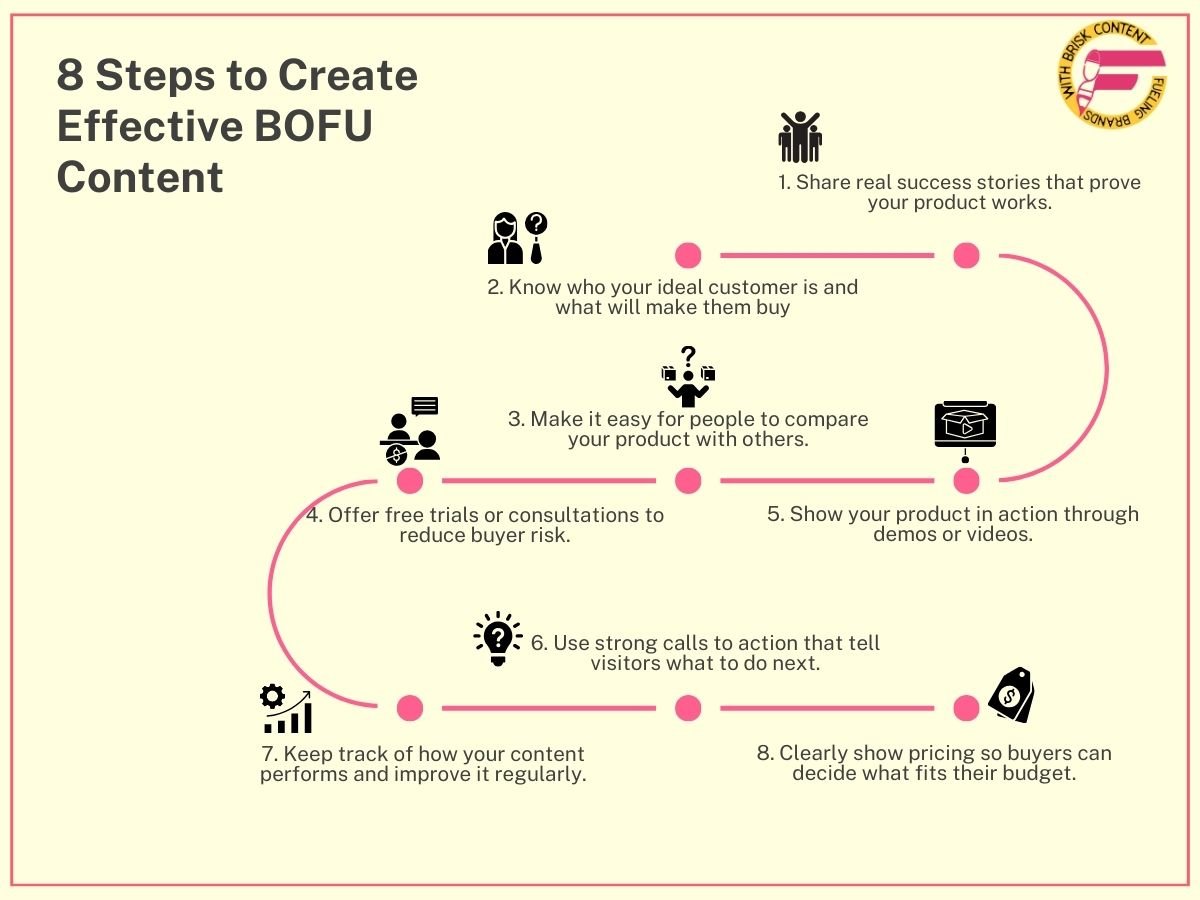
Here’s a simple step-by-step guide to help you create effective Bottom-of-the-Funnel (BoFu) content:

  1. Know who your ideal customer is and what will make them buy.
  2. Share real success stories that prove your product works.
  3. Show your product in action through demos or videos.
  4. Make it easy for people to compare your product with others.
  5. Clearly show pricing so buyers can decide what fits their budget.
  6. Offer free trials or consultations to reduce buyer risk.
  7. Use strong calls to action that tell visitors what to do next.
  8. Keep track of how your content performs and improve it regularly.

This simple approach will help you create BoFu content that converts visitors into customers.

Best Practices for BOFU Content Creation

  1. Focus on One Buyer at a Time
    Make your content for a specific type of buyer who is ready to make a decision. Use keywords that show they want to buy, not just browse.
  2. Be Clear and Direct
    Tell your readers exactly what to do next—like “Start Your Free Trial” or “Request a Demo.” Focus on your product and how it helps, but always keep it helpful.
  3. Build Trust
    Use real customer reviews, testimonials, and success stories to show others have had a good experience. Share awards or credentials that prove you’re reliable.
  4. Write Persuasive and Helpful Copy
    Explain how your product benefits the buyer, not just what it does. Create urgency by mentioning special deals or limited stock. Answer common doubts right away.
  5. Make It Easy to Find and Enjoy
    Use strong images and videos to keep people interested. Optimize your content in a way that it shows up in search engines when buyers look for last-minute info. Keep your content updated with fresh examples.

Measuring the Success of Your BOFU Content

Measuring the success of your Bottom-of-the-Funnel (BoFu) content means looking at how well it helps turn interested leads into paying customers. You want to focus on key signs like conversion rates — how many people sign up for free trials, request demos, or make purchases.

Also, check the ratio of leads turning into customers and the revenue your BoFu campaigns bring in. Other useful measures include tracking assisted conversions, spotting where people drop out of your sales funnel, and collecting direct feedback to see how your content influences the final buying decision. This way, you’ll know exactly how your content is performing and where to improve for better results.

Examples of Effective BOFU Content

Effective BoFu content includes comparison pages that help buyers see how your product stacks up against others, and case studies that share real success stories from customers. Product demos and testimonials build trust by showing your product in action and with happy users. Free trials let buyers test your product risk-free, while clear pricing pages make it easy for them to understand costs. Other great examples are personalized sales calls, webinars, and “best of” or “alternative” product lists that guide prospects in choosing the right fit.

Common Mistakes to Avoid in BOFU Content Creation

Avoid these common mistakes to make your Bottom-of-the-Funnel content clear, trustworthy, and effective at turning visitors into customers.

  1. Buyer confusion: Not clearly understanding who your buyer is and what they need.
  2. Weak messaging: Being unclear or hesitant in your sales approach.
  3. Missing CTAs: Not telling people what step to take next.
  4. No trust builders: Leaving out testimonials or proof that your product works.
  5. Too much info: Overwhelming buyers with unnecessary details.
  6. Poor SEO/user experience: Making it hard to find or use your content.
  7. Lack of teamwork: Not involving sales or product teams to cover buyer questions.

Conclusion

Bottom-of-the-Funnel (BoFu) content helps ready-to-buy customers confidently choose your product by providing clear proof, demos, and testimonials that remove final doubts. It’s about guiding buyers smoothly to “yes” with case studies, pricing clarity, and risk-free trials.
Ready to create high-converting BoFu content that closes sales? Content Fayah specializes in funnel-optimized content that turns prospects into customers. From case studies to demo videos, our experts craft BoFu strategies that deliver ROI. Get started today for content that converts.

1. What is Bottom-of-the-Funnel (BoFu) content?

BoFu content targets ready-to-buy prospects with case studies, demos, testimonials, pricing, and free trials. It builds trust and removes final doubts to convert visitors into customers.

2. How does BoFu content differ from ToFu and MoFu?

ToFu attracts and educates, MoFu nurtures with solutions, BoFu closes sales with proof like demos and testimonials. Each stage matches a different buyer intent for maximum conversion.

3. What are the best types of BoFu content?

Case studies, product demos, customer testimonials, comparison pages, clear pricing, and free trials work best. They provide social proof and reduce buyer risk effectively.

Categories
Content Marketing

Content Marketing Trends that are Working in 2026

Remember when posting twice a week on Instagram, running some Facebook ads, and sending a monthly newsletter seemed enough for digital marketing? Those days are over.

As 2026 unfolds, content marketing trends 2026 are reshaping how brands connect with people. Technology is advancing fast, privacy laws are tighter, and audiences now jump between platforms faster than ever.

But it’s not just about technology. It’s about trust, relevance, and connection. Whether you work with a digital marketing agency or run your own campaigns, these shifts define the future of content marketing.

AI-Driven Content Creation and Personalisation

Artificial Intelligence has matured. Tools like ChatGPT, Jasper, and Copy.ai are far smarter than before. They now adapt to tone, style, and brand voice, helping marketers produce more tailored and consistent content.

Still, 2026 is not about letting AI take over. The winning formula is clear: use AI-driven content creation for speed and scale, but keep humans in charge of creativity. People can detect when content feels robotic. That’s why the best brands use AI to enhance, not replace, authentic storytelling.

Smart marketers also use AI for customer data analysis, campaign testing, and trend prediction—saving time while personalising at scale. The key is balance: let technology optimize efficiency and keep people handling empathy and emotional connection.

Search Is No Longer Just Google

Search habits are changing. Nearly 40% of Gen Z users now search using Instagram Reels or YouTube Shorts instead of Google. Add to that the growth of tools like Perplexity.ai and voice-enabled devices, and search is now everywhere.

For brands, SEO must evolve into generative engine optimization (GEO). This entails producing content that is recognized, referenced, and remembered by AI models. Ranking in Google results is no longer the only consideration. It’s about conversational tools and AI systems that remember and mention you.

Marketers need to take into account a variety of channels when releasing content:

  • Long-form reviews or blog posts for traditional search.
  • Short, snappy videos for visual search.
  • Conversational content for AI assistants and chat-based engines.

Voice Search Optimization

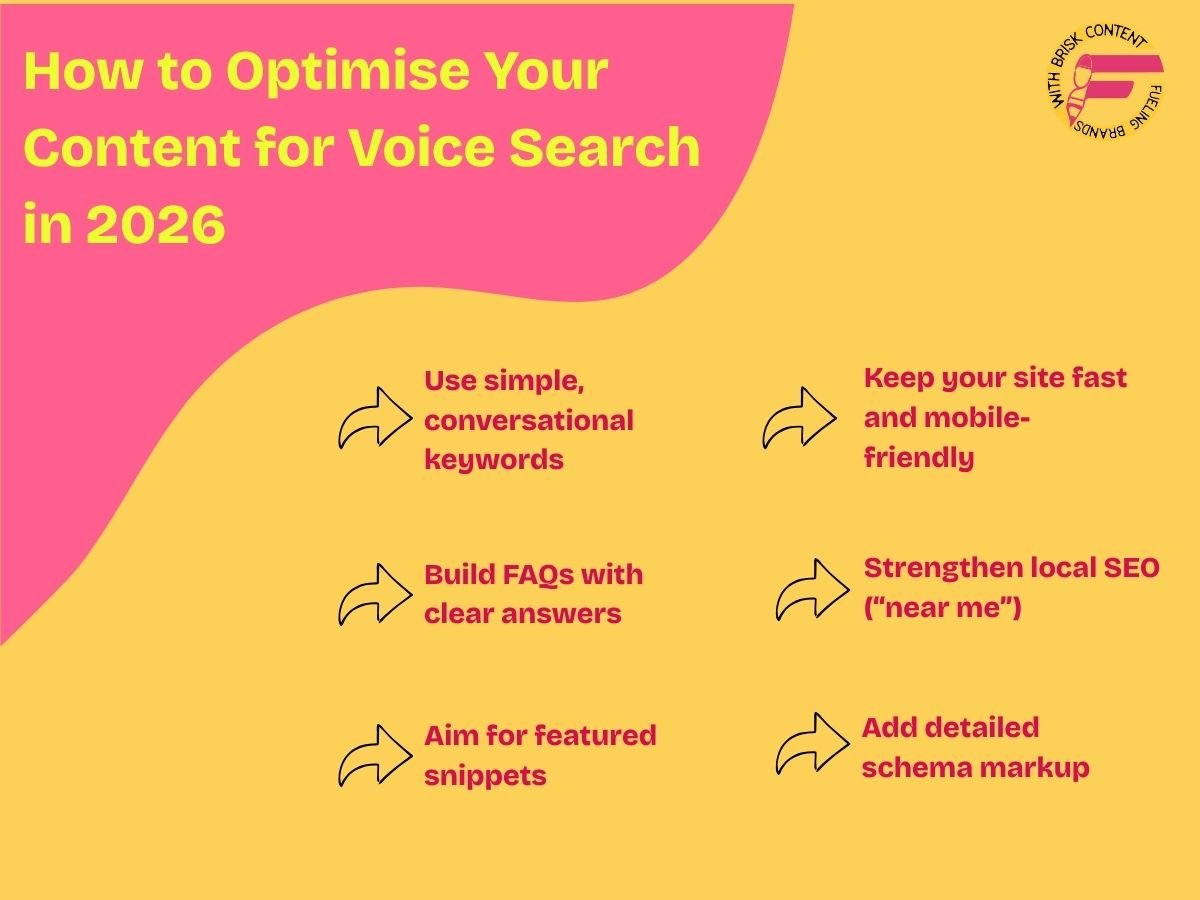
Voice search optimization continues to grow in 2026 as more people use devices like Alexa, Siri, and Google Assistant. To succeed, brands must create content that matches how people talk.

Here’s what works now:

  • Use natural, conversational keywords.
  • Build FAQ pages answering real questions.
  • Optimise for featured snippets using bullet points or tables.
  • Use schema markup to help AI assistants extract answers.
  • Focus on local SEO because many voice searches include “near me.”
  • Keep sites fast and mobile-friendly.

Another big shift is optimizing for Answer Engine Optimization (AEO) and Generative Engine Optimization (GEO). This ensures your brand shows up in AI-generated summaries. Voice and AI search are merging, so the clearer and more direct your content, the better your visibility.

The Rise of Community-Driven Content

The most powerful marketing in 2026 is community-focused. Brands are no longer just broadcasting messages; they are building two-way conversations.

Community-driven marketing strengthens relationships through spaces like Discord servers, Slack groups, or private brand communities. These communities give loyal customers a place to connect, share user-generated content, and exchange ideas.

This approach offers real benefits:

Builds long-term loyalty.

  • Creates authentic user content (UGC).
  • Generates valuable customer feedback.
  • Turns customers into advocates.

In an advertising-filled world, actual customer feedback is unique. Engaged communities encourage dialogue rather than just clicks, which keeps brands relevant and promotes organic growth.

Algorithm Volatility: The New Normal in 2026

Algorithms now change faster than ever, and AI integration into social platforms has made visibility unpredictable. Algorithm volatility 2026 means that what works one month might fail the next.

Success now comes from adaptability. Marketers must combine automation with creativity, using AI to manage personalization while humans focus on storytelling.

At the same time, misinformation is rising. Brands must invest in monitoring false narratives, correcting them quickly, and being transparent. Building credibility before problems arise is the best defence.

The Micro-Influencer Advantage

Big celebrity endorsements are losing power. Instead, micro-influencer marketing dominates digital marketing trends 2026.

Micro-influencers have smaller followings but stronger trust. Their recommendations feel more genuine, and they engage in niche or private online spaces where real discussions happen.

Brands now prefer forming long-term relationships with these creators rather than one-off sponsored posts. Authentic partnerships deliver better engagement, credibility, and brand storytelling.

Content Scale vs. Authenticity

AI now helps marketers automate reports and analyse trends. Many agencies use it to scale fast, but speed can’t replace substance.

AI-driven tools sometimes produce bland messages that lack emotional depth. That’s why content authenticity is becoming marketing’s most valuable asset.

Stories with heart, emotion, and real meaning stand out. Even in an AI-driven environment, people still want connection. In 2026, authentic storytelling that is grounded in human experience and supported by analytics will be the key to brand success.

The GEO Revolution: Redefining Visibility in 2026

A major shift in content marketing trends 2026 is Generative Engine Optimization (GEO). Unlike SEO, which focuses on search rankings, GEO is about becoming part of AI’s memory.

AI systems such as ChatGPT and Gemini don’t just list results; they also recall the most credible sources. Hence, visibility now depends on being cited and recognised by AI.

The stories that AI “remembers” are those most shared and referenced across media. To stay visible, brands must build strong reputations, produce credible content, and ensure their voices are represented in trusted, editorial-quality spaces.

Being “recalled” by generative engines will soon carry more weight than backlinks or social mentions.

Strategic Implications: Preparing for 2026

The marketing environment of 2026 calls for more intelligent AI utilization, authentic storytelling, and more robust trust-building techniques. Agility, ethics, and authenticity are three areas where agencies and internal teams need to modify their approaches. Below is a summary of the main goals and common needs.

PriorityAgency FocusIn-House FocusShared Need
AI IntegrationAutomation and reporting to scale efficiency for several clients (more than 60% of international agencies)Personalized content creation tailored to customer behaviour (~40%) ​Maintain human oversight for creativity and ethical AI use
ChallengesHandling algorithm changes and combating misinformationTying marketing results directly to revenue growth and ROIStrengthening authenticity and transparency in messaging
InfluencersClose relationships with micro-influencers (who are preferred by 75% of respondents over celebrities)Lower dependency on influencer marketing, focusing on brand-owned narrativeBuilding credibility and community trust over reach
MeasurementFollowing stories in exclusive, invite-only online areasConnecting metrics to customer retention and business resultsConverting conversion and reputation data into unified performance scorecards

Beyond 2026: The Long Arc of Marketing Transformation

As digital environments grow, content marketing will be built on the three pillars of authenticity, adaptability, and audience interaction.

Technology will keep transforming how we create and distribute content, but the human desire for honest communication will never fade. The brands that balance AI efficiency with human warmth will lead in 2026 and beyond.

Stay ahead of the curve with Content Fayah’s latest insights on content marketing trends and strategies for 2026. Subscribe now and empower your brand with the tools and knowledge to succeed in the rapidly evolving digital landscape.

1. What are the top content marketing trends for 2026?

AI-driven personalization, Generative Engine Optimization (GEO), voice search, micro-influencer partnerships, and community-driven content lead 2026 trends for authentic engagement and visibility.

2. How does GEO differ from traditional SEO in 2026?

GEO optimizes content for AI platforms like ChatGPT and Perplexity to get cited in answers. SEO focuses on Google rankings. Both work together for maximum visibility across search types.

3. Why is authenticity important in 2026 content marketing?

AI scales content fast, but audiences crave human connection. Authentic storytelling builds trust, differentiates brands, and outperforms robotic content despite algorithm changes.

Categories
Content Marketing

GEO in 2026 – A Complete Guide for Beginners

In 2026, search is changing fast. With over 79% of users turning to AI tools like ChatGPT, Gemini, and Perplexity, businesses can’t rely only on old SEO methods. Gartner predicts that regular search traffic may drop by 25% as more people use AI for quick answers.

This is where Generative Engine Optimization (GEO) comes in. GEO helps your brand show up in AI-generated results, not just on Google. It focuses on clear, factual, and easy-to-understand content that AI tools can trust, cite, and share — keeping your brand visible in the new age of intelligent search.

What Is Generative Engine Optimization (GEO)?

Generative Engine Optimization (GEO) means improving your website content so it appears in results from AI-based search tools like ChatGPT, Perplexity, Gemini, Copilot, and Google AI Overviews.

GEO helps your brand show up when people use these tools to look for topics related to your products, services, or expertise.

As more people use AI to search, it’s important for your brand to show up in AI answers. This helps you reach the right customers and connect with them, wherever they start their search.

The main goal of GEO is to help more people discover your website, increase targeted visitors, and turn them into loyal followers who keep coming back.

Why GEO matters in 2026?

Generative Engine Optimization, or GEO, is becoming a big deal as AI-powered search keeps growing fast. The early buzz around AI is now turning into trust and stability, and these tools are getting smarter every day.

Search isn’t just about Google anymore. Bing’s AI, ChatGPT, Perplexity, and other platforms are stepping up and changing how people find information online.

What’s Happening to Organic Search?

AI is now reshaping how search works. Businesses can’t rely only on traditional SEO now — they need to think differently. Gartner predicts that by 2026, regular search traffic might drop by 25%, and organic visits could fall by over 50% as more people move to AI tools for answers.

Plus, 79% of users are expected to use AI search soon, and 70% already trust the results. To stay visible, brands must start using GEO — it’s the key to showing up in AI-driven results and keeping people’s attention.

How Search Behavior Is Changing?

People are now beginning their searches on AI platforms — whether they’re looking for facts, comparing products, or deciding what to buy.

ChatGPT already has more than 180 million monthly users, and Perplexity’s traffic jumped by 858% last year, with around 10 million active users. This shows that people want quick, accurate, and personalized answers.

When you optimize your content from these channels, your brand shows up wherever people search. GEO helps your brand stay visible and easy to find in AI answers.

How GEO and SEO Work Together?

GEO and SEO work hand in hand to improve your online presence. SEO will make sure your website ranks higher on search engines like Google and brings more visitors to your site. GEO, on the other hand, makes your content easy for AI tools to understand and include in their answers. When you use both together, your brand gets noticed in traditional search results and AI-generated responses, helping you reach more people in different ways.

GEO vs. SEO: What’s the Difference?

Let us understand how search engines and AI platforms handle their content differently. Here’s a quick comparison between SEO and GEO to show how each works and what they aim to achieve:

PointSEO (Search Engine Optimization)GEO (Generative Engine Optimization)
GoalGet higher rankings on Google or BingAppear in AI-generated answers like ChatGPT, Gemini, or Perplexity
How It WorksOptimizes web pages with keywords and backlinksAppear in AI-generated answers like ChatGPT, Gemini, or Perplexity
How It WorksOptimizes web pages with keywords and backlinksOptimizes content to be understood and cited by AI tools
Action of the user Users click your website’s linkUsers see your brand mentioned in AI responses
Main FocusKeywords, content quality, and backlinksStructured data, clear context, and reliable citations
Result Typelistings in search resultsQuick answers with your content included
MeasurementTrack rankings, traffic, and clicksTrack brand mentions and visibility in AI answers
Primary BenefitsGets a direct visit to the website Builds trust and awareness via AI exposure
Main PracticeUse proper SEO structure and stronger linksWrite clear, factual content optimized for AI learning

How is it revolutionizing digital marketing?

GEO is totally changing digital marketing. Earlier, brands focused on SEO and tried to rank high on Google or Bing. But now, people ask AI tools like ChatGPT, Perplexity, and Gemini for quick answers instead of browsing websites.

That’s where GEO comes in. It helps AI understand and trust your content so your brand shows up in those answers. When that happens, users discover your business instantly — even before visiting your site.

So today, marketing isn’t just about keywords or backlinks anymore. It’s about creating clear, helpful, and factual content that AI can easily read, cite, and recommend.

7 ways for businesses to begin with Generative AI Optimization

  1. Understand AI Search Behavior
    Explore how people use tools like ChatGPT, Perplexity, and Google AI Overviews. See what kind of answers show up and what tone or detail they prefer.
  1. Create Clear, Fact-Based Content
    Write simple, reliable, and well-structured content that answers real questions directly. AI tools value clarity, facts, and context.
  1. Use Structured Data
    Add schema markup and structured meta information. This helps AI engines easily identify your brand, products, and services.
  1. Build Strong Author Profiles
    A trustworthy author or brand identity increases the chances of your content being referenced by AI models. Add bios, credentials, and a transparent source.
  1. Focus on Context, Not Just Keywords
    GEO isn’t about stuffing keywords. It’s about giving AI content that truly makes sense. Use related terms and explain topics naturally.
  1. Track AI Mentions and Visibility
    Start observing where your brand appears in AI-generated answers. New analytics tools like Glimpse or BrightEdge can help.
  1. Combine GEO with SEO
    Don’t drop SEO — combine it with GEO. Optimize for web rankings while ensuring AI engines can read and recommend your content too.

The Future of GEO, SEO, and AI Search

As we move into 2026 and beyond, GEO will become a key part of every marketing strategy. SEO isn’t going away, but it’s expanding. Search optimization will now happen in two spaces: traditional search engines and generative AI platforms. Brands that adapt early will gain more visibility, stronger trust, and closer customer connections. The lines between “search” and “conversation” will blur, and content that’s helpful, human, and data-backed will succeed.

Ready to future-proof your brand for AI search dominance? Content Fayah specializes in GEO + SEO strategies that get your brand cited by ChatGPT, Perplexity, and Gemini. Get started today for visibility that scales across all search platforms.

1. What is Generative Engine Optimization (GEO)?

GEO optimizes content to appear in AI-generated answers from ChatGPT, Perplexity, and Gemini. Unlike SEO for Google rankings, GEO focuses on structured, factual content that AI tools cite directly.

2.  How does GEO differ from traditional SEO?

SEO targets Google/Bing rankings with keywords and backlinks. GEO makes content AI-readable for instant answers. Use both: SEO drives clicks, GEO builds instant brand awareness.

3. Why is GEO important for businesses in 2026?

With 79% of users shifting to AI search and organic traffic dropping 25%, GEO ensures your brand stays visible. Early adopters gain trust and authority across AI platforms.