Categories
Content Marketing

What Is Share of Search? Definition, Best Practices?

Have you ever wondered how many people searching online are actually looking for your brand compared to your competitors? Share of Search answers this exact question by measuring what percentage of searches in your product category are specifically for your brand. In 2025, Google processes around 9.5 million searches every minute, with over 60% 

happening on mobile devices.

Tracking your brand’s Share of Search can provide valuable insights into consumer interest and predict your future market share, with some studies showing it accounts for up to 83% of it. Understanding this metric helps marketers focus their efforts on boosting brand visibility where it truly matters.

How does Share of Voice differ from Share of Search?

When comparing brand metrics, it is important to understand the difference between Share of Voice and Share of Search, as both provide amazing insights into your market presence and consumer behavior.

AspectShare of Voice (SOV)Share of Search (SOS)
DefinitionThis measures brand presence across paid and organic media channels, such as advertising, social mentions, and PR.Measures the percentage of brand-related searches within a product category on search engines.
FocusBrand visibility and media exposure across multiple channels.Consumer search behavior and branded search interest online
Measurement BasisVolume of ads, impressions, social media mentions, and overall media share.Number of searches for the brand versus competitors in a category.
ReflectsMarketing spend and brand awareness efforts (input metric).Actual consumer intent and interest (outcome metric).
Funnel StageTypically, the upper funnel shows brand awareness.Closer to the lower funnel, indicating a stage of purchasing consideration.
UsageTo gauge media dominance and advertising effectiveness.To predict market share and understand real buyer interest.
Data FrequencyOften periodic, based on advertising campaigns and media reports.Continuously updated, real-time search data.

What tools and software can measure Share of Search effectively?

Several tools can help you measure Share of Search consistently and accurately. Best practice is to use these tools regularly to capture seasonal trends and campaign effects. Some of the popular options include:

  • Google Keyword Planner and Google Trends for tracking search volume.​
  • SEO platforms like SEMrush, Ahrefs, and Mangools allow deep keyword analysis, brand search monitoring, and competitive comparisons.​
  • Mangools provides a simple dashboard to compare multiple brands side by side for organic search, ideal for benchmarking.​

How can Share of Search inform your SEO and content marketing strategies?

Share of Search reveals the portion of your digital audience that is looking for your brand versus your competitors, providing marketers with insight for planning effective campaigns. If your Share of Search goes up, your SEO and content efforts are likely paying off.​ By measuring the metrics/ changes below over time, marketing teams can see what works in creating brand presence.

  1. Set content priorities: Focus on terms linked to high search interest for your brand. Check out our blog on the best SEO content writing software to create optimized content that boosts your Share of Search.
  2. Spot gaps and opportunities: If your Share of Search lags, adjust your content topics, backlink strategy, or landing page messaging.
  3. Gauge real impact: Track how new blog posts, PR, or ad campaigns lift Share of Search.

What are the common pitfalls or challenges when analyzing Share of Search?

Fix the following issues by routinely updating keyword lists, cross-verifying data, and segmenting Share of Search reports. Tracking Share of Search sounds simple, but comes with a few common challenges:

  • Not defining category scope: Results are only relevant if category terms are clear and competitors are accurately listed.​
  • Ignoring keyword variations and brand misspellings: These can skew the actual percentage.
  • Overlooking seasonal spikes in interest can give a misleading picture of long-term trends.
  • Relying only on one data source or looking at Share of Search in isolation from other metrics like conversion rates.

How to Choose the Right Keywords for Measuring Share of Search?

Selecting the right keywords is the foundation of accurate Share of Search analysis. A focused keyword list gives a reliable picture of consumer interest and helps you see how your brand stacks up against competitors. Here is a simple and effective way to build that list.

  1. Define your category first

Start by clarifying the product category you operate in. A clear category scope ensures you compare your brand against the right competitors and avoid noisy data.

  1. Use your core branded terms

Branded keywords should be at the centre of your list. Include your brand name, product names, and any well-known variants. These terms reveal true intent and direct brand interest.

  1. Add spelling errors and variations

Users often misspell brand names. Add the most common variations so you capture full search behaviour and avoid under-reporting your actual share.

  1. Include category keywords for context

Category terms help you understand overall search volume and validate whether interest in your market is rising or falling. Keep these terms specific and relevant.

  1. Avoid overly broad or irrelevant terms

Generic keywords may inflate your numbers and give a false impression of interest. Stick to terms that clearly relate to your brand or category.

  1. Keep the list compact

A concise keyword list reduces noise and gives cleaner trends. A small, well-selected set of terms works better than a long list filled with marginal keywords.

  1. Review and refine regularly

Search behaviour changes with launches, campaigns, and market shifts. Update your keyword list from time to time to keep your Share of Search data accurate. Learn more about content marketing trends shaping search in 2026 to stay ahead of keyword evolution.

How can Share of Search predict future sales or market trends?

Share of Search is often a strong leading indicator. Research suggests that shifts in Share of Search can predict up to 83% of future market share for some industries. When more people search for your brand versus the competition, it signals rising interest and intent.​

This is useful for planning inventory, measuring campaign impact, or anticipating quarterly sales trends. While not guaranteed, an uptick in Share of Search usually means more people are considering your brand, often before sales numbers reflect those changes.

What industries benefit the most from tracking Share of Search?

Categories where purchase consideration starts with an online search will see the largest impact from monitoring Share of Search. Industries with high competition and frequent changes tend to gain the most, including:

  1. Consumer goods (e.g., beverages, snacks, electronics).
  2. Automotive and travel markets.
  3. Technology and software brands.
  4. Health and finance products.

How do offline marketing efforts influence online Share of Search?

Traditional ads, sponsorships, and even PR activities can impact Share of Search. Offline campaigns may generate curiosity or buzz that leads people to look up your brand online. For this reason, align your online and offline campaigns and look for jumps in Share of Search after major TV ads, events, or press coverage.

Can Share of Search be applied to social media or other digital platforms?

Share of Search has traditionally focused on search engines, but similar concepts can extend to social platforms. Tools are available for Facebook, Instagram, and YouTube to measure branded search or hashtag usage.

However, intent differs by platform. Search engines show active interest, while social media may track passive engagement or brand mentions.

How can small businesses leverage Share of Search insights compared to larger brands?

Share of Search is not just for big brands. Small businesses can use simple keyword tracking tools to see how local search interest changes and compare against nearby competitors. Smaller brands can act quickly if data shows a drop, switching up content, ads, or community engagement strategies to regain share.

You just need to focus on:

  1. Location-based tracking.
  2. Seasonal campaigns (e.g., holiday or event-driven spikes for local services).
  3. Niche keyword clusters that reflect your specialties.

Conclusion

Clear insights into how consumers search for your brand versus competitors open a new window of opportunity for marketers. Share of Search provides a fresh perspective on brand awareness by focusing on actual consumer purpose rather than just media presence. This clarity helps in informed decision-making in SEO, content, and marketing plans. Creating your strategy around these insights can help bridge the gap between digital visibility and real engagement. 

For businesses aiming to promote their brand’s online impact and drive meaningful growth, professional content marketing can make a significant difference. Dig out how expert guidance can transform your marketing efforts by visiting Content Fayah. Let data-driven content strategies be the cornerstone of your path to capturing and retaining consumer attention in a competitive landscape.

1. How often should Share of Search be measured?

Monthly is best, with additional checks during or after major campaigns for accuracy.

2. Can Share of Search help in launching new products?

Yes, tracking search trends lets you gauge early audience interest and adjust marketing plans fast.

3. Is a drop in the Share of Search always bad?

Not always, it can be due to seasonality, competitor launches, or temporary trends. Investigate closely before making changes.

4. Are there free tools to monitor Share of Search?

Free options include Google Trends and Mangools’ dashboard. Paid tools offer deeper insights and reporting features.

Categories
Content Marketing

How to Plan Your AI Content Strategy?

Effective content marketing starts with an exceptional content strategy. An efficiently planned content marketing strategy will boost your search traffic and increase the number of valuable actions your audience takes.
As Artificial Intelligence (AI) transforms how we work, think and create, why not use it to supercharge your content strategy, too? In this post, we will discuss how to plan and build your AI content strategy using the latest AI tools, making the complete process smarter, faster and more impactful.

What is a content strategy?

A content strategy outlines how your business develops, publishes and manages its online content to achieve clear objectives. It acts as a roadmap to guide your efforts in delivering targeted, valuable, and consistent digital material across different platforms. 

The essential components of a reliable content strategy include:

  • Ideas for valuable content: Testimonials, video tutorials, Interviews, research, FAQ’s
  • Type of content: Blogpost, videos, podcast, infographics, whitepapers, etc.
  • Distribution Platform: Website, emails, social media, etc.
  • Resources: Workforce, time, and budget.
  • Publishing deadline: A Structured calendar to ensure a consistent publishing

Why is it Necessary for Marketers to create a Content Marketing Strategy?

A strong content strategy will better equip you to create convincing narratives and rich content experiences that inform, engage and inspire. Without a structured approach, your efforts risk being inconsistent and ineffective.

A well-defined content marketing strategy provides several long-term benefits:

  • Consistency in output and brand message.
  • Better website performance
  • Improved brand awareness, credibility, and trust.
  • Enhanced SEO performance and valuable search traffic.
  • A better return on investment through optimized content creation processes.
  • Helps in goal setting and Tracking
  • Lower operational costs by avoiding redundant efforts.

Charging up your Content Marketing Strategy with  AI

AI is reshaping the content marketing landscape at a rapid pace. According to recent AI content marketing statistics

  • 67% of marketers use AI for content marketing or SEO 
  • Marketers who use AI see an average of 70% increase in ROI

Using AI for content marketing leverages machine learning algorithms to automate and optimize your content-related processes. It will improve your audience targeting, discover new content opportunities, and enhance engagement through better personalization. By adopting AI tools, you can focus on high-value creative work while AI handles data-intensive tasks such as research, keyword analysis, and performance tracking.

Content Marketing Strategy Statistics

“At this moment, AI is changing the game for marketers. If you are not adopting AI in your day-to-day process, the risk of falling behind your competitors is greater and greater.” Dan Sheffer, Director, SEO.com

Below is the list highlighting the growth of AI in marketing

  • In 2025, AI in the marketing industry is worth $47.32 billion, up from $12.05 billion in 2020.
  • International AI marketing revenue is estimated to reach 107.5 billion dollars by 2028
  • The AI marketing industry is expected to grow at a compound annual growth rate of 36.6% globally between 2024 and 2030. 

Elements of a Content Strategy Plan Powered by AI

The stages of an AI content marketing strategy include content ideation, creation, distribution, and performance measurement. Let’s see how AI content creation tools support each stage of content planning:

1. Brainstorming: 

The first step to creating a plan is generating ideas. There are powerful AI tools designed to generate new viewpoints and connections, resulting in more diverse and innovative content ideas. Miro AI Assist, Notion AI, and Otter are great brainstorming tools you can use.

2. Research and Data Analysis

Great marketers are also great researchers. Effective content relies on an in-depth understanding of both the audience and competitors. Elicit, Research Rabbit, and Consensus are AI tools that simplify this process by consolidating insights from multiple credible sources, summarizing findings, and identifying key trends. This will help you make quicker, data-backed decisions and identify content gaps. 

4. Text-Based Content Creation

AI’s text generation tools, such as ChatGPT, Google’s Gemini, Claude, and Copy.ai, help you quickly draft blog posts, ad copy, and emails. Want the top SEO content writing tools that work with AI? Check out our blog on the best SEO content writing software for 2026 to discover AI-powered tools that make content creation faster and more effective.

5. Automated Conversational Marketing

AI chatbots have become an integral part of conversational marketing, enabling personalized engagement. Platforms like Drift, Slack integrations, and ManyChat help automate interactions and provide instant support. These systems operate 24/7, ensuring your brand remains approachable at any hour and leading to higher conversion rates. 

6. Multimedia Content Creation

Multimedia generation powered by AI is experiencing rapid growth. Tools like Synthesia, Pictory, and Runway ML enable the quick creation of videos, graphics, and infographics. For instance, you can repurpose a current blog post into a video to enhance engagement on social platforms. 

7. Performance Tracking

AI tools for content marketing performance measurement analyze large amounts of data to provide actionable insights, track key metrics, and optimize future strategies. HubSpot’s Marketing Hub and SEMrush are examples of such platforms that help you track how content impacts the sales pipeline and revenue.

Limitations of AI in Content Planning

While the potential of AI content creation tools is extensive, they still have limitations. One must remain watchful as AI can lack context, creativity, and emotional intelligence.

Some common challenges include:

  • Data Quality: AI-generated content relies on patterns found in existing data, which can sometimes be outdated or inaccurate. Human verification is essential before publishing information online.
  • Data Security: AI is currently unregulated, so there is no guarantee your shared information won’t be stored or shared with others.
  • Over-Automation: Relying entirely on AI can lead to generic and impersonal content that fails to connect emotionally.

Conclusion

AI may be used to conduct various types of research and identify interesting angles, but it can never fully replace writers and thinkers. Humans’ touch in content strategy will always require critical thinking. AI can assist you by producing content in a shorter time, but you will need the services of humans to feed in the right prompt. Combining these tools with Human creativity and careful thinking is the best way to use them.

Content marketers like Content Fayah can help you by adding that essential human touch, ensuring creativity and credibility are maintained. The expertise to seamlessly combine AI with human creativity allows you to connect with your audience on an emotional level and build strong customer relationships, which are paramount to a successful marketing campaign. 

1. What is an AI content strategy?

An AI content strategy uses tools like ChatGPT and Gemini to plan, create, and optimize content faster while preserving human creativity to drive better engagement and ROI.

2. What AI tools help with content ideation?

Miro AI Assist, Notion AI, and Otter generate diverse content ideas quickly, helping you brainstorm innovative topics and angles for blogs, videos, and social posts.

3. What are AI content creation limitations?

AI lacks emotional intelligence and context, so human oversight is needed to ensure authenticity, data accuracy, and brand voice in final content.

Categories
Uncategorized

What is Bottom-of-the-Funnel Content and How to Create it?

Starting your journey to boost sales means focusing on what really works when buyers are ready to commit. Bottom-of-the-Funnel (BoFu) content does exactly that—it gives your prospects the confidence and proof they need to choose your product over others. 
Companies like Reloadly have increased sales by giving buyers clear product demos, interesting case studies, and simple price pages that stick in their minds. Another smart tactic is showing customer testimonials or hosting webinars to address last-minute questions. This kind of content doesn’t just inform; it helps buyers see real value and removes doubts, pushing them to take action confidently.

What Is Bottom-of-the-Funnel Content?

Bottom of the Funnel (BoFu) is the final stage in the buyer’s journey where potential customers are ready to make a purchase decision. At this point, they have already researched their options, compared different brands or products, and are now deciding which one to choose.

BoFu content and marketing concentrate on helping these prospects take the last step to become paying customers by giving information that builds trust and shows clear value, such as demos, consultations, case studies, or customer testimonials. Essentially, it’s about turning interested leads into buyers by answering their final questions and making the buying process easy and convincing.

Why Is Bottom-of-the-Funnel Content Important?

Bottom-of-the-Funnel (BoFu) content is important because it targets people who are ready to buy, helping you turn visits into real sales and grow your business faster.

1. Different Content, Different Buyer Intent

  • BoFu content targets buyers who are ready to make a purchase decision.
  • Unlike general content that attracts curious visitors, BoFu content helps people who are comparing options and are serious about buying.

2. Quality Over Quantity

  • BoFu content may get less traffic, but it attracts high-quality visitors with clear buying intent.
  • It focuses on converting these visitors into customers, which is more valuable than just increasing overall pageviews.

3. Higher Conversion Rates

  • BoFu content converts at much higher rates — up to 10 times more than top-of-the-funnel content.
  • This means more of your website visitors become paying customers.

4. Bigger and More Valuable Deals

  • Sales coming from BoFu content tend to be larger and more profitable.
  • For example, comparison posts (a common BoFu content type) often bring in not just more customers but also bigger deals.

5. Focus on Business Results

  • Investing in BoFu content first helps you get real business results much faster.
  • It ensures you’re creating content that actually drives sales and revenue, rather than just traffic.

6. Boosts Confidence and Removes Doubts

  • BoFu content answers final questions, provides proof like case studies or demos, and helps buyers feel confident in their decision.

Differences Between Top, Middle, and Bottom-of-the-Funnel Content

Let’s understand the difference between the three stages of the content marketing funnel:

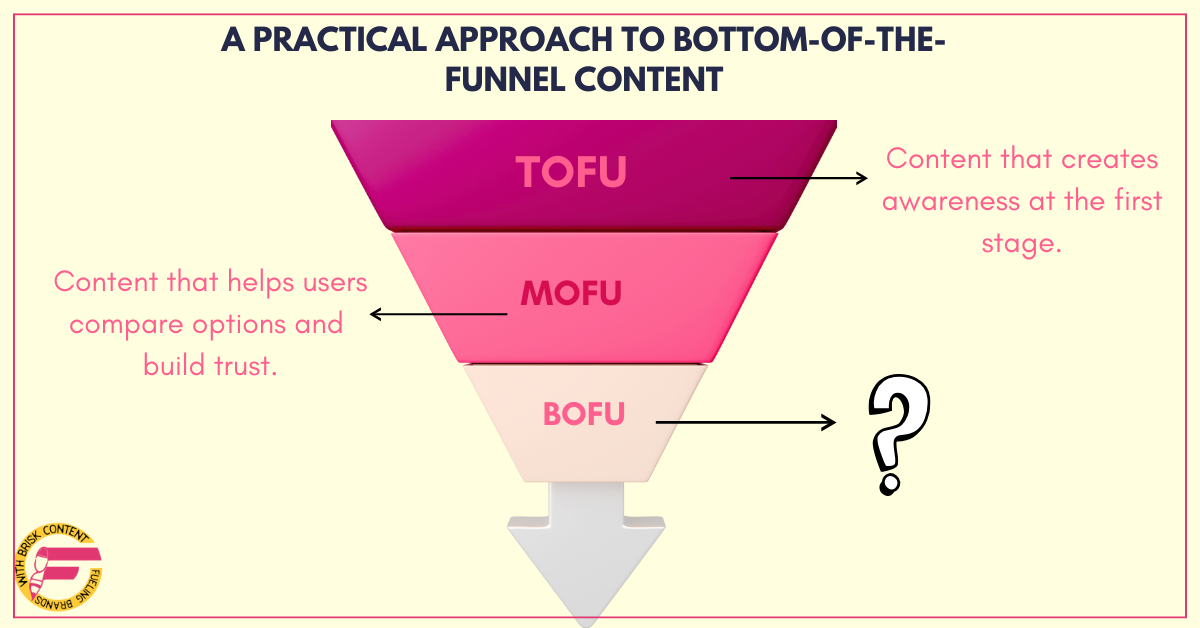
  • At the Top of the Funnel (ToFu), your goal is to grab people’s attention. This is where they first hear about your brand and realize they might have a problem. The content here is simple and broad, designed to educate or entertain, like blog posts or social media updates.
  • Moving to the Middle of the Funnel (MoFu), people know their problem and start looking for solutions. They compare options and want to know how your product or service can help. Content here dives deeper with guides, webinars, and case studies to build trust.
  • Finally, at the Bottom of the Funnel (BoFu), people are ready to buy. They need clear reasons to pick your product and proof that it works. BoFu content includes product demos, free trials, pricing details, and customer reviews to help them make the final decision.

Types of Bottom-of-the-Funnel Content That Converts

Here are some types of Bottom-of-the-Funnel content that really help you convert visitors into customers:

  1. Case Studies — These tell real stories about how your product helped someone solve a problem. They show proof that your product works and can give your visitors confidence to buy.
  2. Product Demos — Videos or tutorials that show your product in action. When people see how easy or useful something is, they feel more sure about choosing it.
  3. Customer Testimonials and Reviews — Hearing from happy customers builds trust. It’s like a friend recommending something—it makes your product feel more reliable.
  4. Comparison Posts — When people are deciding between options, comparison articles or pages help them see why your product is the best choice.
  5. Pricing Pages — Clear, simple info about costs and plans helps buyers decide quickly without confusion.
  6. Free Trials or Consultations — Letting people try your product or talk to you without risk gives them a nudge to commit.

How to Create Effective BOFU Content: Step-by-Step Guide

Here’s a simple step-by-step guide to help you create effective Bottom-of-the-Funnel (BoFu) content:

  1. Know who your ideal customer is and what will make them buy.
  2. Share real success stories that prove your product works.
  3. Show your product in action through demos or videos.
  4. Make it easy for people to compare your product with others.
  5. Clearly show pricing so buyers can decide what fits their budget.
  6. Offer free trials or consultations to reduce buyer risk.
  7. Use strong calls to action that tell visitors what to do next.
  8. Keep track of how your content performs and improve it regularly.

This simple approach will help you create BoFu content that converts visitors into customers.

Best Practices for BOFU Content Creation

  1. Focus on One Buyer at a Time
    Make your content for a specific type of buyer who is ready to make a decision. Use keywords that show they want to buy, not just browse.
  2. Be Clear and Direct
    Tell your readers exactly what to do next—like “Start Your Free Trial” or “Request a Demo.” Focus on your product and how it helps, but always keep it helpful.
  3. Build Trust
    Use real customer reviews, testimonials, and success stories to show others have had a good experience. Share awards or credentials that prove you’re reliable.
  4. Write Persuasive and Helpful Copy
    Explain how your product benefits the buyer, not just what it does. Create urgency by mentioning special deals or limited stock. Answer common doubts right away.
  5. Make It Easy to Find and Enjoy
    Use strong images and videos to keep people interested. Optimize your content in a way that it shows up in search engines when buyers look for last-minute info. Keep your content updated with fresh examples.

Measuring the Success of Your BOFU Content

Measuring the success of your Bottom-of-the-Funnel (BoFu) content means looking at how well it helps turn interested leads into paying customers. You want to focus on key signs like conversion rates — how many people sign up for free trials, request demos, or make purchases.

Also, check the ratio of leads turning into customers and the revenue your BoFu campaigns bring in. Other useful measures include tracking assisted conversions, spotting where people drop out of your sales funnel, and collecting direct feedback to see how your content influences the final buying decision. This way, you’ll know exactly how your content is performing and where to improve for better results.

Examples of Effective BOFU Content

Effective BoFu content includes comparison pages that help buyers see how your product stacks up against others, and case studies that share real success stories from customers. Product demos and testimonials build trust by showing your product in action and with happy users. Free trials let buyers test your product risk-free, while clear pricing pages make it easy for them to understand costs. Other great examples are personalized sales calls, webinars, and “best of” or “alternative” product lists that guide prospects in choosing the right fit.

Common Mistakes to Avoid in BOFU Content Creation

Avoid these common mistakes to make your Bottom-of-the-Funnel content clear, trustworthy, and effective at turning visitors into customers.

  1. Buyer confusion: Not clearly understanding who your buyer is and what they need.
  2. Weak messaging: Being unclear or hesitant in your sales approach.
  3. Missing CTAs: Not telling people what step to take next.
  4. No trust builders: Leaving out testimonials or proof that your product works.
  5. Too much info: Overwhelming buyers with unnecessary details.
  6. Poor SEO/user experience: Making it hard to find or use your content.
  7. Lack of teamwork: Not involving sales or product teams to cover buyer questions.

Conclusion

Bottom-of-the-Funnel (BoFu) content helps ready-to-buy customers confidently choose your product by providing clear proof, demos, and testimonials that remove final doubts. It’s about guiding buyers smoothly to “yes” with case studies, pricing clarity, and risk-free trials.
Ready to create high-converting BoFu content that closes sales? Content Fayah specializes in funnel-optimized content that turns prospects into customers. From case studies to demo videos, our experts craft BoFu strategies that deliver ROI. Get started today for content that converts.

1. What is Bottom-of-the-Funnel (BoFu) content?

BoFu content targets ready-to-buy prospects with case studies, demos, testimonials, pricing, and free trials. It builds trust and removes final doubts to convert visitors into customers.

2. How does BoFu content differ from ToFu and MoFu?

ToFu attracts and educates, MoFu nurtures with solutions, BoFu closes sales with proof like demos and testimonials. Each stage matches a different buyer intent for maximum conversion.

3. What are the best types of BoFu content?

Case studies, product demos, customer testimonials, comparison pages, clear pricing, and free trials work best. They provide social proof and reduce buyer risk effectively.

Categories
Content Marketing

Content Marketing Trends that are Working in 2026

Remember when posting twice a week on Instagram, running some Facebook ads, and sending a monthly newsletter seemed enough for digital marketing? Those days are over.

As 2026 unfolds, content marketing trends 2026 are reshaping how brands connect with people. Technology is advancing fast, privacy laws are tighter, and audiences now jump between platforms faster than ever.

But it’s not just about technology. It’s about trust, relevance, and connection. Whether you work with a digital marketing agency or run your own campaigns, these shifts define the future of content marketing.

AI-Driven Content Creation and Personalisation

Artificial Intelligence has matured. Tools like ChatGPT, Jasper, and Copy.ai are far smarter than before. They now adapt to tone, style, and brand voice, helping marketers produce more tailored and consistent content.

Still, 2026 is not about letting AI take over. The winning formula is clear: use AI-driven content creation for speed and scale, but keep humans in charge of creativity. People can detect when content feels robotic. That’s why the best brands use AI to enhance, not replace, authentic storytelling.

Smart marketers also use AI for customer data analysis, campaign testing, and trend prediction—saving time while personalising at scale. The key is balance: let technology optimize efficiency and keep people handling empathy and emotional connection.

Search Is No Longer Just Google

Search habits are changing. Nearly 40% of Gen Z users now search using Instagram Reels or YouTube Shorts instead of Google. Add to that the growth of tools like Perplexity.ai and voice-enabled devices, and search is now everywhere.

For brands, SEO must evolve into generative engine optimization (GEO). This entails producing content that is recognized, referenced, and remembered by AI models. Ranking in Google results is no longer the only consideration. It’s about conversational tools and AI systems that remember and mention you.

Marketers need to take into account a variety of channels when releasing content:

  • Long-form reviews or blog posts for traditional search.
  • Short, snappy videos for visual search.
  • Conversational content for AI assistants and chat-based engines.

Voice Search Optimization

Voice search optimization continues to grow in 2026 as more people use devices like Alexa, Siri, and Google Assistant. To succeed, brands must create content that matches how people talk.

Here’s what works now:

  • Use natural, conversational keywords.
  • Build FAQ pages answering real questions.
  • Optimise for featured snippets using bullet points or tables.
  • Use schema markup to help AI assistants extract answers.
  • Focus on local SEO because many voice searches include “near me.”
  • Keep sites fast and mobile-friendly.

Another big shift is optimizing for Answer Engine Optimization (AEO) and Generative Engine Optimization (GEO). This ensures your brand shows up in AI-generated summaries. Voice and AI search are merging, so the clearer and more direct your content, the better your visibility.

The Rise of Community-Driven Content

The most powerful marketing in 2026 is community-focused. Brands are no longer just broadcasting messages; they are building two-way conversations.

Community-driven marketing strengthens relationships through spaces like Discord servers, Slack groups, or private brand communities. These communities give loyal customers a place to connect, share user-generated content, and exchange ideas.

This approach offers real benefits:

Builds long-term loyalty.

  • Creates authentic user content (UGC).
  • Generates valuable customer feedback.
  • Turns customers into advocates.

In an advertising-filled world, actual customer feedback is unique. Engaged communities encourage dialogue rather than just clicks, which keeps brands relevant and promotes organic growth.

Algorithm Volatility: The New Normal in 2026

Algorithms now change faster than ever, and AI integration into social platforms has made visibility unpredictable. Algorithm volatility 2026 means that what works one month might fail the next.

Success now comes from adaptability. Marketers must combine automation with creativity, using AI to manage personalization while humans focus on storytelling.

At the same time, misinformation is rising. Brands must invest in monitoring false narratives, correcting them quickly, and being transparent. Building credibility before problems arise is the best defence.

The Micro-Influencer Advantage

Big celebrity endorsements are losing power. Instead, micro-influencer marketing dominates digital marketing trends 2026.

Micro-influencers have smaller followings but stronger trust. Their recommendations feel more genuine, and they engage in niche or private online spaces where real discussions happen.

Brands now prefer forming long-term relationships with these creators rather than one-off sponsored posts. Authentic partnerships deliver better engagement, credibility, and brand storytelling.

Content Scale vs. Authenticity

AI now helps marketers automate reports and analyse trends. Many agencies use it to scale fast, but speed can’t replace substance.

AI-driven tools sometimes produce bland messages that lack emotional depth. That’s why content authenticity is becoming marketing’s most valuable asset.

Stories with heart, emotion, and real meaning stand out. Even in an AI-driven environment, people still want connection. In 2026, authentic storytelling that is grounded in human experience and supported by analytics will be the key to brand success.

The GEO Revolution: Redefining Visibility in 2026

A major shift in content marketing trends 2026 is Generative Engine Optimization (GEO). Unlike SEO, which focuses on search rankings, GEO is about becoming part of AI’s memory.

AI systems such as ChatGPT and Gemini don’t just list results; they also recall the most credible sources. Hence, visibility now depends on being cited and recognised by AI.

The stories that AI “remembers” are those most shared and referenced across media. To stay visible, brands must build strong reputations, produce credible content, and ensure their voices are represented in trusted, editorial-quality spaces.

Being “recalled” by generative engines will soon carry more weight than backlinks or social mentions.

Strategic Implications: Preparing for 2026

The marketing environment of 2026 calls for more intelligent AI utilization, authentic storytelling, and more robust trust-building techniques. Agility, ethics, and authenticity are three areas where agencies and internal teams need to modify their approaches. Below is a summary of the main goals and common needs.

PriorityAgency FocusIn-House FocusShared Need
AI IntegrationAutomation and reporting to scale efficiency for several clients (more than 60% of international agencies)Personalized content creation tailored to customer behaviour (~40%) ​Maintain human oversight for creativity and ethical AI use
ChallengesHandling algorithm changes and combating misinformationTying marketing results directly to revenue growth and ROIStrengthening authenticity and transparency in messaging
InfluencersClose relationships with micro-influencers (who are preferred by 75% of respondents over celebrities)Lower dependency on influencer marketing, focusing on brand-owned narrativeBuilding credibility and community trust over reach
MeasurementFollowing stories in exclusive, invite-only online areasConnecting metrics to customer retention and business resultsConverting conversion and reputation data into unified performance scorecards

Beyond 2026: The Long Arc of Marketing Transformation

As digital environments grow, content marketing will be built on the three pillars of authenticity, adaptability, and audience interaction.

Technology will keep transforming how we create and distribute content, but the human desire for honest communication will never fade. The brands that balance AI efficiency with human warmth will lead in 2026 and beyond.

Stay ahead of the curve with Content Fayah’s latest insights on content marketing trends and strategies for 2026. Subscribe now and empower your brand with the tools and knowledge to succeed in the rapidly evolving digital landscape.

1. What are the top content marketing trends for 2026?

AI-driven personalization, Generative Engine Optimization (GEO), voice search, micro-influencer partnerships, and community-driven content lead 2026 trends for authentic engagement and visibility.

2. How does GEO differ from traditional SEO in 2026?

GEO optimizes content for AI platforms like ChatGPT and Perplexity to get cited in answers. SEO focuses on Google rankings. Both work together for maximum visibility across search types.

3. Why is authenticity important in 2026 content marketing?

AI scales content fast, but audiences crave human connection. Authentic storytelling builds trust, differentiates brands, and outperforms robotic content despite algorithm changes.

Categories
Content Marketing

GEO in 2026 – A Complete Guide for Beginners

In 2026, search is changing fast. With over 79% of users turning to AI tools like ChatGPT, Gemini, and Perplexity, businesses can’t rely only on old SEO methods. Gartner predicts that regular search traffic may drop by 25% as more people use AI for quick answers.
This is where Generative Engine Optimization (GEO) comes in. GEO helps your brand show up in AI-generated results, not just on Google. It focuses on clear, factual, and easy-to-understand content that AI tools can trust, cite, and share — keeping your brand visible in the new age of intelligent search.

What Is Generative Engine Optimization (GEO)?

Generative Engine Optimization (GEO) means improving your website content so it appears in results from AI-based search tools like ChatGPT, Perplexity, Gemini, Copilot, and Google AI Overviews.

GEO helps your brand show up when people use these tools to look for topics related to your products, services, or expertise.

As more people use AI to search, it’s important for your brand to show up in AI answers. This helps you reach the right customers and connect with them, wherever they start their search.

The main goal of GEO is to help more people discover your website, increase targeted visitors, and turn them into loyal followers who keep coming back.

Why GEO matters in 2026?

Generative Engine Optimization, or GEO, is becoming a big deal as AI-powered search keeps growing fast. The early buzz around AI is now turning into trust and stability, and these tools are getting smarter every day.

Search isn’t just about Google anymore. Bing’s AI, ChatGPT, Perplexity, and other platforms are stepping up and changing how people find information online.

What’s Happening to Organic Search?

AI is now reshaping how search works. Businesses can’t rely only on traditional SEO now — they need to think differently. Gartner predicts that by 2026, regular search traffic might drop by 25%, and organic visits could fall by over 50% as more people move to AI tools for answers.

Plus, 79% of users are expected to use AI search soon, and 70% already trust the results. To stay visible, brands must start using GEO — it’s the key to showing up in AI-driven results and keeping people’s attention.

How Search Behavior Is Changing?

People are now beginning their searches on AI platforms — whether they’re looking for facts, comparing products, or deciding what to buy.

ChatGPT already has more than 180 million monthly users, and Perplexity’s traffic jumped by 858% last year, with around 10 million active users. This shows that people want quick, accurate, and personalized answers.

When you optimize your content from these channels, your brand shows up wherever people search. GEO helps your brand stay visible and easy to find in AI answers.

How GEO and SEO Work Together?

GEO and SEO work hand in hand to improve your online presence. SEO will make sure your website ranks higher on search engines like Google and brings more visitors to your site. GEO, on the other hand, makes your content easy for AI tools to understand and include in their answers. When you use both together, your brand gets noticed in traditional search results and AI-generated responses, helping you reach more people in different ways.

GEO vs. SEO: What’s the Difference?

Let us understand how search engines and AI platforms handle their content differently. Here’s a quick comparison between SEO and GEO to show how each works and what they aim to achieve:

PointSEO (Search Engine Optimization)GEO (Generative Engine Optimization)
GoalGet higher rankings on Google or BingAppear in AI-generated answers like ChatGPT, Gemini, or Perplexity
How It WorksOptimizes web pages with keywords and backlinksAppear in AI-generated answers like ChatGPT, Gemini, or Perplexity
How It WorksOptimizes web pages with keywords and backlinksOptimizes content to be understood and cited by AI tools
Action of the user Users click your website’s linkUsers see your brand mentioned in AI responses
Main FocusKeywords, content quality, and backlinksStructured data, clear context, and reliable citations
Result Typelistings in search resultsQuick answers with your content included
MeasurementTrack rankings, traffic, and clicksTrack brand mentions and visibility in AI answers
Primary BenefitsGets a direct visit to the website Builds trust and awareness via AI exposure
Main PracticeUse proper SEO structure and stronger linksWrite clear, factual content optimized for AI learning

How is it revolutionizing digital marketing?

GEO is totally changing digital marketing. Earlier, brands focused on SEO and tried to rank high on Google or Bing. But now, people ask AI tools like ChatGPT, Perplexity, and Gemini for quick answers instead of browsing websites.

That’s where GEO comes in. It helps AI understand and trust your content so your brand shows up in those answers. When that happens, users discover your business instantly — even before visiting your site.

So today, marketing isn’t just about keywords or backlinks anymore. It’s about creating clear, helpful, and factual content that AI can easily read, cite, and recommend.

7 ways for businesses to begin with Generative AI Optimization

  1. Understand AI Search Behavior
    Explore how people use tools like ChatGPT, Perplexity, and Google AI Overviews. See what kind of answers show up and what tone or detail they prefer.
  1. Create Clear, Fact-Based Content
    Write simple, reliable, and well-structured content that answers real questions directly. AI tools value clarity, facts, and context.
  1. Use Structured Data
    Add schema markup and structured meta information. This helps AI engines easily identify your brand, products, and services.
  1. Build Strong Author Profiles
    A trustworthy author or brand identity increases the chances of your content being referenced by AI models. Add bios, credentials, and a transparent source.
  1. Focus on Context, Not Just Keywords
    GEO isn’t about stuffing keywords. It’s about giving AI content that truly makes sense. Use related terms and explain topics naturally.
  1. Track AI Mentions and Visibility
    Start observing where your brand appears in AI-generated answers. New analytics tools like Glimpse or BrightEdge can help.
  1. Combine GEO with SEO
    Don’t drop SEO — combine it with GEO. Optimize for web rankings while ensuring AI engines can read and recommend your content too.

The Future of GEO, SEO, and AI Search

As we move into 2026 and beyond, GEO will become a key part of every marketing strategy. SEO isn’t going away, but it’s expanding. Search optimization will now happen in two spaces: traditional search engines and generative AI platforms. Brands that adapt early will gain more visibility, stronger trust, and closer customer connections. The lines between “search” and “conversation” will blur, and content that’s helpful, human, and data-backed will succeed.

Ready to future-proof your brand for AI search dominance? Content Fayah specializes in GEO + SEO strategies that get your brand cited by ChatGPT, Perplexity, and Gemini. Get started today for visibility that scales across all search platforms.

1. What is Generative Engine Optimization (GEO)?

GEO optimizes content to appear in AI-generated answers from ChatGPT, Perplexity, and Gemini. Unlike SEO for Google rankings, GEO focuses on structured, factual content that AI tools cite directly.

2.  How does GEO differ from traditional SEO?

SEO targets Google/Bing rankings with keywords and backlinks. GEO makes content AI-readable for instant answers. Use both: SEO drives clicks, GEO builds instant brand awareness.

3. Why is GEO important for businesses in 2026?

With 79% of users shifting to AI search and organic traffic dropping 25%, GEO ensures your brand stays visible. Early adopters gain trust and authority across AI platforms.

Categories
Content Marketing

What is Digital Asset Management (DAM)?

Digital content fuels every modern business. From marketing teams to creative departments. Companies rely on digital assets such as images, videos, brochures, and logos to run campaigns and maintain brand identity. As content libraries grow, managing this digital clutter becomes complex. That’s where a digital asset management system (DAM) comes in.

Without a proper system, storing, finding, and sharing files can turn into chaos. A DAM system keeps everything organized and accessible. It helps teams improve collaboration, speed up tasks, and maintain brand consistency. In a world of endless content, digital asset management solutions help companies stay efficient and competitive.

What Is Digital Asset Management (DAM)?

Digital asset management (DAM) is the organised process of storing, managing, retrieving, and sharing digital files. A DAM software acts as a central hub, a structured library that keeps all your media assets searchable, secure, and easy to use.

Any file of value owned by a company, such as documents, videos, presentations, images, or graphics, is a digital asset. A DAM system tags these assets with metadata like keywords, project names, and file details. This makes searching effortless. It also controls user permissions, version history, and usage rights, ensuring that the right people have the right access at the right time.

Why Digital Asset Management Matters for Businesses

A digital asset management platform saves time, cuts costs, and boosts efficiency. Businesses no longer waste hours searching for files or recreating missing materials. Teams find what they need in seconds, speeding up workflows and reducing human error.

  • Cost savings: By centralising digital files, companies remove duplicate storage and unnecessary spending. It also helps track licensing and usage rights, avoiding legal or copyright issues.
  • Brand consistency: A DAM solution ensures everyone uses approved, up-to-date files. This keeps visuals and messaging uniform across channels, no more old logos or outdated materials floating around.
  • Better customer experiences: A cloud-based DAM connects with digital experience tools to deliver fast, consistent content. Add AI-driven automation and collaboration, and teams can deliver relevant, high-quality content that improves customer engagement and brand trust.

Key Features of a Digital Asset Management System

  1. Metadata tagging and search

Metadata adds context to every asset. Tags such as campaign names or product types make files easier to find. What once took minutes or hours now takes seconds.

  1. Role-based access and permissions

A DAM system gives structure and control. Teams can access what they need while administrators manage who can edit, download, or approve files.

  1. Integrations with creative tools

Project management applications, Microsoft Office, and Adobe Creative Cloud are all connected to contemporary digital asset management systems. Approved assets are immediately usable in the workflows of marketing teams and designers.

  1. Version control and workflow approvals

No more confusion over the “final” version. DAM tools track file updates and keep revision history. Built-in approval workflows help teams publish brand-compliant content faster.

  1. Analytics and tracking

The system logs who uses what, providing reports on asset engagement and performance. These insights help teams identify top-performing materials and underused ones worth repurposing.

How Does a DAM System Work?

A DAM platform acts as a central library. Users or admins upload assets, which are tagged with metadata, often with AI assistance. This metadata acts as a digital label that helps others find the content later.

Secure permission settings define who can view, edit, or share files. Once uploaded, teams can share assets directly through links, portals, or integrations with other platforms. Compared to traditional file management solutions, a DAM system offers more control, faster access, and better scalability.

Benefits of Using a Digital Asset Management Platform

  1. Increased productivity

With a centralized media library, teams no longer waste time searching for files. They can focus more on creative work.

  1. Cost efficiency

Businesses reduce expenses by cutting duplicate file storage and unnecessary content creation. Whether on-premise or cloud-based, a DAM software improves return on investment.

  1. Improved collaboration

Remote teams and global offices can work together seamlessly. File-sharing and editing become faster and more transparent.

  1. Enhanced brand consistency

A brand asset management system ensures every image, logo, and graphic matches the company’s guidelines.

  1. Stronger security

Advanced asset organization tools provide encrypted storage and user-level permissions to protect valuable content.

Who Needs Digital Asset Management?

Almost every industry with digital content can benefit from digital asset management solutions. Marketing agencies, retailers, universities, healthcare providers, manufacturers, and media companies all rely heavily on consistent, accessible content.

DAM helps marketing teams maintain brand clarity, designers find the right assets faster, and IT teams ensure data security. Whether you’re managing hundreds or thousands of files, a media asset management system streamlines your workday.

Top Digital Asset Management Tools in 2026

Here are some of the best digital asset management systems for marketers in 2026:

  1. For big businesses that desire complete integration with Adobe Creative Cloud, Adobe Experience Manager (AEM) is the best option.
  2. Bynder: Excellent for branding teams that want robust brand portal features and collaborative workflows.
  3. Widen Collective is a powerful cloud-based DAM with enterprise-class capabilities.
  4. Cloudinary is ideal for organizing and sharing excellent photos and videos on the internet.
  5. Creative teams prefer Brandfolder because it’s an easy-to-use system.
  6. Reliable options for small to midsize teams in need of effective digital content management include Canto, MediaBeacon, and Extensis Portfolio.

How To Choose the Right DAM System

Choosing the right digital asset management platform starts with identifying your goals.

  1. Use cases and requirements: List the resources you are in charge of and how your teams utilize them.
  2. Usability: If the interface is intuitive and easy to use, everyone should be able to use it with ease.
  3. Integration: Choose a system that complements your collection of software tools.
  4. Scalability: Pick a media that can grow with the quantity and volume of content produced by your team.
  5. Security: Take note of activity tracking, encryption, and role-based permissions.
  6. Customer service: Verify that the supplier provides trustworthy advice and assistance.
  7. Cost: Take into account the setup, maintenance, and long-term value before making a decision.

The importance of managing digital assets effectively lies in selecting the right platform that supports both your present and future needs.

Common Challenges in Managing Digital Assets

Even if a DAM has many advantages, adoption may present certain difficulties.

  1. Data migration: Transferring current assets to a new asset storage system might take a lot of time.
  2. Metadata management: Although proper tagging requires preparation, it is crucial for searchability.
  3. User adoption: To assist teams in using the system with confidence, training is essential.
  4. Integration: Making sure it integrates seamlessly with marketing tools or CMS can be challenging.
  5. Cost and security: Ongoing subscriptions, storage, and cyber protection require budgeting and monitoring.

Planning for these early reduces headaches later.

Digital Asset Management Best Practices

To get the most from your digital content management system, follow these best practices:

  1. Plan and prepare: Identify goals, evaluate workflows, and define success metrics before implementation.
  2. Train and support users: Run adoption programs so all employees understand how to use the DAM efficiently.
  3. Keep assets clean: Regularly update and archive old files to maintain a healthy system.
  4. Review and optimise: Track usage analytics to see which assets work best and adjust accordingly.

Well-executed digital asset management best practices in 2026 create faster workflows, stronger brand presence, and better ROI.

One Last Thing

Managing digital assets shouldn’t feel like a never-ending game of hide and seek. With the right DAM system, everything you need is right where it should be, easy to find, update, and share. It keeps your teams together, your brand strong, and your material flowing naturally. Consider it your unsung hero, subtly driving each campaign and artistic endeavor you do.

Need help turning your content chaos into a smart, efficient system? Content Fayah can help you organize, create, and scale your digital content the right way.

1. What is a digital asset management (DAM) system?

A DAM system is a centralized platform for storing, organizing, tagging, and sharing digital files like images, videos, and documents. It uses metadata for fast search and maintains brand consistency.

2. What are the key benefits of digital asset management?

DAM improves productivity, reduces file search time, ensures brand consistency, cuts duplicate storage costs, and enhances team collaboration through secure access and version control.

3. Which industries need digital asset management solutions?

Marketing agencies, retailers, manufacturers, media companies, healthcare providers, and universities all benefit from DAM to manage content chaos and maintain brand standards efficiently.

Categories
Content Marketing

What Is a Content Calendar? How To Plan Your Content

In 2025, more than 60% of marketers create new content every day, helping businesses grow their audiences and leads. Email marketing paired with smart scheduling tools can generate $44 for every $1 spent, showing how important planning is for success. The marketing calendar software market will grow from $15 billion this year to over $28 billion by 2034, proving that more companies rely on smart content calendars every day. 
With billions of users using social media, planning posts with a content calendar saves time, avoids mistakes, and lets brands post consistently to keep their audience engaged and growing. In this blog, we will cover what a content calendar is, why it matters, and how you can plan content step by step for better results.

What Is a Content Calendar?

A content calendar is a simple plan that shows when and where you will share your content. It helps you organize everything: blogs, social posts, videos, and emails in one place. With a content calendar, you will not have to rush at the last moment or miss important dates. It keeps your schedule clear and helps you know what to work on next.

Why Every Brand Needs a Content Calendar?

Every brand, big or small, can benefit from a content calendar. It helps you stay organized and make sure you don’t forget important posts. When you post regularly, your audience begins to trust and expect your content. A calendar also helps your team work well together because everyone knows what to do and when. Plus, you can see which posts work best and improve your planning over time.

Components of an Effective Content Calendar

A good content calendar has a few main parts. This shows the sort of content, like a blog, social media post, email, or video. It also has the date and time to post. It also shows who will create or post the content. The calendar notes the channel where the content will occur. It shows the status, like writing, ready, or published. You can add notes about your goals, keywords, or your target audience. Use simple tools like Google Sheets or other software to keep everything clear and easy to find.

How To Plan Your Content Step-by-Step

Planning your content calendar is easy if you follow these steps:

  1. Set your goals: Know what you want, more website visitors, sales, or followers.
  2. Know your audience: Understand who you want to reach and what they like.
  3. Brainstorm topics: Write ideas that match your goals and the audience’s interests.
  4. Choose channels: Decide where you will post: blogs, Instagram, Facebook, and emails.
  5. Make a schedule: Spread your content over days or weeks with different types of posts.
  6. Assign tasks: Give each post to a person or do it yourself.
  7. Fill your calendar: Enter all details in a planner or tool.
  8. Use schedule features: Automate posts to save time.
  9. Review and adapt: Check your calendar often and make changes when needed.

Choosing the Right Content Calendar Tools

Using the right tools will make your content planning simple. Here are good options for 2025:

  • Google Sheets or Calendar: Easy and good for beginners.
  • Trello or Asana: Great for teams to share and manage tasks.
  • WordPress: Best if blogging is your main focus.
  • CoSchedule or Monday.com: Strong apps for scheduling, reminders, and teamwork.

Tips for Keeping Your Calendar Consistent & Flexible

Here are tips to keep your calendar working well:

  • Make content in groups to stay ahead.
  • Leave days open for trending or urgent posts.
  • Check your calendar every week to stay on track.
  • Use reminders for deadlines.
  • Have backup team members in case someone is busy.
  • Mark special days like holidays and product launches.

Common Mistakes To Avoid When Planning Content

When you plan content, try to avoid some common mistakes. Always keep your calendar updated and don’t miss your deadlines. Make sure your content matches your goals so your work stays focused. Ask your team for ideas to get better topics. Check how your posts are doing to know what works best. Use a calendar tool to stay organised. Avoiding these mistakes will make your plan smooth, successful and on time.

Example of a Content Calendar

Here is a simple example of a monthly calendar:

DatePlatformContent TypeTopicStatusOwner
Nov 4BlogArticleStep-by-step guideDraftAlex
Nov 6InstagramSocial PostBehind-the-scenesReadyJamie
Nov 8FacebookVideoProduct launchEditingPriya
Nov 12NewsletterEmailMonthly highlightsScheduledTeam Lead

One Last Thing

A content calendar helps you work with more control and less stress. It gives you time to create better content instead of rushing at the last minute. When your team uses a calendar, everyone knows what to do and when to do it, which makes teamwork easier. 

A clear plan like this keeps your messages steady, so your audience trusts you more. It also helps you spot what works well and where you can improve. Using a content calendar isn’t just about planning; it’s about making your work smarter and your marketing stronger each and every day. If you want help building a clear, results-driven content calendar, Content Fayah can help you plan, create, and manage content that stays consistent and delivers real impact.

1. How often should I update my content calendar?

 You should review your calendar weekly and update it whenever priorities, trends, or goals change.

2. Can a content calendar work for small businesses?

Yes. Even small businesses benefit from content calendars because they save time, reduce stress, and improve consistency.

3. Do I need paid tools to manage a content calendar?

No. Free tools like Google Sheets or Calendar work well. Paid tools are helpful for larger teams or frequent posting.

.

Categories
Blogs Content Marketing

7 Content Hacks for a Successful B2B Marketing

As we enter 2025, effective content marketing remains the foundation for B2B success. However, things are changing; AI is here to aid us and be a partner in our marketing strategies. The B2B marketing team needs to move with this change and get ahead of others. But what AI lacks is the human touch; hence, teams. It is the best tool for B2B success as it brings awareness about your products, and gives trust, leads generation, and traffic generation. 

We shall discuss seven hacks to improve your content marketing strategy.

7 Important Content Marketing Hacks for B2B Success

1. Craft a Well-Organized Content Calendar

The right planning tool for a B2B marketing team is a content calendar. As a strategic road map, it enables planning and scheduling content ahead of time. Organizing your topics, deadlines, and distribution channels helps align your message with the key events or product launches tied to the seasonal trend.

 This proactive approach streamlines the content creation and makes collaboration easier for team members. A content calendar offers a visual of weeks or even months for your content strategy, helping you catch gaps and messaging overlaps more easily.

 It allows consistent posting frequencies – contributing to trust, engagement, and audience-building from your followers’ side. Last but not least, effective content calendars make your team’s work possible by delivering good, engaging, and meaningful content to the audience.

2. Understand and Classify Your Audience Segments

The core of successful content marketing is understanding the audience for content. Audience segmentation splits your broader audience into smaller, more defined subgroups based on specific characteristics, such as demographics, interests, or behaviors. This approach enables you to create the right kinds of content to meet each subgroup’s special needs and preferences.

 A technology company might have different content for IT managers than for other end-users. Using data analytics tools and customer feedback, you can create detailed buyer personas that guide your content creation process. This way, your messages are relevant and engaging, increasing the likelihood of conversion.

 In addition, segmented campaigns often have higher engagement rates because they speak directly to the audience’s pain points and interests. Knowing your audience deeply in a competitive B2B landscape can be the difference between you and competitors who take a more general approach.

3. Produce Content That Remains Relevant Over Time

Evergreen content is a rich element of any B2B content marketing. Unlike news content or article-driven pieces, which quickly lose relevance over time, it remains useful far into the future. 

The basis of such writing usually concerns central industry subjects for which people could use guidance that would last forever and a day. Such content saves time in the long term and guarantees consistent website traffic by attracting visitors over months or years. 

To search engine-optimize by using relevant keywords. Update the content periodically to keep it fresh and aligned with your niche’s current trends or developments. Investing in evergreen content builds a robust library of resources that can establish your authority in the field and nurture leads over time.

4. Expand Your Reach Across Multiple Channels

In today’s digital world, depending on a single platform for distribution can limit your reach and engagement potential. Expanding your reach across multiple channels is key to capturing a wider audience and maximizing the impact of your content marketing efforts.

Consider using blogs, videos, infographics, podcasts, and social media posts to effectively engage with different segments of your audience. Each platform has its own strength; for instance, video content may be best suited for social media, but in-depth articles are better for LinkedIn or industry blogs. This will increase the chances of engagement and sharing, depending on the platform’s specific style and audience preferences.

Furthermore, diversifying your reach allows you to experiment with different types of content and discover what resonates best with your audience. Ultimately, this multi-channel approach broadens your visibility and fosters deeper connections with potential clients.

 5. Maintain Consistency in Your Content Strategy

Consistency is also a key to successful content marketing. Top-tier content published from time to time helps you achieve the audience’s trust and thereby positions your business as an expert in that sector. Whether it’s weekly blog updates or monthly webinars, maintaining such a schedule builds anticipation among viewers and provides them with fresh information regularly.

Maintaining consistency helps you stay at the forefront of consumers’ minds and boosts your website’s search engine results because search engines prefer sites that consistently add new content.

Maintaining a consistent voice and style for all channels helps strengthen brand identification and facilitates audience recognition and connection. Establishing rules for frequency, tone, and style that all team members can follow can help you achieve this level of consistency.

6. Implement SEO Strategies to Boost Online Presence

SEO is important for increasing the visibility of your B2B content online. By optimizing your content with relevant keywords and phrases your potential customers search for, you increase the likelihood of appearing higher in search engine results pages (SERPs). Begin by researching keywords to identify terms that align with your business goals and customer queries. Incorporate these keywords naturally into all content elements, including titles, headings, meta descriptions, and throughout the body text to improve its relevance to search engines without sacrificing user readability. 

Technical aspects of SEO – including site speed and mobile-friendliness – can improve the user experience while making a ripple effect on rankings. Moreover, blogging older posts with new information or even different keywords can be relevant. If SEO is part of your content strategy, you can drive more organic traffic and position yourself as an authority within your niche.

7. Evaluate and Enhance Your Content Performance

Continuously evaluating and optimizing your content marketing efforts is the last hack to B2B success in 2025. Analytics tools let you track KPIs such as website traffic, engagement, conversions, and social shares. It helps you see which types of content resonate best with your audience and which need adjustment or improvement.

For instance, if certain topics generate higher engagement than others, consider creating more related content or exploring those themes further. Additionally, pay attention to user feedback through comments or surveys; this qualitative data can provide valuable insights into what audiences find most valuable or engaging about your offerings.

Optimization should be an ongoing process. Using analytics, you’ll experiment with distribution formats or channels to improve results. By committing to analysis and optimization, you ensure your B2B marketing strategy remains agile and responsive to changing market dynamics.

Conclusion

These seven hacks help you build a strong foundation for B2B content marketing in 2025. Tie strategies to business goals, understand audience pain points, and create evergreen content for lasting value. Diversify channels while staying consistent to boost reach and brand identity.

Regularly review metrics to refine what works, keeping you ahead in the digital landscape through planning, insights, longevity, and optimization.

If you’re ready to supercharge your B2B content with proven hacks that drive leads and growth, Content Fayah can help. Our experts deliver data-driven strategies tailored for success. Get started today for scalable results.

What is a content calendar in B2B marketing?

A content calendar is a planning tool that schedules topics, deadlines, and channels ahead of time. It aligns content with business goals, ensures consistency, and spots gaps for better engagement.

Why is evergreen content important for B2B?

Evergreen content stays relevant long-term, driving ongoing traffic and leads. Optimize it with SEO keywords and update periodically to maintain authority and value.

How do I measure B2B content performance?

Track KPIs like traffic, engagement, conversions, and shares using analytics tools. Use insights to optimize high-performers and refine underperformers for better ROI.

Categories
Blogs

9 Employee Engagement Metrics Every Manager Should Calculate

As a professional human resources manager, employee engagement should be at the top of your priority list. Corporate has come a long way, from customer satisfaction being the centric role to ensuring the company’s employees are as engaging as they should be.

Tracking and considering Employee engagement metrics are vital ways to pay attention to employees. Focusing on the company’s workforce becomes more critical as working methods become more secluded and complicated.

Employee engagement metrics help businesses identify which areas of employment need improvement and furnishing. These metrics help create a healthy, happy, satisfied, and motivated workforce for the company, which is crucial for long-term success.

What are Employee Engagement Metrics?

Employee engagement is the capacity and extent to which a person can be committed and passionate about their work. It could be described as dedication to his day-to-day work, time investment, and extra effort for success.

Employee engagement metrics help HR professionals and managers understand where their teams need help and support. The metrics also provide job descriptions, job feedback, employee feedback, relationships with seniors and colleagues, job recognition, and personal wellness for the company’s progress.

There are several ways to measure employee engagement metrics, and as a manager and HR professional, you should measure these nine metrics for future growth and success.

  1.  Employee Net Promoter Scores (ENPs)

ENP is a well-known metric for measuring employee engagement. This method tests an employee’s loyalty to the company. 

This is measured simply by a survey asking employees: “On a scale of 1-10, how likely are you to recommend our company to your friends and peers?”

The answer is then measured and divided into three different categories of employees, i.e., promoters, passives, and detractors.

  • Promoter: If an employee responds with a 9 or 10, it indicates that they are satisfied and happy with the company.
  • Passives: Employees who give a response of 7 or 8 are essentially neutral toward the organization; they are neither happy nor unhappy. They will neither endorse it nor disparage it to others.
  • Detractors: Responses below six fall under this category. They are not satisfied with the company. 
  1.  Non-attendance

The higher employee absenteeism, the lower the company’s engagement rate. If an employee or a group of employees is taking too much leave, they’re probably bored or uninterested in their office work. 

Measuring absenteeism helps us track employee engagement. Probable reasons for not attending the office regularly could be a poor working environment, low maintenance of the surroundings, poor governance, lack of work-personal life balance, etc. Less attendance can result in a heavy workload for the employee.

  1.  Work-life balance

A balance between work and personal life is essential for an employee’s health and wellness. By supervising an employee’s wellness metrics, you can identify challenges and issues that might not be comfortable enough to bring up in a meeting or employee engagement measurement. 

Employees who balance work and personal lives can be more engaged with the company.

  1.  Work Recognition

Workers want to be appreciated and complimented for their work. Recognizing their efforts and hard work is a low-cost, highly effective way to improve employee engagement. 

Kindness comes in both directions; noticing their day-to-day tasks being completed on time and appreciating them will make them feel recognized and motivate them to do more hard work to receive compliments from their manager.

  1.  New Hire Engagement Rate

The new hire engagement rate is the percentage of new hires who quickly committed to their work within the first 90 days. 

High new hire engagement rates indicate that the company is excellently recruiting new hires and herding them to work quickly.

  1.  Customer gratification

The logic behind this crucial metric is simple: happy employees mean happy customers. If your employee is satisfied with his work and engaged with the business, then there is a high chance that your customers will be satisfied and happy.

To measure whether one is inversely or directly related to the other, measure the ENP and customer happiness scores. If both of these are high, the company is doing great with engaging employees, but if the score is low, it needs polishing for success.

Engaged employees are always hungry for good work and eager to learn about new things. They surrender to providing high-quality work and customer gratification.

  1. Employee turnover rate

Highly engaged employees are less inclined to resign independently, contributing to the employee turnover rate. The percentage of employees that leave the company each year is known as the employee turnover rate.

Turnover is one of a business’s highest costs; lower turnover leads to more productivity, less disruption, and increased cohesion.

Employees expect to be supported, have good relations at the workplace, be developed, and face challenges for future growth. A satisfied employee has more chances for long-term tenure in an organization.

  1.  Employee retention

Employee retention is quite the opposite of employee turnover. The ability to keep employees for a long time indicates high employee engagement.

To create a productive, long-lasting workplace, you must keep your best employees on staff and devoted to their duties.

  1.  Average output

It’s pretty simple to understand that it could be employee engagement if your marketing or business loses profitability or productivity.

The company will always grow if employees are fully engaged and strive to provide premium-quality work. However, if the business experiences the opposite of growth, the employees should be more engaged and motivated.

Above and beyond employee engagement metric

While it’s essential to ensure employee engagement, the primary purpose behind measuring these metrics is not that the scores should be 10/10. There are so many advantages to ensuring employee engagement; it helps you understand what spots need to be appropriately filled.

What you do with your employees and how much their survey feedback matters to you is just as important as calculating these metrics. Learn the points you find essential in surveys and work accordingly. Your employee’s happiness is just as important as your customer’s satisfaction.
In the long run, engaged employees are happier, more loyal, and perform better in the organization. Your employees are the reason for your present and future success.

Categories
Blogs Content Marketing

17 Massive Content Marketing Examples to Boost Your Brand

Are you a new marketing company seeking inspiration and case studies to understand better how branding and promotion may strengthen your business? Worry not because you are exactly where you should be.

In this digital era of business, marketing has become an easy path to success. There are multiple ways and roots to promote your brand like a pro.

Successful entrepreneurs and brands are always here to help and figure out how it all works because they have been through exactly what you’re going through.

We have numerous examples of different brands to boost your fresh new startup company; let’s learn briefly about them and how they’re marketing their products. 

Augmented Reality Examples

  1. Ikea

Who doesn’t like spending time at Ikea, the Swedish furniture brand? We all enjoy roaming the aisles of the lavishly furnished market. Some consumers who are too busy and occupied to purchase new furniture might be unable to find the time to visit the store.

Hence, Ikea has created an app where customers can place furniture in their homes without even buying it. Yes, you read that right. Without buying, we can now determine which art piece will suit our home’s wall.

This is an excellent way of enhancing the products and marketing them smartly.

  1. L’Oreal Paris 

The new L’Oreal Paris app “try before you buy” features a tool that allows users to quickly try on a product virtually and figure out what shade of lipstick or blush will suit their skin tone without even buying it. 

This feature allows customers to try the product without even purchasing it from the comfort of their home.

This is an excellent idea for promoting or marketing your product while making customers happy with the new updates.

  1. McDonald’s 

McDonald’s new customer service feature, “question time,” helps people understand what ingredients are in the food they’re about to consume. 

We can now determine what product is used in the burger patty we’re about to devour. This feature helped McDonald’s build connections with customers by being honest. 

Customers can feel more free and connected with the brand. It also drove authenticity across different platforms. 

  1. Coca-cola

Coca-Cola launched a new marketing campaign called “Share a Coke,” in which the beverage company printed familiar names on the bottle.

This step by the brand touched the sky with success as people started buying the product just for the name on the bottle.

Who doesn’t enjoy talking about themselves, after all? 

Seeing your name on a bottle sparked joy and conversation, leading to excellent product marketing.

  1. Rolex

Visualization plays a crucial role in marketing. People buy what they find attractive and eye-catching, and this is precisely what Rolex worked on. 

To capture the classic aesthetic of its brand, Rolex uses Instagram photographs. The pictures scream classic, simplicity, and the product’s sparkliness, resulting in millions of followers on the social media app.

Blog Examples

  1. Neil Patel’s Marketing Blog

Neil Patel is everywhere, helping businesses broaden their marketing and educating them. His in-depth guides and blogs on KissMetrics and Quick Sprouts rank him in the top five, and he assists many entrepreneurs who started their businesses from scratch.

Patel is a prolific blogger, earning around 3 million visitors on his blog every month. His aggressive content marketing strategy is the primary reason behind this success.  

Although his articles are straightforward, he goes all in on the information he provides. From using charts and graphs to providing accurate statistics and personal experiences, he always delivers as much content as possible. 

  1. HubSpot

HubSpot is a machine that creates and spreads content. They are doing incredibly well with their work.

HubSpot recommends that amateurs publish 4-6 blogs per day on their site. Posting content frequently will engage you with your audience on any platform. 

HubSpot posts regular blog posts, ebooks, and whitepapers. It also creates and broadcasts multiple webinars and videos. 

  1. Shopify 

Despite its e-commerce niche, Shopify also posts bulk content on its website. Its blog reflects on its journey and that of the people who sell through it.

Shopify had more than 26 million page views in the last year alone. It also conducts a podcast show called “Shopify Masters,” where they interrogate successful store owners and have long conversations with them. 

The primary reason Shopify is doing so well with blogs is that they understand their audience.

We take this away from them: Do not limit your reach and content scope just because you don’t have a niche or if you have a proper niche. 

  1. Etsy

Etsy is also an online marketplace, like Shopify. In its e-commerce niche, Etsy sells handmade and aesthetic vintage goods. The brand uses blogs to market its products and goods on different apps.

Products from Etsy are ideal for marketing on Pinterest, where users, particularly the younger generation, enjoy looking through attractive and cosmetic products. 

Etsy has 9.7 million Pinterest followers, 10 million+ monthly visits, and 3 million Instagram followers.

The brand is famous for its handicrafts, designs, aesthetically pleasing visuals, and photography.

Etsy advertises its work on social media and blogs because its customers admire its presentation.

  1. Zip Recruiter’s podcast

The recruitment site ZipRecruiter collaborated with Shark Tank star Daymond John to create the podcast “Rise and Grind with Daymond John.” 

John invites and features entrepreneurs, athletes, and musicians worldwide in his show. ZipRecruiter made an astounding move, not to promote and talk about his service but to talk about things that motivate people.

People listen to podcasts to be entertained, educated, and motivated; making them interested in you by marketing your company and goods will turn them off. 

  1. Microsoft’s “Stories” blog

Life stories and personal experiences connect us. We hear the life tales of hundreds of people; that is what we connect to and relate to.

Microsoft created a new way of expanding its business through this human act. The new “stories” blog helps consumers become more familiar with Microsoft, which helps build brand loyalty and repeat business.

  1. Xero Blog

Xero is a famous online B2B brand that invests in content marketing to promote and advertise its products through blogs. 

The Xero blog’s target audience is mainly interested in topics related to small businesses, tech, and products. 

It demonstrates the significance of this digital marketing tactic: a well-known B2B company like Xero utilizes content marketing to publish stories on its blog.

Social Media Marketing examples

  1. Starbucks

Starbucks started campaigns like #ShotOfPride and #WhatsYourName to support the LGBTQ+ community and gender-diverse youth, respectively. This move created a huge buzz among the public.

Approximately 70-80K likes were gained on Instagram. Starbucks used real people and a politically uplifting trend to attract its audience.

They also started a “one of the people” trend to share real-life stories.

The critical takeaway from Starbucks is that, as a social media marketer, you must follow the trend that creates a long-lasting impression on people. 

  1. Dove’s #ShowUs project

Dove started an initiative called #ShowUS to shatter beauty clichés. Working with Getty Images, they took photos of everyday individuals and non-binary persons without editing to demonstrate true beauty. 

The project reached around 2 billion people in 39 countries; 500+ women participated; around 660 media pieces were created, and more than 700,000 posts were made on Instagram. 

We realize from this project as marketers that people on social media want to be connected with real people who understand unrealistic beauty standards and want to be featured as such.

As a social media marketer, run a campaign or hashtag that makes people feel noticed and special.

  1. Gillette

In 2019, Gillette posted a short film exclusively on YouTube, aiming directly at the modern interpretation of manhood, called “Gillette: We Believe: The Best Men Can Be”. The film depicted the cases of men going through masculinity, bullying, and sexual harassment.

The film launched in the campaign got more than 27 million views and around 1K likes on Instagram (which is more than the usual post from Gillette). The #GilleteAd reached almost 150 Million people in just one month.

Even though the ad reached millions, some found it offensive and started a hashtag #boycottgillette. Nonetheless, it didn’t get much attention, and men felt appreciated.

It isn’t easy to be politically active, but if you can, do it. This calls for investigation, audience feedback, and a profound comprehension of your brand voice.

Content Marketing examples

  1. LinkedIn

We know that LinkedIn is a vast platform for searching for jobs and hiring. Its marketing relies on visualization.  LinkedIn uses visualization as a significant marketing tool. It uses all images for blogs, quotes, posts, Illustrations, etc.  

Use images and pictures to keep your audience interested and engaged. 80% of LinkedIn users are unlikely to read the posts you make, but they will undoubtedly see the images and videos you upload.

  1. The Furrow

John Deere, the founder of “The Furrow,” has been using B2B content marketing even before we started calling it that (a century ago). Deere was a blacksmith who saved farmers struggling to turn the heavy, sticky prairie soil with traditional plows made for New England’s light, sandier soils.

He published the magazine “The Furrow” to educate farmers with the latest technology to solve the newest farming problems.

His magazine mainly focused on a farmer’s problems rather than his inventions and products.

The article is still published in the journal and discusses the contemporary issues farmers face while scarcely mentioning their products.

“The Furrow” is an excellent example of B2B content marketing.

In a nutshell

Multiple companies are creating epic content on their websites along with these. If these successful companies can occupy the facility of content marketing strategy, why not you?

We explored 17 content marketing examples that boosted their companies even without a content strategy. 

Carefully analyze your approach based on what works best for your brand, where you can find talent and the resources you have at your fingertips. After you have outlined your plan, you can go forward.