


Introduction
Nothing makes a content creator happier than knowing their content ranks on Google’s SERPs and generates leads.
Every Content masterpiece needs time and effort to rule the charts. But reaching peak performance is hardly the end of the story. Over time, content performance changes, and when it does, we know it is time to take action: update the old blog or refresh the website content.
A HubSpot study found that refreshing online content led to an average 106% increase in organic traffic.
Online content must be managed in accordance with the company’s content maintenance strategy. Its performance must be reviewed regularly, and, if necessary, refreshed and updated to extend its lifespan.
This blog explores why, when, and how online content must be updated to improve performance. It also provides a practical, easy-to-follow framework for the update process, so your content stays fresh and relevant for longer.
Why is the content update necessary?
Every piece of content contains data and information that the audience is searching for. The data can become outdated, information can become obsolete, and search intent can change over time. It is natural, then, that high-performing content can decline in rankings and conversions because Google prefers fresh, authentic content that precisely matches its customers’ search intent. According to 90% of marketers, updated older content outperforms new content.
When is the best time to update the content?
There is no one best time to update a particular piece of content. Rather, there are signs to watch out for and events that may necessitate a content update.
Events that require content updates.
- Changing your web address: If you have changed your web address, please notify Google. Make all necessary changes to your internal and external links, and create proper redirect pages where needed so that visitors can find your pages easily.
- Updates to products and services: If the company has made any changes to products or services, including additions or updates, they should be updated online immediately.
- Updates in general or marketing site copy: If there are any changes made in the branding, then it should immediately reflect not only the new content but also all the content that is already present online.
As we have already discussed, the primary sign to look for is a failure in the content’s performance. Watch for red flags, such as a decline in rankings, lead generation, or conversion rates. If you notice any of these signs over the next few weeks, it is time to update and refresh your content.
Signs that require content updates
- Inspect SEO scores: Use content optimization tools such as Clearscope and SurferSEO to review your content’s SEO performance and suggest fixes to improve content rankings, if needed. Read our blog on ‘Best Keyword Optimization Techniques to try’, if you are interested in learning more about SEO.
- Check for a mismatch in Search Intent: If your page is no longer ranking for its intended queries, run a competitor content analysis to identify what your content lacks relative to competitor content, and make updates accordingly.
- Review information accuracy: Google ranks accurate, properly referenced content on facts and figures. Always keep your data-driven content up to date. Content with obsolete data leads to reduced traffic, lower CTR’s and higher bounce rates.
- Scan for Technical Glitches: If your SEO score, search intent, and information accuracy are in check but your pages still aren’t ranking or driving conversions, the issue could be a technical glitch, such as a broken link, indexing issues, or multi-device adaptability.
How often Should You Check for Update Signals?
Now, let’s answer the big question: how often should you check for the signs that indicate the need for an update? Or how often do you do content performance tracking?The answer is simple: Content audit effectively identifies the signs indicating updates, such as traffic decline, ranking drop and increasing bounce rates. Content audit frequency is typically once or twice a year. Therefore, align your content updates with content audits for non- critical pages.
However, review and update critical business pages, such as product and landing pages, every few weeks. Frequent monitoring of business-critical pages enables early detection of problems and prevents escalation. Free analytical tools, such as Google Analytics, can help you track performance with ease and suggest the required updates.
How to update your content: A practical Framework

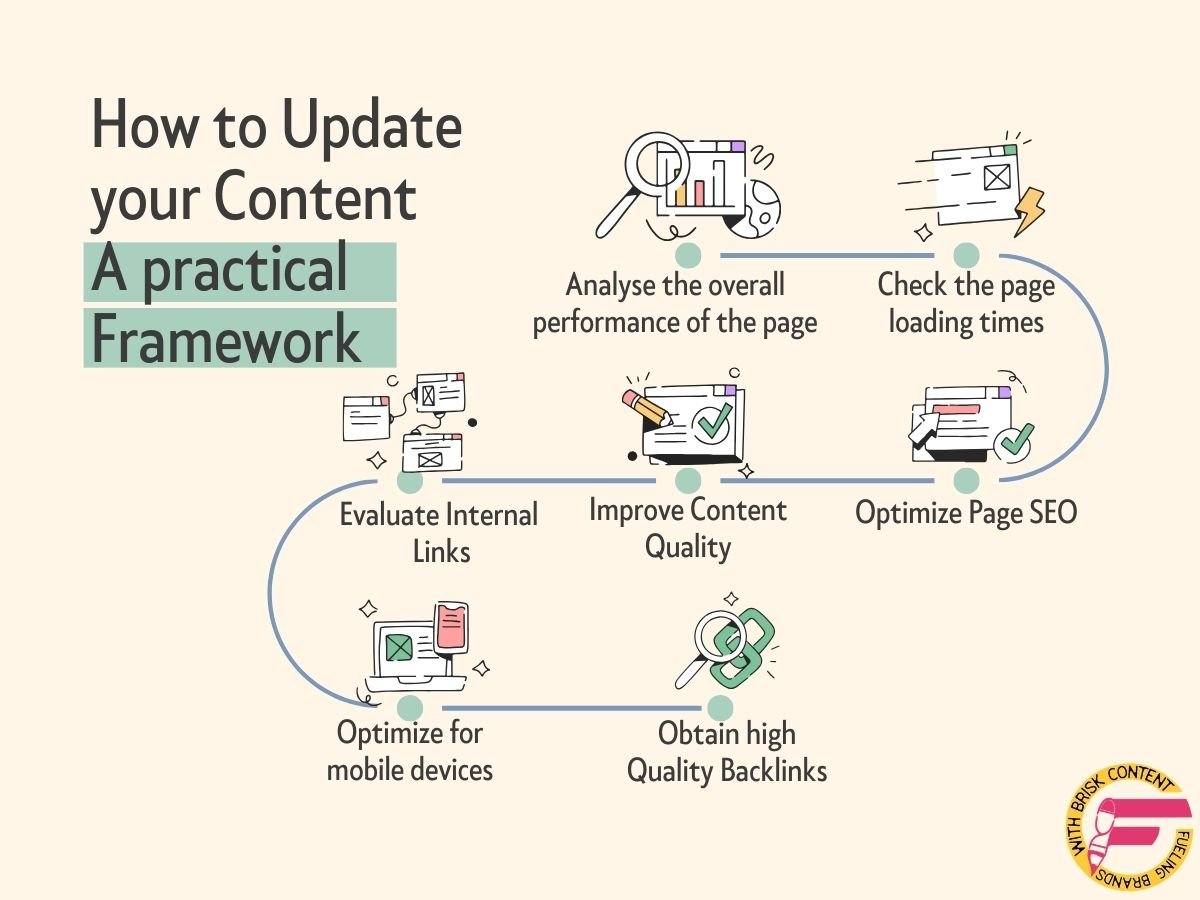
Once you have identified content that needs updating, use this simple framework to guide you through.
- Crawl your pages using analytical tools to assess overall page performance and note down the problem areas.
- Check page loading times. If slow, optimize videos, images, and scripts.
- Optimise the headers, meta-descriptions and URL slug in accordance with the latest SEO keywords
- Improve content quality by updating facts, figures, and publication dates, and by enhancing multimedia content in accordance with the pages that are ranking high.
- Evaluate and fix internal links
- Work on improving the user experience(UX) over multiple devices
- Focus on obtaining high-quality backlinks to improve visibility
Conclusion
Your online content can drive significant business growth. It is essential to keep it fresh and relevant to leverage its full potential. By conducting regular content audits, monitoring performance red flags, and following a systematic update framework, you can extend your content’s lifespan and maximize its performance.
Online content experts at ContentFayah can help your business grow by creating and managing your online content. Let us help you fuel your brands’ online presence with our brisk content strategy.
FAQ’s
The frequency of content updates depends on the type of content. Review critical business pages, such as product and landing pages, every few weeks. However, update general content during your annual or bi-annual content audits.
When you update old content, the SEO rankings improve because Google favors fresh, accurate, and relevant content. Update the content strategically by refreshing outdated information, adding new keywords, and improving E-E-A-T.
When content is refreshed, data, statistics, keywords, and formatting are updated while the core message remains intact. Whereas rewriting means creating the content from scratch with a new angle or approach to a certain topic.
Start by running an analytical tool to identify the underperforming pages. Once the tool identifies the pages with issues, focus on those that historically drove significant traffic or conversions and have the best potential for recovery.